

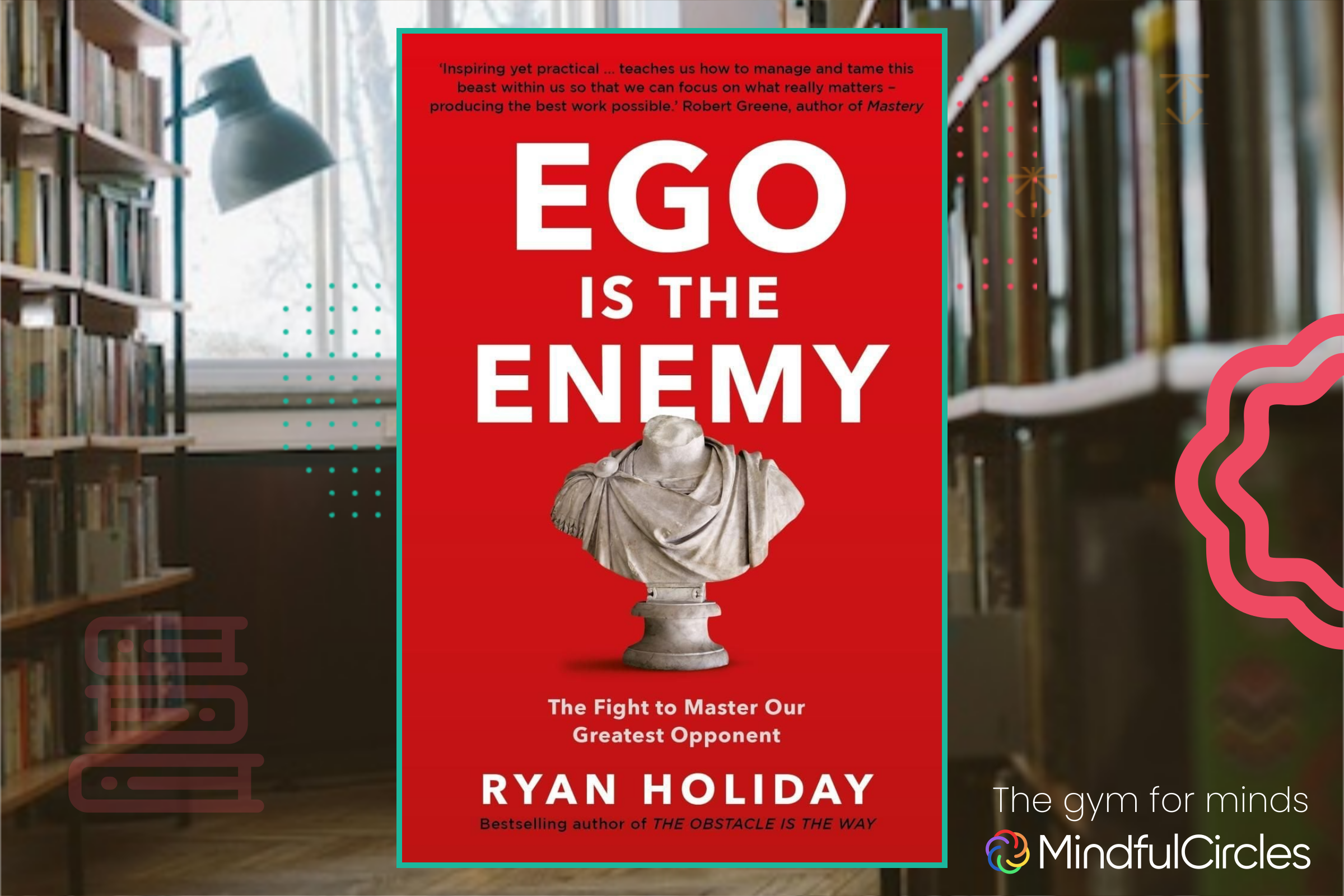

The Man Behind the Book
Ryan Holiday left college at nineteen to apprentice under Robert Greene, author of The 48 Laws of Power, and soon became director of marketing at the fashion company American Apparel while still in his early twenties. His first book, Trust Me, I’m Lying, was a confession of how he had manipulated the media for a living. Then he turned, somewhat unexpectedly, to ancient Stoic philosophy — and wrote a trilogy that has reached millions of readers: The Obstacle Is the Way, Ego Is the Enemy (2016), and Stillness Is the Key.
The book’s origin is personal, and Holiday says so plainly. He reached his own goals young, and watched ego — his and other people’s — quietly corrode the companies and relationships around him. He has the phrase tattooed on his forearm. Ego Is the Enemy is, before it is advice to anyone else, a warning he wrote to himself.
The Core Idea
Holiday’s argument runs against the grain of an age built on self-promotion: the thing most likely to undo you is not your competition, your circumstances, or your lack of talent. It is you — or more precisely, your ego.
By ego he does not mean confidence. He means the unhealthy, restless need to be more than, to be recognised, to be right. Ego is the voice that says you already know enough, that you deserve more than you do, that the work is beneath you. It feels like strength. It behaves like sabotage.
The book follows ego through the three seasons every endeavour passes through — when we aspire to something, when we taste success, and when we meet failure — and shows that at each stage the same enemy is waiting, in a different costume.
Ego is the enemy of what you want and of what you have.
The Three Seasons: Aspire, Success, Failure
The structure of the book is also its argument. Life, Holiday says, is not a single climb but a cycle we move through again and again.
When we aspire, ego inflates our sense of what we deserve before we have earned it, and seduces us into talking instead of doing. When we succeed, ego whispers that we did it alone, that the rules no longer apply to us, that we can stop learning. And when we fail — as everyone eventually does — ego turns the setback into a story about our worth, which makes recovery almost impossible.
The same humility that helps you begin is the humility that protects you at the top and steadies you at the bottom. Ego is not a problem you solve once. It is a tendency you manage for life.
Talk, Talk, Talk
One of the book’s sharpest observations concerns the gap between talking and doing.
When we are unsure of ourselves, or facing something hard, talking about it feels like progress. We announce the plan, describe the vision, accept the encouragement — and something in us relaxes, as though the work were already done. It is not. Holiday argues that the satisfaction of being seen to attempt something quietly drains the energy we needed to actually attempt it.
Talk depletes us.
The people who do the work, he notes, are often the ones least interested in narrating it. Silence here is not modesty for its own sake. It is fuel conservation.
Always a Student
Ego’s favourite lie is that you have arrived — that you now know enough.
Holiday’s antidote is to adopt, permanently, the posture of a student. Not as a phase you pass through at the start, but as a stance you hold for life. The moment you believe you have nothing left to learn, you stop being able to learn — and someone humbler and hungrier begins to overtake you.
He borrows a simple practice from the fighter Frank Shamrock: keep around you someone better than you to learn from, someone lesser to teach, and an equal to test yourself against. The point is to stay in motion, and to keep ego from hardening into the most dangerous thing it can become — the pretence of already knowing.
Passion Is Not the Answer
Here the book pushes against the conventional wisdom. We are told to follow our passion. Holiday is wary of it.
Passion, he argues, is often ego in disguise — loud, restless, in love with its own intensity, more interested in the feeling of pursuing a thing than in the patient work of doing it well. It burns bright and runs out. What lasts is something quieter: purpose, paired with realism. The calm, deliberate competence of someone who knows exactly what they are trying to do, and is willing to be unglamorous about it.
Passion is form over function.
The Canvas Strategy
If ego demands credit, Holiday offers a discipline designed to starve it.
In ancient Rome, an anteambulo was the servant who walked ahead of an important person, clearing the path. Holiday turns this into a strategy for anyone starting out, or starting over: find ways to clear the path for others. Do the unglamorous work. Make the people around you look good. Help without needing to be seen helping.
This is not servility, and it is not forever. It is an investment. By providing the canvas on which others paint, you learn more, build more trust, and accumulate more goodwill than the person loudly demanding recognition ever will. The credit, when it comes, follows the contribution — not the other way around.
The Cost and the Critics
Ego Is the Enemy has sold widely and been quoted endlessly, and its limitations are worth naming honestly.
Holiday is a synthesiser, not an original researcher. The book is a curated sequence of historical anecdotes — Sherman, Howard Hughes, George Marshall, and many others — chosen to illustrate ideas drawn largely from the Stoics. Critics point out that anecdotes are easy to cherry-pick: for almost any claim about success, history offers a vivid example, and the examples that complicate the thesis tend not to make the cut.
There is a subtler concern. The counsel to suppress your ego, defer credit, and clear the path for others is genuinely wise for the already-confident and the already-powerful. In the hands of someone who is routinely overlooked or under-credited — and the people most often told to be less ambitious are rarely the powerful — the same advice can quietly become a reason to stay small. Knowing whether you need more humility or more nerve is a judgment the book cannot make for you.
And ego, while real, is not the only enemy. Some lives are constrained less by self-importance than by circumstance, and no amount of Stoic restraint rewrites those odds.
The diagnosis is sharp. The prescription asks you to know which season you are actually in.
What the Book Is Really About
Underneath the history and the philosophy, Holiday returns again and again to a single choice, framed by the military strategist John Boyd. To his young officers Boyd would offer two roads. You can set out to be somebody — to accumulate rank, recognition, and the approval of others — or you can set out to do something — to make a real contribution, often without credit, sometimes at the cost of being noticed at all. You rarely get both.
Ego is the part of us that wants to be somebody. The work — the real, quiet, unglamorous work — is how we do something. Holiday’s book is one long argument for the second road, and an honest account of how often, and how easily, the first one calls us back.
It does not promise that humility will make you successful. It promises something more modest and more durable: that it will keep you present, keep you learning, and keep you from becoming the kind of person your success would otherwise make of you.
End of Summary
What to sit with:
Three questions to reflect on, each rooted in a core concept from the book:
- (To Be, or To Do) Is there a place in your work right now where you are quietly choosing to be seen — recognised, credited, validated — over simply doing the thing itself? What would change if you let the credit go?
- (Talk, Talk, Talk) What is something you have been talking about — to others, or to yourself — instead of beginning? What might it cost you to stay quiet and just start?
- (Always a Student) Where have you begun to assume you already know — and what might open up if you returned, just for this season, to the posture of a beginner?
MindfulCircles
We’ve just published the book reflection in one minute video on Youtube, Instagram and Tiktok:
Instagram: https://www.instagram.com/reel/DZpyJHtse27/?utm_source=ig_web_copy_link&igsh=MzRlODBiNWFlZA==
YouTube: https://youtube.com/shorts/mzZzkdYPZYs?si=t7kVkzVgqw34BZd2
TikTok: https://www.tiktok.com/@mindfulcircles.org/video/7652025124589456673?is_from_webapp=1&sender_device=pc