

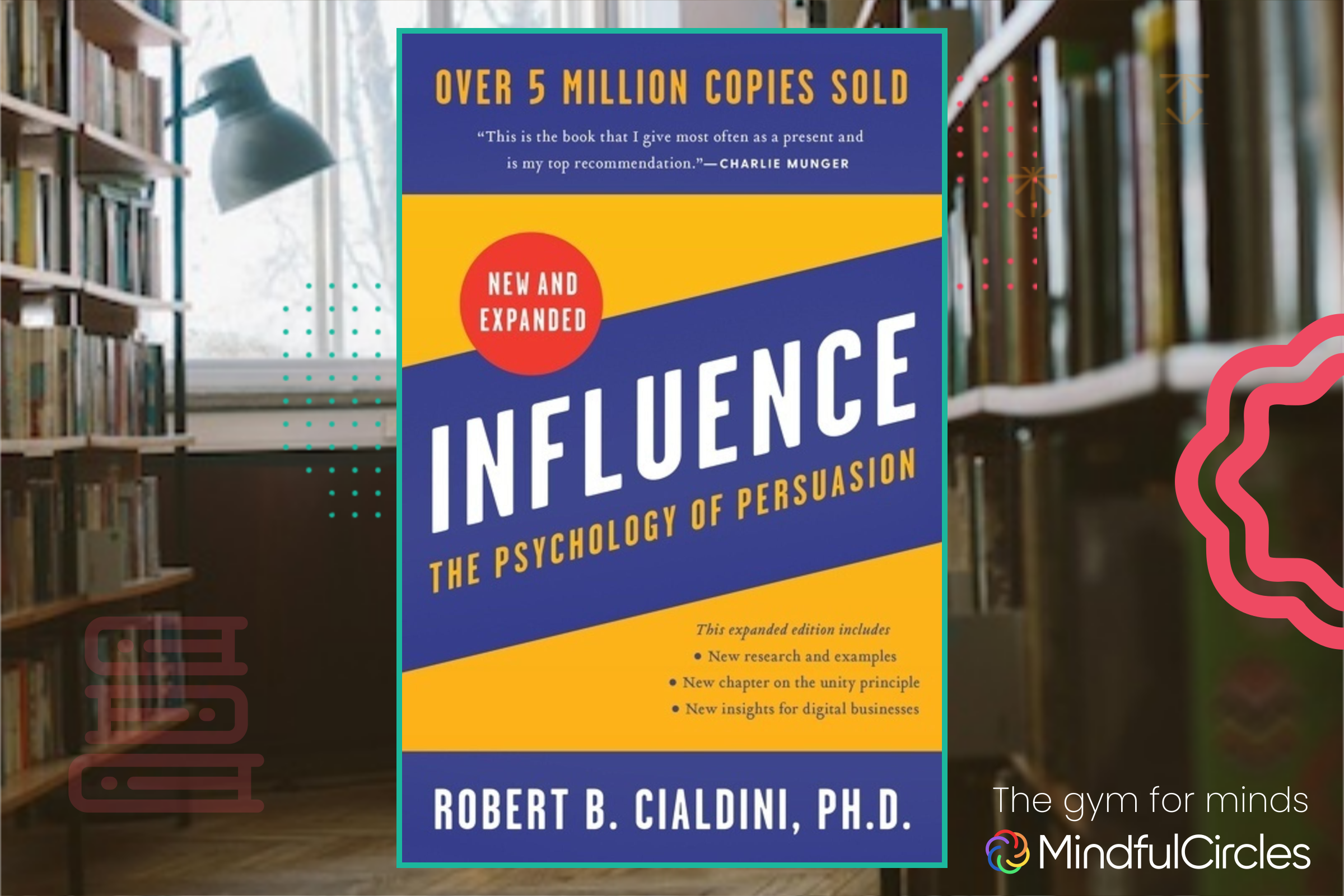

The Man Behind the Book
Robert Cialdini is an American social psychologist who spent decades studying a single question: why do people say yes? Frustrated that the textbooks of his field told him little about how persuasion actually works in the world, he went undercover for three years — training as a car salesman, a fundraiser, an advertiser, inside the so-called compliance professions — to learn their methods from the inside. Influence, first published in 1984, distilled what he found. It has since sold over five million copies, been translated into dozens of languages, and become one of the most cited books in marketing, sales, and behavioural science. A new and expanded edition arrived in 2021, adding a seventh principle and a wealth of modern examples.
Cialdini’s insight was that we live in an age of overwhelming information, and that no one has the time or capacity to weigh every decision carefully. So we rely on shortcuts — mental rules of thumb that usually serve us well. The compliance professionals, he discovered, were not inventing tricks. They were reverse-engineering these shortcuts, and triggering them on cue.
The Core Idea
Cialdini’s central argument is that much of human behaviour runs on autopilot. Like animals with fixed action patterns — the mother turkey who will mother anything that makes the right cheep-cheep sound, even a stuffed predator — we have our own automatic responses. Present the right trigger, and the behaviour follows, often without conscious thought.
He calls this click, run: the right cue is pressed, and the tape plays. These shortcuts are not a flaw. They are a necessity — we could not function if we deliberated over every choice. But because they are automatic, they can be exploited by anyone who knows which button to press.
“The truly gifted negotiator, then, is one whose initial position is exaggerated enough to allow for a series of concessions.”
The book is, on the surface, a field guide to seven of these triggers. Underneath, it is something more useful: a way to recognise when they are being used on you, so that you can choose to step out of automatic and back into deliberate thought.
The First Principle — Reciprocation
We feel a deep obligation to repay what others give us. A gift, a favour, a concession — each one creates a debt that sits uneasily until it is settled. Cialdini shows how the Hare Krishna found this out: handing a flower to a stranger in an airport, refusing to take it back, then asking for a donation. Most people gave, and then threw the unwanted flower away — only to be handed another.
The rule is so strong it works even when the first gift is uninvited, and even when the return favour is far larger than the original. Its subtlest form is the reject-then-retreat move: ask for something large, get refused, then retreat to the smaller thing you wanted all along. The retreat reads as a concession — and concessions demand to be repaid.
The Second Principle — Commitment and Consistency
Once we take a stand, we feel pressure — from others and from inside ourselves — to behave consistently with it. Consistency is prized because it is usually a virtue, and because it spares us the labour of rethinking. But it can be weaponised.
The lever is the small initial commitment. Get someone to agree to something tiny, and they will later agree to something far larger that fits the same self-image. Commitments work best when they are active, public, effortful, and freely chosen — which is why writing a goal down, or saying it aloud to others, changes behaviour far more than holding it privately.
“It is, quite simply, our nearly obsessive desire to be (and to appear) consistent with what we have already done.”
The Third Principle — Social Proof
When we are unsure what to do, we look to what others are doing. If everyone is looking up, we look up. If the laugh track laughs, we find it funnier. The rule is sensible — the crowd is often right — but it fails badly in two conditions: when we are uncertain, and when the people we are watching are like us.
Cialdini uses social proof to explain the bystander effect, where a crowd of witnesses can leave a person in distress unhelped, each one reading the inaction of the others as a sign that nothing is wrong. The lesson he draws is practical: in an emergency, do not cry out to a crowd. Point to one person and ask them, directly, for help.
The Fourth Principle — Liking
We prefer to say yes to people we like — and the things that make us like someone are surprisingly easy to manufacture. Physical attractiveness, similarity, familiarity, compliments, and cooperation toward a shared goal all increase liking, often below the level of awareness.
This is why the salesperson finds something in common with you, why the request comes from a friend at the party rather than a stranger, and why we are so easily flattered. Cialdini’s defence is not to refuse to like people — it is to notice when we have come to like someone faster or more than the situation warrants, and to separate the deal from the person making it.
The Fifth Principle — Authority
We are trained from childhood to defer to legitimate authority, and the deference runs deeper than we like to admit. Stanley Milgram’s famous obedience experiments showed ordinary people willing to deliver what they believed were dangerous shocks to a stranger, simply because a man in a lab coat told them to continue.
What is striking is that we respond not to authority itself but to its symbols — titles, uniforms, expensive cars, the trappings of expertise — any of which can be borrowed by someone with no real authority at all. The defence is two simple questions: Is this authority truly an expert? And how truthful can I expect this expert to be here?
The Sixth Principle — Scarcity
Opportunities feel more valuable when they are less available. The fear of losing something is a more powerful motivator than the hope of gaining something of equal worth. This is why “limited time,” “only a few left,” and “while supplies last” work as reliably as they do.
Scarcity bites hardest when a freedom we already had is suddenly threatened — Cialdini calls this psychological reactance, the urge to want what we are about to lose. The signal to watch for is the rush of arousal that scarcity produces. When you feel it, he advises, stop and ask whether you want the thing itself, or merely want to win it.
“The idea of potential loss plays a large role in human decision making. People are more motivated by the thought of losing something than by the thought of gaining something of equal value.”
The Seventh Principle — Unity
The newest principle, added in the 2021 edition, is the most powerful. Unity goes beyond liking: it is not about being similar to someone, but about sharing an identity with them — being, in some real sense, one of us. Family, ethnicity, nationality, region, team — the categories that define who counts as “we.”
When someone is inside our circle of “we,” their opinions weigh more, their requests carry more force, and the other six principles all amplify. Cialdini found that simply asking people for their advice — rather than their opinion — pulls them into a shared, collaborative frame, and makes them far more receptive afterward. Unity, he came to believe, was the accelerator hiding beneath all the rest.
The Cost and the Critics
Influence has shaped how a generation of marketers, fundraisers, and salespeople do their work — and that is precisely the discomfort at its centre. A book that teaches you to defend yourself against manipulation is, read from the other direction, a manual for manipulating others. Cialdini is aware of this, and in the expanded edition he argues forcefully that the principles must be used honestly: that pointing to real social proof, genuine scarcity, and true authority is legitimate, while manufacturing them is a kind of theft that eventually corrodes trust.
Critics raise other concerns. Some of the classic studies the book leans on are decades old, and a few — like certain figures in the social psychology of the era — have not all replicated cleanly in the years since. Others note that the framework can flatten a rich human moment into a set of buttons and triggers, as if every yes were a reflex rather than a choice. And there is the unavoidable irony that the more widely the principles are known, the more the world fills with people trying to use them on each other.
The principles are real and the evidence is substantial. The danger is in the hands that hold them. Both are part of an honest reading.
What the Book Is Really About
Stripped of the case studies and the seven labels, Influence is a book about attention. Its real subject is the gap between automatic and deliberate — the moment when a trigger has been pressed and the tape is about to play, and we have a brief chance to notice and choose otherwise.
Cialdini is not asking us to abandon our shortcuts; we cannot live without them. He is asking us to stay awake at the few moments that matter — to feel the pull of the gift, the commitment, the crowd, the liking, the uniform, the closing door, the appeal to “us,” and to recognise it for what it is. The freedom the book offers is small but real: the freedom to say yes on purpose.
“Where all think alike, no one thinks very much.”
That, in the end, is why the book endures. It is not a guide to controlling others. Read rightly, it is a guide to noticing when you are not entirely in control of yourself — and to gently taking the wheel back.
End of Summary
What to sit with:
Here are three questions to reflect on, each rooted in a core concept from the book:
- (Commitment and Consistency) Where in your life are you holding to a path mainly because you once committed to it — and would you choose it again today, freshly, if no past version of you had already said yes?
- (Scarcity) Think of something you recently wanted badly. How much of the wanting was the thing itself, and how much was the fear of losing it or missing out?
- (Unity) Whose voice carries extra weight with you simply because they feel like “one of us” — and is there a truth you have been discounting because it came from outside that circle?
MindfulCircles
We just published the book reflection in one minute video on Instagram, YouTube and tiktok:
instagram: https://www.instagram.com/reel/DZ-Zw42tg8o/?utm_source=ig_web_copy_link&igsh=MzRlODBiNWFlZA==
YouTube: https://youtube.com/shorts/9awhjtutFqY?si=_4h37zHRohgUcrDC
TikTok: https://www.tiktok.com/@mindfulcircles.org/video/7654996623625440545?is_from_webapp=1&sender_device=pc