


The Man Behind the Book
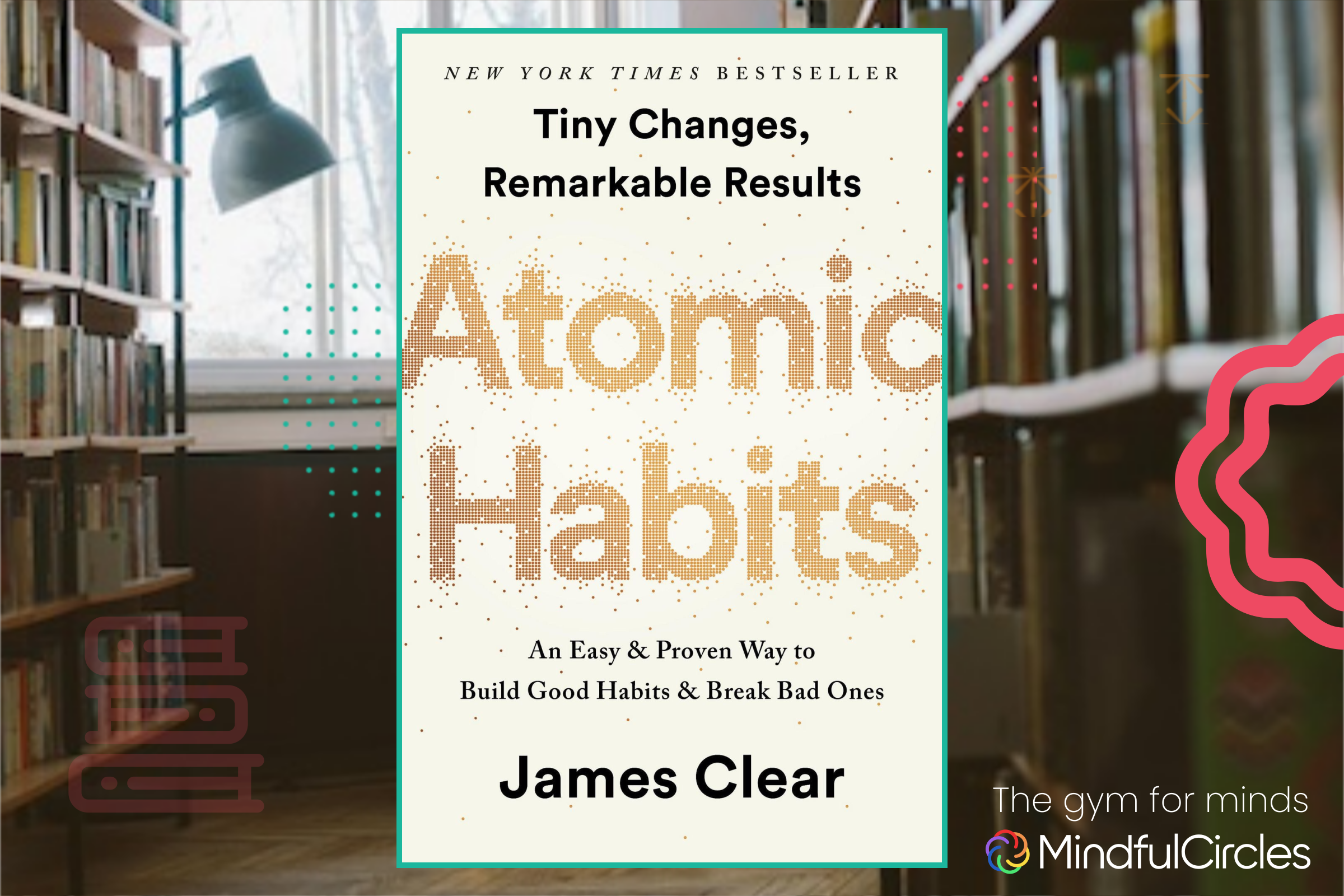
James Clear is an American writer who built a large following through a weekly newsletter on habits, decision-making, and continuous improvement. Atomic Habits, published in 2018, distilled a decade of his writing and research into a single system. It has since sold over fifteen million copies and become one of the most widely read books on personal change of the modern era.
The book’s origin is partly personal. In high school, Clear was struck in the face by a baseball bat in a freak accident, suffering a fractured skull and serious brain trauma. His promising athletic career seemed over. He returned to baseball slowly, through college, by focusing not on dramatic comebacks but on small daily improvements in sleep, study, training, and routine. By his senior year he was named the top male athlete at his university. The lesson he took from that period became the spine of the book: small habits, repeated, compound into outcomes that look impossible from the outside.
The Core Idea
Clear’s central argument is that we badly overestimate the importance of big moments and badly underestimate the importance of small ones. We wait for the breakthrough, the transformation, the dramatic turning point — when in truth, our lives are quietly built by the things we do every day without thinking.
He calls these small, repeated actions atomic habits — atomic in two senses. They are small, like atoms. And they are the building blocks from which everything larger is constructed.
“You do not rise to the level of your goals. You fall to the level of your systems.”
The argument has a mathematical version. If you get 1% better every day for a year, you end up roughly 37 times better. If you get 1% worse every day for a year, you decline almost to zero. The daily change is invisible. The yearly result is enormous. Habits are the compound interest of self-improvement — and, equally, of self-destruction.
Identity-Based Habits
The most quietly radical idea in the book is this: habits are not really about what you do. They are about who you believe you are.
Clear distinguishes three layers of change. The outermost is outcomes — what you achieve. The middle is processes — what you do. The innermost is identity — what you believe about yourself.
Most people try to change from the outside in. They start with the outcome they want, work backwards to the process, and never touch the identity. This is why most change does not last. The moment willpower fades, the old identity reasserts itself.
The book’s prescription is to reverse the direction. Start with identity. Not I want to run a marathon, but I am a runner. Not I want to write a book, but I am a writer. Every action you take is then a vote for the kind of person you are becoming.
“Every action you take is a vote for the type of person you wish to become.”
You do not need a unanimous vote. You only need a majority.
The Four Laws of Behaviour Change
The practical heart of the book is a four-part framework, derived from how habits actually form in the brain. Every habit follows the same loop: cue, craving, response, reward. To build a good habit, you make each stage work for you. To break a bad one, you do the opposite.
The First Law — Make It Obvious. Habits begin with a cue. Most behaviour is triggered by what we see, where we are, and who we are with. Clear offers two key tools: implementation intentions (writing down exactly when and where you will do a behaviour — “I will meditate at 7am in the living room”) and habit stacking (anchoring a new habit to an existing one — “after I pour my morning coffee, I will write for ten minutes”). A cue that is invisible is a habit that will not happen.
The Second Law — Make It Attractive. The brain releases dopamine not when we receive a reward, but when we anticipate one. To build a habit, the anticipation itself has to feel appealing. Pair a habit you need to do with one you want to do, and join a culture where the behaviour is the norm. We do what is normal among our tribe. Choose the tribe deliberately.
The Third Law — Make It Easy. This is the law most people get wrong. We assume motivation is the obstacle. Clear argues the obstacle is almost always friction. The habit you want to build should be made absurdly easy to start. He calls this the Two-Minute Rule: scale any new habit down until it can be done in two minutes. Read before bed becomes read one page. Go for a run becomes put on running shoes. The point is not the two minutes. The point is showing up. Once the identity of someone who does this is established, the duration grows on its own.
The Fourth Law — Make It Satisfying. Habits stick when the brain registers them as worth repeating. Because the rewards of good habits are usually delayed, you need to engineer immediate satisfaction. Habit trackers — a simple X on a calendar — work because they make progress visible. Never miss twice is one of his most quoted rules: missing once is an accident, missing twice is the start of a new habit. Do not let the second miss happen.
To break a bad habit, you invert all four laws. Make it invisible, unattractive, difficult, and unsatisfying.
The Plateau of Latent Potential
One of the most psychologically important ideas in the book is what Clear calls the Plateau of Latent Potential.
When we begin a new habit, we expect linear progress. We do the work, we expect to see the result. The reality is different. For a long time, nothing visible happens. The reader who studies, the writer who drafts, the person rebuilding their health — all of them spend weeks or months in a stretch where the effort is real and the evidence is not.
Clear draws this as a curve that stays flat for a long time and then bends sharply upward. Most people quit during the flat stretch, mistaking the absence of visible progress for the absence of progress itself. In truth, the ice is warming from -10°C to 0°C the whole time. Nothing looks different. Then one degree more — and everything melts.
“Habits often appear to make no difference until you cross a critical threshold and unlock a new level of performance.”
The lesson is not motivational. It is structural. You are not failing during the flat stretch. You are accumulating.
The Goldilocks Rule
Clear also addresses why habits, once established, so often fade. The answer is boredom.
He calls this the Goldilocks Rule: humans experience peak engagement when working on tasks that are right at the edge of their current ability — not too easy, not too hard. When a habit becomes too easy, it becomes boring, and boredom is the most underestimated enemy of long-term progress.
Professionals, Clear argues, are not people who feel motivated more often than amateurs. They are people who keep showing up when the work has stopped being exciting. Mastery is the willingness to do the same thing, slightly better, for longer than the people who quit.
The Cost and the Critics
Atomic Habits has been praised for its clarity and criticised for what that clarity leaves out. Some readers find the tone overly mechanical — a system for optimising behaviour that risks reducing a human life to a series of cues and rewards. Critics in psychology note that Clear synthesises a great deal of existing research (from B.F. Skinner to Charles Duhigg to BJ Fogg) without always crediting how much of his framework rests on prior work.
Others argue the book is most useful for people whose lives already have a baseline of stability — time, safety, autonomy, mental health — and less useful for those whose primary obstacle is not their habits but their circumstances. Telling someone in crisis to make it obvious and make it easy can feel tone-deaf when the obstacle is poverty, illness, or trauma.
The deeper critique is that habits, while powerful, are not the whole story of a life. Meaning, relationships, grief, transformation — these do not always respond to systems. There is a risk in treating the self as a machine to be optimised rather than a person to be lived with.
Clear’s framework is genuinely useful. It is also, on its own, incomplete. Both are part of an honest reading.
What the Book Is Really About
Stripped of the diagrams and the four laws, Atomic Habits is a book about one quiet truth: you become what you repeatedly do, and you repeatedly do what your environment, identity, and systems make easy.
Change is not, for most people, a matter of effort. It is a matter of design. Design the cue. Design the friction. Design the identity. Then let time do the work that no amount of motivation can do.
“You should be far more concerned with your current trajectory than with your current results.”
The book’s promise is modest and, for that reason, believable. It does not offer transformation. It offers compounding. And over a long enough timeframe, compounding is transformation.
End of Summary
What to sits with:
Here are three questions to reflect on, each rooted in a core concept from the book:
1. (Identity-Based Habits) Who are you trying to become — and does your daily life cast votes for that person, or against them?
2. (The Plateau of Latent Potential) Where in your life are you currently in the flat stretch — doing the work, not yet seeing the result — and what would help you stay with it?
3. (The Two-Minute Rule) What is one habit you have been postponing because it feels too big — and what would the two-minute version of it look like, starting this week?
MindfulCircles
We just published the reflection in one minute short vide on TikTok: https://www.tiktok.com/@mindfulcircles.org/video/7645750250740747553?is_from_webapp=1&sender_device=pc&web_id=7638160051077482006
Instagram: https://www.instagram.com/reel/DY-Pu0mtcBB/?utm_source=ig_web_copy_link&igsh=MzRlODBiNWFlZA==
and YouTube: https://youtube.com/shorts/LciIh19n1h4?si=B3BL_bNPXbN-cWam