

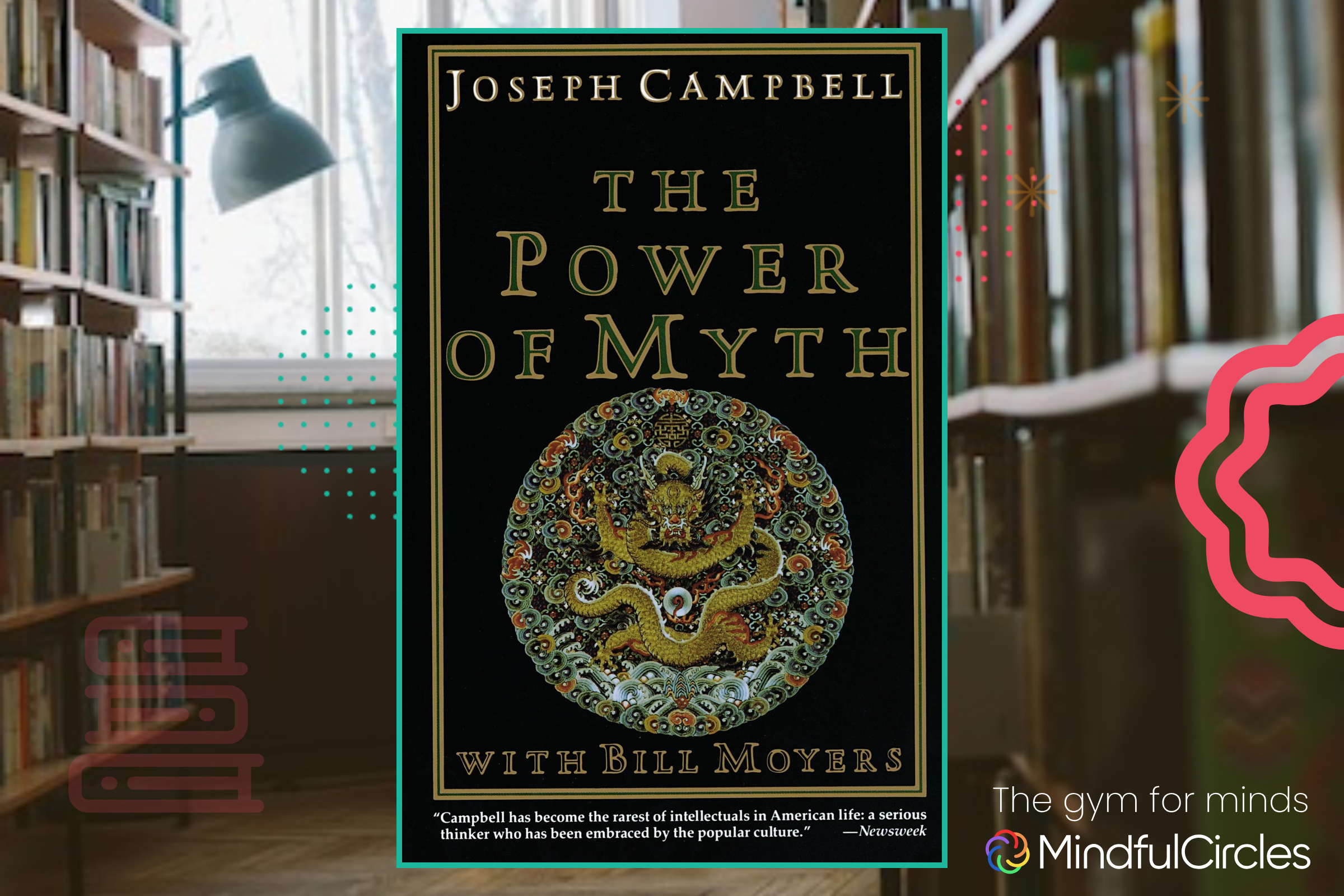

The Men Behind the Book
Joseph Campbell was born in New York in 1904. As a boy, his father took him to Buffalo Bill’s Wild West show, and he became fascinated by Native American stories. That fascination never left him. He studied medieval literature at Columbia, then in Paris and Munich, where he discovered the work of Freud, Jung and the modernist artists.
He came home in 1929, just as the Great Depression began. With no job and no prospects, he rented a small cabin in Woodstock, New York, and spent about five years doing almost nothing but reading, dividing his days into strict blocks of study. He later called those years the foundation of everything he did. He went on to teach at Sarah Lawrence College for nearly four decades, and in 1949 published The Hero with a Thousand Faces, the book that later inspired George Lucas while he was writing Star Wars.
Bill Moyers was one of America’s best-known journalists, a former press secretary to President Lyndon Johnson who became a thoughtful public television interviewer. In 1985 and 1986, he sat down with Campbell for a long series of conversations, much of it filmed at George Lucas’s Skywalker Ranch.
Campbell never saw the result. He died in 1987, a few months before The Power of Myth aired on PBS in 1988. The series became one of the most watched in public television history, and the book, edited from the transcripts, became a bestseller. It reads less like a lecture than a long, warm conversation between a curious student and an old teacher who has nothing left to prove.
The Core Idea
Campbell spent his life reading the myths of the world: Greek and Norse, Hindu and Buddhist, Native American, African, Christian and Polynesian. And he kept noticing the same patterns.
His argument is that myths are not primitive science or false history. They are stories that help human beings live: through birth and adolescence, love and loss, ageing and death. They speak in symbols because the truths they carry are too big for literal language.
In Campbell’s words, myths are public dreams, and dreams are private myths. Both come from the same place in us.
The problem of modern life, he argues, is that we have lost our living myths. Many people no longer find meaning in the old religious stories, and nothing has fully replaced them. So we are left to find our own way through the great passages of life, often without a map.
Myths are not stories about other people a long time ago. They are stories about you, right now.
The Hero’s Journey
Campbell’s most famous idea is what he called the monomyth: the single story that, in his view, appears in countless forms across every culture.
A hero is called away from ordinary life. They cross a threshold into the unknown. They face trials, find helpers, and descend into a moment of darkness: a belly of the whale, a confrontation with death. They come through it changed. And then, crucially, they return home with something to give: a boon, a wisdom, a healing for the community.
Departure. Initiation. Return.
Campbell’s point is that this is not only a story about Moses or the Buddha or Luke Skywalker. It is the shape of every real transformation. Leaving a job. Building a company. Ending a relationship. Going through illness or grief. Each is a call, a threshold and a descent, and each asks whether we will come back with something to share.
He also notes that many people refuse the call. They stay where it is safe, and something in them quietly withers.
Follow Your Bliss
The phrase most people remember from the book is three words long: follow your bliss.
Campbell meant something deeper than doing whatever feels good. He meant paying attention to the moments when you feel most deeply alive, and having the courage to organise your life around them, even when it is not the safe or expected path. If you do, he says, doors will open where you did not know there were doors.
He was also clear that it is not easy. Later in life, half joking, he said he should have said “follow your blisters”. Bliss is not comfort. It is alignment, and alignment usually costs something.
In one of the book’s best-loved passages, he suggests that what we are really seeking is not the meaning of life but the experience of being alive: the feeling that our inner life and our outer life are in harmony.
The question is not “what should I do with my life?” but “when do I feel most alive, and am I brave enough to go there?”
Sacred Space
A quieter idea runs through the conversations, and it may be the most practical one in the book.
Campbell suggests that everyone needs a sacred space: a room, or simply a certain hour of the day, where you do not know what the news was, who owes you what, or what you owe anyone. A place where you can simply experience who you are and who you might be.
At first, he says, you may find nothing happens there. But if you keep returning, something will.
It is hard not to recognise in this a description of meditation, of journaling, and of circles like ours: places set apart from the demands of the week, where people return again and again until something begins to happen.
The Masks of Eternity
Campbell’s view of religion was generous and, for some, provocative. He saw the great traditions as different masks over the same mystery: different languages pointing to something none of them could fully name.
His warning was against literalism. When a symbol is taken as a fact, he argued, it loses its power to transform and becomes a cause for division. When it is read as a metaphor, it opens: the virgin birth becomes the birth of a spiritual life within a person; the promised land becomes a state of the heart rather than a piece of territory to fight over.
When we confuse the map with the territory, we start wars over maps.
The Cost and the Critics
The Power of Myth introduced millions of people to world mythology and gave a generation of writers, filmmakers and seekers a shared language. It has also drawn serious criticism.
Many scholars of religion and folklore argue that the monomyth is too neat. By searching for the one story underneath all stories, Campbell tended to flatten real differences between cultures and to select the examples that fit while setting aside those that did not. Critics also note that his hero is overwhelmingly male, and that women in his scheme often appear as goddess, temptress or prize rather than as heroes in their own right.
His approach leaned heavily on Jungian ideas about universal archetypes, which are difficult to test. And “follow your bliss”, stripped of the struggle Campbell attached to it, has been widely borrowed as a slogan for consumer culture and easy self-indulgence.
The criticism of Campbell the man was harder. In 1989, the writer Brendan Gill published an essay accusing him of antisemitism and reactionary political views, based on recollections of his remarks over many years. Friends and former students strongly disputed the charge, and the debate has never been fully settled. It is part of his story, and worth knowing.
The insight into what stories do for us is profound. The scholarship is more selective than it appears. Both are part of an honest reading.
What the Book Is Really About
Stripped of the gods and heroes, The Power of Myth is a book about one quiet truth: your life is already a story, and it has a shape.
The crises are not interruptions. They are thresholds. The dark moments are not proof that something has gone wrong. They are the belly of the whale, the place every hero passes through. And the purpose of the journey is not only to be changed, but to come back and share what you found.
For anyone in the middle of building something, leaving something or losing something, that is a deeply steadying idea. You are not lost. You are somewhere on the road.
We are not looking for the meaning of life. We are looking for the experience of being alive.
End of Summary
What to sit with:
Here are three questions to reflect on, each rooted in a core concept from the book:
- (The Hero’s Journey) Where are you right now in your own journey: hearing a call, crossing a threshold, in the belly of the whale, or on the way home? And what might you bring back for others?
- (Follow Your Bliss) When did you last feel completely alive, and what would it cost you to build a little more of your life around that?
- (Sacred Space) Where, or when, is your sacred space this week: a place or hour where nobody needs anything from you, and you can simply be?