

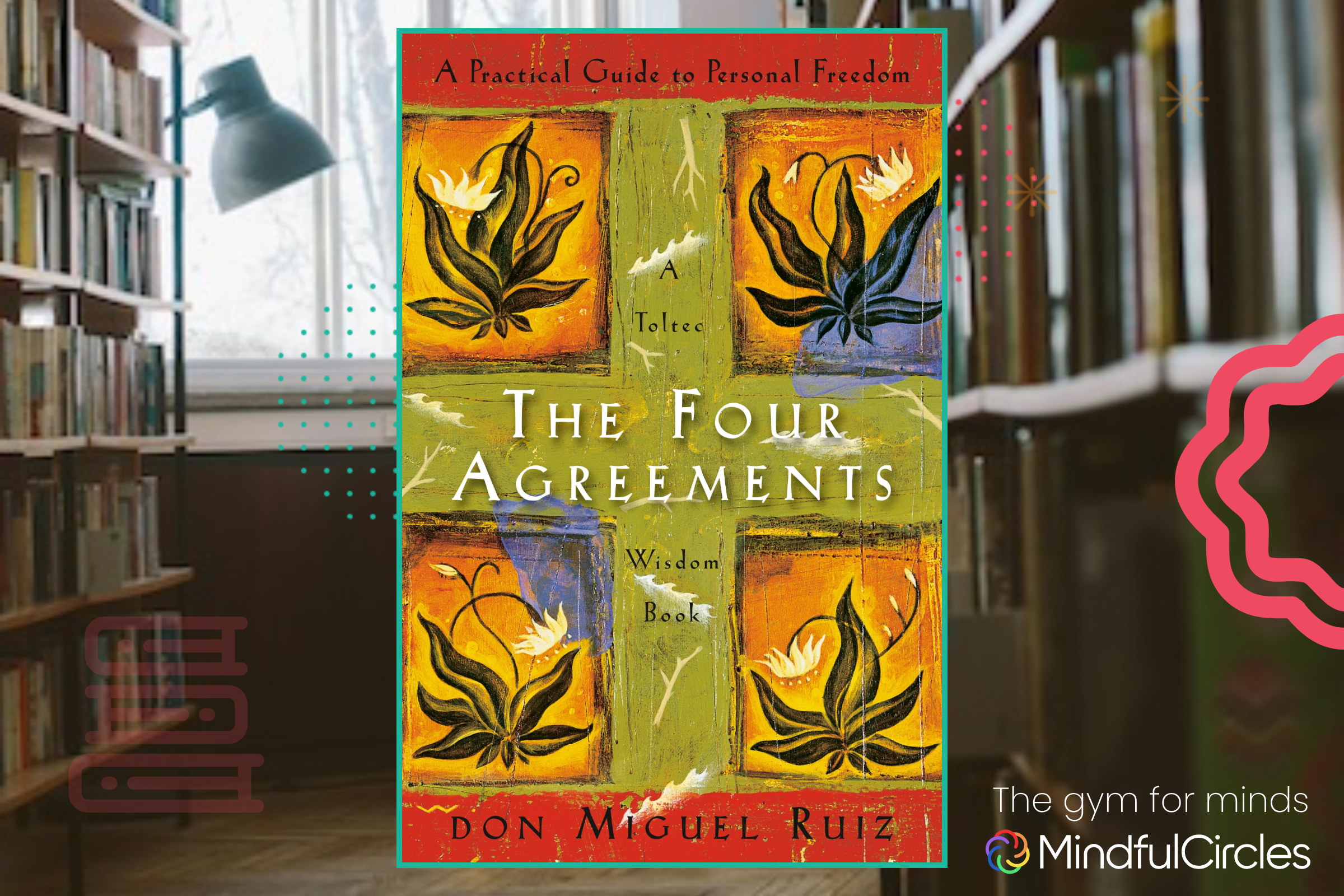

The Man Behind the Book
Don Miguel Ruiz was born in rural Mexico in 1952, the youngest of thirteen children. His mother was a curandera, a traditional healer, and his grandfather was a nagual, a shaman. He grew up surrounded by their teachings, and then, like many sons who want to go their own way, he turned his back on them. He chose modern medicine instead and trained as a surgeon.
His path changed in a single night. In his twenties, he fell asleep at the wheel and crashed his car. He has described watching his own body pull his unconscious friend from the wreckage, as if from outside it. The experience shook his certainty about what a human being is, and sent him back to his family’s ancestral wisdom.
He spent years learning from his mother and from a teacher in the desert, then began teaching himself. The Four Agreements was published in 1997 by a small Californian publisher. Sales grew slowly by word of mouth until Oprah Winfrey featured it in 2001. It went on to spend more than a decade on the New York Times bestseller list. In 2002, Ruiz survived a severe heart attack, and he has spoken since about facing death as one more teacher.
The book is very short, under 150 pages. That is part of its power.
The Core Idea
Ruiz begins with a simple claim: we are all living in a dream.
Not a dream in the sense of sleep, but a set of beliefs about who we are, what is right, and how the world works. We did not choose these beliefs. We absorbed them as children, from parents, schools, religion and culture, long before we could question them. Ruiz calls this process domestication. We learned to seek reward and avoid punishment, and in doing so, we agreed to a picture of ourselves.
Those agreements live inside us as a kind of rule book. An inner Judge enforces them, punishing us every time we fall short. And an inner Victim carries the guilt and shame. Ruiz argues that most of our suffering comes not from what happens to us, but from these old agreements, and from the way we keep punishing ourselves for the same mistake many times over.
The way out is to replace the old agreements with new ones. He offers four.
We were taught who to be before we knew we had a choice. Freedom begins when we notice the agreements we never signed.
The First Agreement: Be Impeccable With Your Word
Ruiz calls this the most important and the most difficult of the four.
Words, he says, are not just sounds. They are a creative force. With words, we can lift someone up or plant a belief that harms them for years. He tells the story of a mother who, in a moment of frustration, told her young daughter that her singing voice was ugly. The girl stopped singing, and carried that sentence for the rest of her life.
Being impeccable means speaking with integrity: saying only what you mean, avoiding gossip, and refusing to use words against others or against yourself. That last part is easy to miss. The harshest words most of us hear every day are the ones we say silently, to ourselves.
The Second Agreement: Don’t Take Anything Personally
When someone criticises you, insults you or rejects you, Ruiz argues, it is not really about you. It is a projection of their own dream: their beliefs, their fears, their wounds.
The same is true of praise. If you build your sense of worth on other people’s approval, you also hand them the power to take it away.
This is not an invitation to stop listening. It is an invitation to stop being wounded by everything you hear. Ruiz suggests that when we no longer take things personally, we become immune to much of the poison around us, and free to respond with clarity instead of hurt.
What others say and do is a reflection of their world. What you feel in response is a window into yours.
The Third Agreement: Don’t Make Assumptions
We assume we know what others think. We assume they know what we need. We assume the silence means something, and then we react to the story we have invented.
Ruiz argues that a great deal of conflict, in relationships, families and teams, is built entirely on assumptions that nobody checked. The remedy is almost embarrassingly simple: ask questions, and say what you really want. Communicate as clearly as you can, and then clarify again.
For anyone leading a team or building a company, this agreement may be the most practical of all. Most misunderstandings are not caused by bad intentions. They are caused by things that seemed too obvious to say.
The Fourth Agreement: Always Do Your Best
The final agreement holds the other three together.
Ruiz’s key point is that your best is not a fixed standard. It changes from moment to moment. Your best when you are rested is different from your best when you are sick, grieving or exhausted. Doing your best means doing what you can with what you have right now, no more and no less.
No less, because that leads to regret. No more, because that leads to exhaustion. And if you have truly done your best, the inner Judge loses its power. There is nothing left to punish.
Some years later, Ruiz and his son, don Jose Ruiz, added a fifth agreement in a follow-up book: be sceptical, but learn to listen. Do not believe everything you hear, including your own inner voice, but listen for the intention behind the words.
The Cost and the Critics
The Four Agreements has sold many millions of copies and is one of the most widely shared spiritual books of its generation. It has also drawn criticism.
The first concerns its origins. Ruiz presents his teaching as ancient Toltec wisdom. Historians note that the Toltec civilisation of central Mexico left very few written records, and there is little evidence linking it to the specific philosophy in the book. Most scholars see the framework as a modern synthesis, influenced by Mesoamerican tradition but also by Western psychology and the New Age movement, in a lineage similar to Carlos Castaneda.
The second concerns the agreements themselves. “Don’t take anything personally” can be misused as a way to tolerate mistreatment, or to dismiss real injustice as simply someone else’s projection. Some harm is personal, and naming it matters. Critics also note that the book offers principles but few practical tools, and that its simplicity can feel thin to readers looking for depth.
The wisdom is real and practical. The claimed history is uncertain, and the agreements need judgement to apply well. Both are part of an honest reading.
What the Book Is Really About
Stripped of the Toltec language, The Four Agreements is a book about one quiet truth: much of our suffering is made of words, the ones we believe, the ones we assume, and the ones we repeat to ourselves.
That makes the path both simple and demanding. Speak carefully. Hold other people’s reactions more lightly. Ask instead of guessing. Do what you can, and then let it be enough.
None of these agreements will be kept perfectly. Ruiz says so himself. You will break them, and when you do, the practice is simply to begin again, without the Judge, without the punishment. Every day is a new chance to make a new agreement.
You do not have to live by rules you never chose. You can choose again, every day.
End of Summary
What to sit with:
Here are three questions to reflect on, each rooted in a core concept from the book:
- (Be Impeccable With Your Word) What is one sentence you repeat to yourself, silently and often, that you would never say out loud to a friend?
- (Don’t Take Anything Personally) Whose words or reactions affected you most this month, and how much of that was really about them rather than about you?
- (Don’t Make Assumptions) What is one assumption you are carrying about someone close to you, at home or at work, that you could simply ask about this week?