


The Man Behind the Book
David M. Buss is an American psychologist, born in Indianapolis in 1953, and one of the founders of the field now called evolutionary psychology. He earned his doctorate at the University of California, Berkeley, taught at Harvard and the University of Michigan, and has spent most of his career as a professor at the University of Texas at Austin.
His path into academia was not a straight one. His father was a psychology professor, and the family moved often. As a teenager, Buss struggled: his grades collapsed, he fell in with a difficult crowd, and he left high school, later finishing his diploma at night school. It was a freshman geology class at the University of Texas that changed his direction. There he met the theory of evolution, which he later called the first intellectual idea that truly mesmerised him. Soon he was asking a question that would shape his life’s work: why do people want the partners they want?
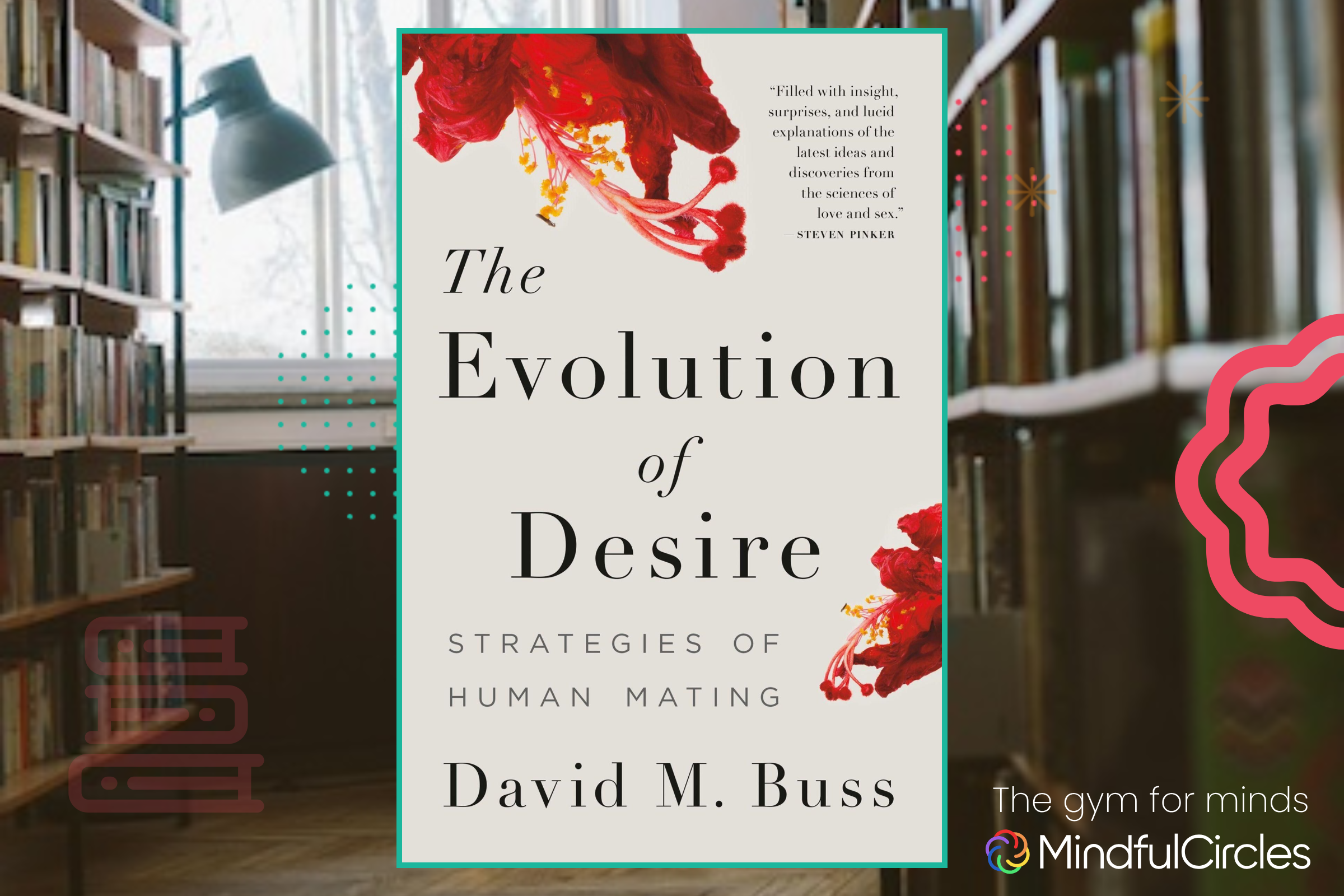
In the 1980s he set out to answer it on a scale nobody had tried before. The Evolution of Desire: Strategies of Human Mating (1994, revised several times since) is the book that grew out of that work. It has been translated into more than ten languages, and it remains one of the most debated books in modern psychology.
The Core Idea
We tend to experience desire as deeply personal. Who we are drawn to, who we fall for, what makes us jealous: it all feels like ours alone, shaped by our story and our taste.
Buss’s argument is that beneath the personal story runs a much older one. Our ancestors faced the same basic problems for hundreds of thousands of years: choosing a partner, keeping one, raising children who would survive. Those who chose well left more descendants. Over time, he argues, their preferences became part of our psychology.
In other words, desire is not random. It carries a history.
What feels like a personal preference is often an ancestral memory we never knew we had.
Buss is careful to say that this is not destiny. Culture, personal experience and choice shape how these tendencies play out. But he insists we cannot understand love, attraction or heartbreak without first understanding where our desires came from.
The 37 Cultures Study
The heart of the book is one of the largest studies of human attraction ever conducted.
Working with dozens of collaborators, Buss surveyed more than ten thousand people across 37 cultures on six continents and five islands: from Germany and Japan to Zambia, Brazil and Iran. He asked them what they looked for in a long-term partner, and how much each quality mattered.
The first finding is often forgotten, and it may be the most important. When asked to rank what mattered most, women and men across almost every culture put the same qualities at the top: mutual attraction and love, kindness, emotional stability, dependability and intelligence. On the things that matter most, we want the same things.
The differences came lower down the list. On average, women placed more weight than men on a partner’s ambition, status and ability to provide resources, and tended to prefer partners slightly older than themselves. On average, men placed more weight on physical attractiveness and youth. Buss interprets these as ancient solutions to different reproductive challenges: for women, securing support for the long investment of pregnancy and childcare; for men, identifying a fertile partner.
Before we notice how we differ, it is worth noticing how much we share.
Short-Term and Long-Term Strategies
Together with his colleague David Schmitt, Buss developed what he calls Sexual Strategies Theory. Its central idea is that every human being carries more than one mating strategy, and which one shows up depends on circumstances.
A long-term strategy looks for commitment, reliability and a partner to build a life with. A short-term strategy looks for something briefer. Both men and women use both, but Buss argues that the costs and benefits have historically been different for each sex, which shapes how strongly and how often each strategy is pursued.
The useful insight here is not about men and women. It is about the inner conflict many of us feel. The part of us that wants freedom and novelty, and the part that wants depth and safety, are not a sign that something is wrong. They are two old strategies, both alive in the same person, competing for the steering wheel.
Jealousy: The Dangerous Passion
Buss gives jealousy more attention than almost any other emotion, and he treats it with unusual respect.
We usually see jealousy as a flaw: a sign of insecurity or possessiveness. Buss argues it evolved for a reason. It is an alarm system, alerting us to real threats to a relationship we have invested in. In small doses, it signals that we care, and it can prompt both partners to pay attention.
In his studies, men on average reported more distress at imagined sexual infidelity, and women on average reported more distress at imagined emotional infidelity, a finding he links to the different risks each faced in ancestral times.
But he is clear about the darker side. Unchecked, the same alarm drives controlling behaviour, rage and, in the worst cases, violence. Understanding where jealousy comes from is not an excuse for it. It is a way of recognising the alarm for what it is before we act on it.
Jealousy is a messenger. It is worth listening to, and dangerous to obey.
Conflict and Harmony Between the Sexes
One of Buss’s most uncomfortable conclusions is that because men and women evolved some different strategies, conflict between partners is not always a failure of communication. Sometimes it is a genuine clash of underlying desires: about commitment, about timing, about attention, about how much is being given and received.
Yet the book ends with a surprising note of hope. Buss argues that the same evolutionary history that created conflict also created love, a universal human experience found in every culture ever studied. Commitment, loyalty and tenderness are as much part of our inheritance as jealousy and rivalry.
The way to harmony, he suggests, is knowledge. Couples who understand the forces pulling on them can stop taking every tension so personally and start working with their nature instead of against it.
The Cost and the Critics
The Evolution of Desire helped build an entire field, and its cross-cultural data are still widely cited. It is also one of the most contested books in psychology.
The strongest scientific challenge comes from social role theory. Alice Eagly and Wendy Wood reanalysed Buss’s own 37-culture data and found that the sex differences in partner preferences were smaller in societies where men and women had more equal access to education, income and power. Their reading is that many of these preferences reflect economic reality and social roles, not only ancient biology.
Other critics point to method. Much of the evidence rests on self-reported preferences, which do not always match who people actually choose. The jealousy findings depend partly on forced-choice questions, and the size of the effect changes when researchers ask differently. More broadly, evolutionary explanations are hard to test, and can become “just-so stories”: plausible accounts that are easy to tell after the fact and difficult to disprove.
The book also focuses almost entirely on heterosexual relationships, and readers outside that frame often find little of themselves in it. And there is the risk of misuse: evolutionary accounts of behaviour are sometimes quoted as if they justify it. Buss himself rejects this explicitly. Explaining where a desire comes from, he argues, does not make it right.
The data are real and the questions are important. The interpretations are debated, and culture matters more than the book sometimes allows. Both are part of an honest reading.
What the Book Is Really About
Stripped of the surveys and the evolutionary theory, The Evolution of Desire is a book about one quiet truth: much of what moves us in love was set in motion long before we were born.
That can feel deflating. It can also be freeing. If our attraction, our longing and our jealousy are partly inherited, then we do not have to take them as the final word on who we are. We can notice them as they arise, with curiosity rather than shame, and then choose how to act.
This is close to what contemplative practice has always offered. Desire appears. Jealousy appears. We do not have to deny them, and we do not have to obey them. Between the ancient impulse and the present action, there is a space where we can choose kindness, which, as the data quietly reminds us, is the quality nearly all of us want most.
We did not choose the desires we inherited. We do choose what we do with them.
End of Summary
What to sit with:
Here are three questions to reflect on, each rooted in a core concept from the book:
- (The 37 Cultures Study) Kindness ranks near the top of what almost everyone wants in a partner. How kind are you, in practice, to the people closest to you, especially when you are tired or under pressure?
- (Short-Term and Long-Term Strategies) Where in your life do you feel the pull between novelty and depth, freedom and commitment, and what would it look like to honour both without being ruled by either?
- (Jealousy) Think of the last time you felt jealous, in love, at work or in friendship. What was the alarm actually trying to tell you?