

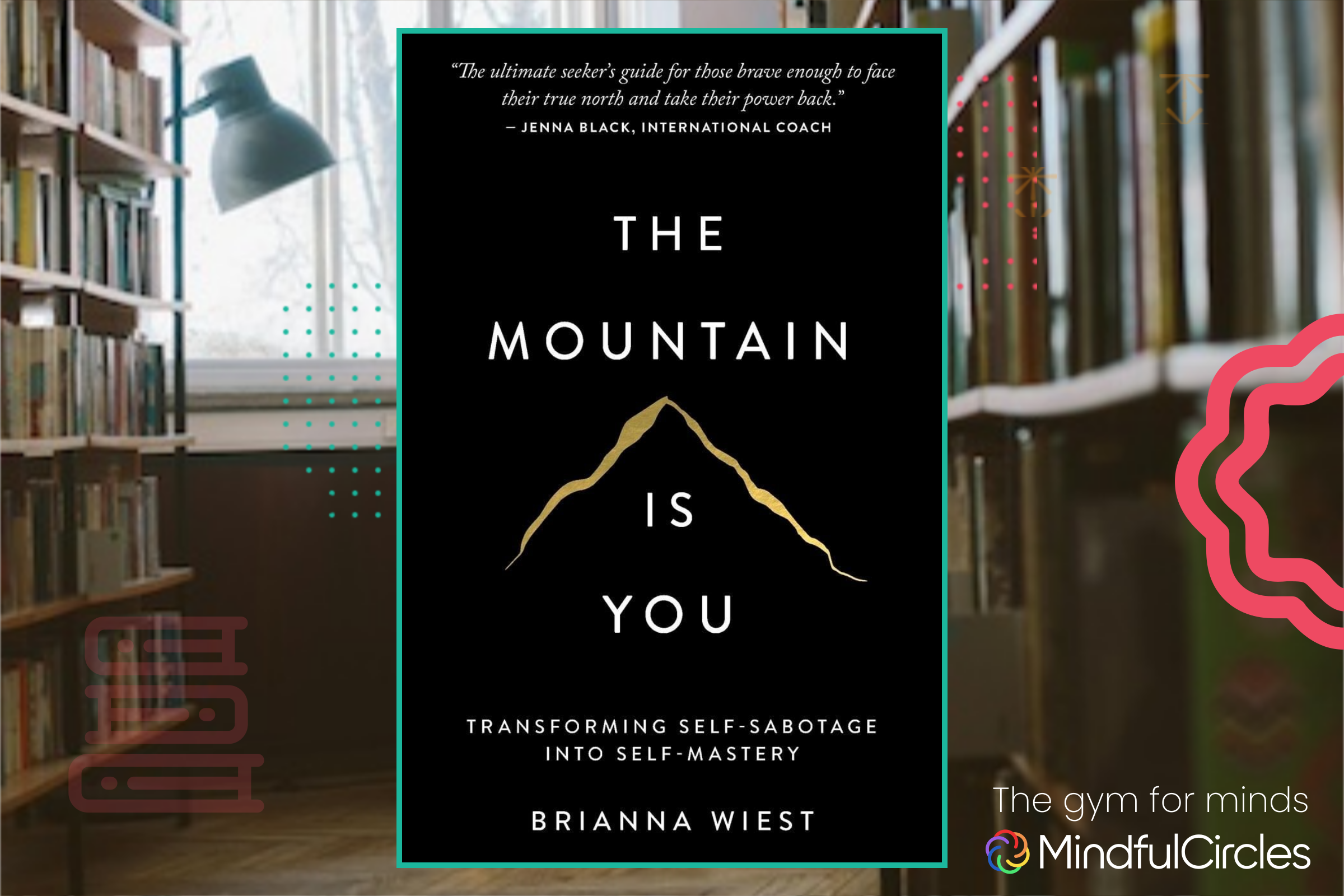

Transforming Self-Sabotage Into Self-Mastery
Author & Book Overview
Brianna Wiest is an international bestselling author and thought leader in emotional intelligence and personal development. Her work has been featured in Forbes, HuffPost, Psychology Today, and Oprah Daily. The Mountain Is You, published in 2020, has sold over 1 million copies worldwide and is currently being translated into 40+ languages. With a quote from the book that has been read more than 75 million times, it has become more than a bestseller — it’s a cultural touchstone.
Wiest writes with what many describe as “generational empathy” — she translates complex psychology into accessible, soul-centered language. Her approach speaks especially to those navigating burnout, self-doubt, and the gap between who they are and who they want to become.
Some critics note that the book’s perspective focuses heavily on internal, psychological factors while giving less weight to external socio-economic circumstances that can also hinder growth. Still, the core insight — that self-sabotage is often rooted in unmet internal needs rather than self-hatred — has proven transformative for millions of readers.
The Central Metaphor: The Mountain Is You
For centuries, mountains have symbolized the big, insurmountable challenges we face. But Wiest reframes this entirely. The mountain isn’t something external you must overcome. The mountain is you.
“Just as a mountain is formed when two sections of ground are forced against one another, your mountain will arise out of coexisting but conflicting needs.”
Your mountain is built from the friction between two parts of yourself: the conscious mind that knows what it wants, and the unconscious mind that meets needs through patterns you don’t fully understand. The journey is not about conquering an external obstacle. It’s about mastering yourself.
Part One: Understanding Self-Sabotage
Self-sabotage is not evidence of brokenness. It’s a message. And Wiest teaches you to read it.
What Is Self-Sabotage?
Self-sabotage appears as something born of self-hatred or low confidence, but it is rooted in a subconscious and unfulfilled need that often clashes with what you consciously want. It’s what happens when there’s an ongoing gap between where you are and where you want to be — and your efforts to close it are consistently met with your own resistance, pain, and discomfort.
Why Do We Sabotage Ourselves?
The answer is paradoxical: you sabotage yourself because two parts of you want different things, and the part you’re not listening to is winning.
Examples:
- You sabotage your relationships because part of you wants intimacy, but another part fears abandonment or loss of freedom.
- You sabotage career success because you consciously want achievement, but unconsciously crave meaning, time, or adventure.
- You sabotage healing by overanalyzing instead of processing emotions — because thinking feels safer than feeling.
Self-sabotage is often a maladaptive coping mechanism — it’s a way to meet subconscious needs without having to properly face and address what those needs are.
Common Forms of Self-Sabotage
Perfectionism, procrastination, emotional avoidance, disorganization, justification and excuses, emotional processing challenges — these aren’t character flaws. They’re adaptations. They’re how your mind has learned to protect you.
Part Two: The Role of Emotions and Triggers
Wiest teaches that emotions are not your enemy — they’re your most valuable guide. But understanding them requires nuance.
Emotions as Signals, Not Reality
Though your emotions are always valid and need to be validated, they are hardly ever an accurate measure of what you are capable of in life. They are not always an accurate reflection of reality. Your feelings know what you’ve done in the past, and they are attached to what they’ve drawn comfort from.
The discomfort of the unfamiliar is not evidence that something is wrong. Change always brings discomfort. The question is: are you confusing “uncomfortable” with “wrong”?
Instinct vs. Feeling: A Critical Distinction
This is one of Wiest’s most practical insights. She distinguishes between instinct and feeling:
- Instinct is a physiological response in the here and now. It’s your body reacting to immediate danger. Trust this.
- Feeling is an emotional reaction shaped by past experiences and future fears. It’s your mind imagining threats that aren’t in front of you right now.
Ask yourself:
- Are you responding to someone who is in front of you, or to your idea of them?
- Are you reacting to what’s happening now, or what you imagine will happen?
- Are your feelings about the present moment, or about what you hope and fear for the future?
Emotional triggers, then, become mirrors of your unmet needs. They’re not problems to suppress — they’re invitations to understand yourself more deeply.
Part Three: The Unconscious Commitment
One of Wiest’s most powerful concepts: your unconscious mind has made commitments your conscious mind doesn’t know about.
You might consciously want success, but unconsciously be committed to staying small (because smallness has always meant safety). You might consciously want a healthy relationship, but be committed to controlling everything (because control kept you alive in a chaotic childhood).
These unconscious commitments are not your fault — they developed as protection. But they are your responsibility to recognize and rewire.
The process requires deep honesty. You have to be willing to ask: What need is my self-sabotage meeting? What would happen if I succeeded? What would I have to give up? What would I have to become responsible for?
Part Four: The Three Phases of Transformation
Wiest structures the journey in three movements:
Phase 1: Observing the Mountain
First, you must see your patterns without judgment. Not as evidence of failure, but as data. Where do you sabotage? When do you pull back? What beliefs underlie these patterns?
This is the work of awareness — honest, compassionate observation of how you’ve been operating.
Phase 2: Ascending the Mountain
Then comes the active, often uncomfortable work of change:
- Rewiring neural pathways that no longer serve you
- Building emotional intelligence
- Learning to act from your highest potential self, not your wounded self
- Taking small risks that prove to yourself you can handle change
Wiest emphasizes that this is not about forcing yourself through willpower. It’s about understanding your resistance and moving through it with compassion.
Phase 3: Reaching the Summit
The summit is not perfection. It’s a new relationship with yourself — built on awareness, resilience, and self-mastery. It’s the person you become in the process of climbing.
Part Five: Letting Go and Self-Reinvention
Throughout life, we undergo a natural process of self-reinvention, experiencing profound growth in both mental and emotional states. However, resistance to this change often results in suffering. Holding onto past trauma while trying to move forward hinders our ability to evolve.
The Bridge Metaphor
Transformation often requires crossing a bridge. The hardest part? The “in-between” phase — when you’ve let go of the old self but haven’t yet reached the new one. You’re in freefall. There’s no solid ground beneath you.
This is where people often turn back. The discomfort feels unbearable. But Wiest says: transformation requires this period of freefall. You cannot take the past with you. You cannot build a new identity while clinging to an old one.
Letting Go as a Process
Letting go is not an immediate act. It is a process of acceptance and rebuilding one’s life. Acknowledging feelings of grief and allowing oneself to cry is part of this journey. Moving on entails creating a new, fulfilling life rather than fixating on the past.
To heal from emotional trauma, you must revisit these memories, understand their origins, and provide comforting reassurance to your younger self — the part of you that was hurt.
Part Six: Building Self-Trust and Practical Tools
One of the biggest barriers to growth is lack of self-trust. Wiest addresses this directly.
Rebuilding Self-Trust
Self-trust is built through consistency — small promises to yourself that you keep. Through self-compassion when you stumble. Through taking small risks that reaffirm your ability to handle change.
It’s not built through grand gestures. It’s built through showing up for yourself, repeatedly, in small ways.
Practical Strategies
Wiest offers several tools for moving from awareness to action:
- Emotional Journaling: Daily writing to uncover unconscious beliefs. Lasting change, she argues, takes 3-6 months of consistent practice.
- The 5-Second Rule: Taking action before fear can paralyze you.
- Setting Boundaries: Saying no as an act of self-respect and clarity.
- Microshifts: Small, incremental changes that build momentum without overwhelming you.
Part Seven: Purpose, Inner Peace, and the Ultimate Goal
Wiest challenges a common cultural assumption: that happiness is the ultimate goal.
Happiness Is Not the Destination
Many people chase happiness through accomplishment, titles, or acquisitions. But happiness is not a destination — it’s a transient emotion. Some days you’ll feel it. Some days you won’t. This doesn’t mean you’re failing.
The Real Goal: Inner Peace
The real goal is inner peace. Not the absence of challenge, but the presence of groundedness. Not the absence of pain, but the ability to move through it without losing yourself.
The book stresses the importance of looking ahead and building a new future, arguing that one’s ultimate purpose is determined by character and impact on humanity rather than career or relationships.
Your purpose is not what you do for a living or who you’re with. Your purpose is determined by who you become — and how that person shows up in the world.
The Mountain Is The Way
Here’s the radical reframing at the heart of this book:
The mountain that stood in your way was never in your way. It was the way.
Every challenge, every pattern you had to face, every part of yourself you had to confront — these were not obstacles to your becoming. They were the very means by which you became.
“One day, the mountain that was in front of you will be so far behind you, it will barely be visible in the distance. But who you become in learning to climb it? That will stay with you forever. That is the point of the mountain.”
The point is not to reach a perfect destination. The point is transformation itself. The strength you build. The self-knowledge you gain. The resilience that becomes woven into your character.
Key Concepts at a Glance
Self-sabotage is not self-hatred. It’s a conflict between what you consciously want and what your unconscious mind needs. Understanding this distinction transforms shame into insight.
Your emotions are valid but not always accurate. They reflect your past, not necessarily your present reality. Learn to distinguish between instinct (immediate physical response) and feeling (emotionally-colored thoughts about imagined futures).
Transformation requires three phases: observing your patterns without judgment, actively rewiring them through practice and small risks, and building a new relationship with yourself based on awareness and self-trust.
Letting go is a process, not an event. You cannot move into a new identity while clinging to an old one. The in-between space is uncomfortable, but it’s essential to genuine change.
Purpose is determined by who you become, not what you achieve. Inner peace — not happiness, not accomplishment — is the ultimate goal. It’s built through consistency, self-compassion, and the daily choice to show up for yourself.
The mountain is the way. Every challenge, every pattern you confront, every part of yourself you integrate — these are not obstacles to your growth. They are the very means by which you become who you’re meant to be.
MindfulCircles
In the session let’s read only what is in blue