


The Man Behind the Book
Robert Greene is an American writer, born in Los Angeles in 1959. Before he wrote a single book, he held dozens of jobs: construction worker, translator, magazine editor, Hollywood screenwriter. He says those years taught him more about people than any classroom did.
His first book, The 48 Laws of Power (1998), became a cult classic in boardrooms, prisons and recording studios alike. It was also widely criticised as cold, cynical and Machiavellian, a handbook for manipulation. Over the following two decades Greene wrote The Art of Seduction, The 33 Strategies of War, The 50th Law and Mastery, and mentored a young Ryan Holiday, later the author of Ego Is the Enemy.
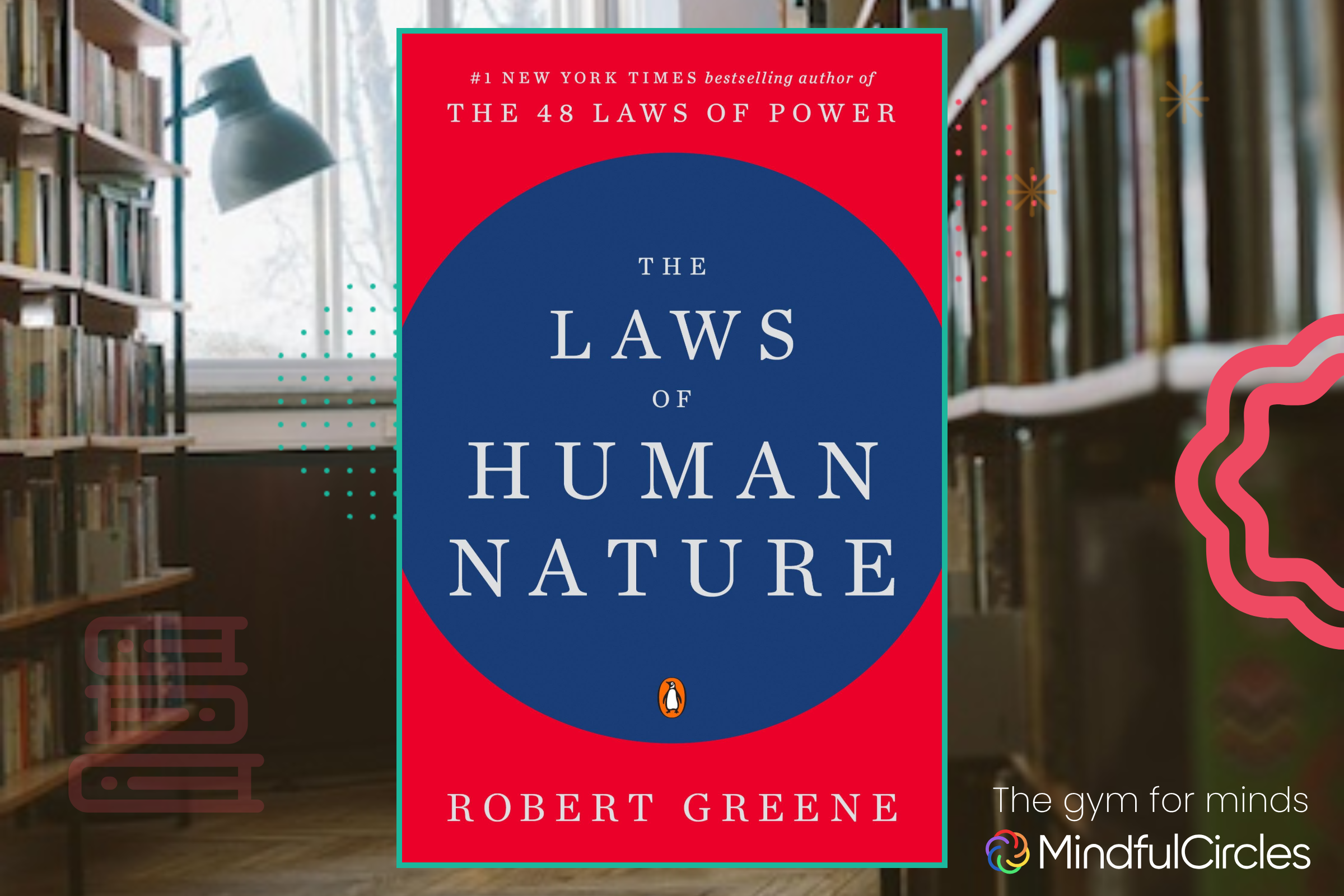
The Laws of Human Nature (2018) is his sixth book, and the one he considers the culmination of his life’s work. Where The 48 Laws of Power looked at people from the outside, asking how to win, this book turns the lens inward, asking why we are the way we are.
In September 2018, shortly before the book’s release, Greene suffered a serious stroke that left him temporarily without the use of his left arm and leg. He has since spoken openly about rebuilding his body through daily physical therapy, and about the morning meditation practice that now anchors his life. A book that ends on mortality was published by a man who had just come face to face with his own.
The Core Idea
Greene’s starting point is uncomfortable: the most fundamental law of human nature is that we deny we have one. We see ourselves as rational, fair and kind. Irrationality, envy, vanity and aggression are things we notice in other people.
The book maps eighteen forces that shape every human being, whether we admit them or not. Among them: irrationality, narcissism, role-playing, envy, grandiosity, conformity, aggression, and the denial of death. Each chapter opens with a story from history, names the law at work, and then shows how the same force can be transformed into something useful.
The goal is not to escape human nature. That is impossible. The goal is to become a calm observer of it, first in yourself and only then in others.
Understanding other people begins with admitting you are made of the same material.
The Law of Irrationality
The book opens in ancient Athens with Pericles, the statesman who led the city through its golden age. His gift, Greene argues, was not brilliance but restraint. Before any major decision he would withdraw, let his first emotional reaction pass, and only then choose.
After Pericles died of the plague, Athens lost that discipline. Leaders who spoke to the crowd’s fear and pride took over, and the city stumbled into disastrous wars it could not win.
Greene’s point is that we all decide emotionally and explain rationally afterwards. Being rational is not the absence of emotion. It is the habit of noticing the emotion before it decides for you. He calls this cultivating the rational self, and it is less a talent than a practice.
In practice, that means a few things. Notice when a decision feels urgent and certain at the same time. Ask what you are feeling before asking what you think. And give important choices time, because the first reaction is rarely the wisest one.
In its own language, this is close to what contemplative traditions have taught for centuries: observe the mind before you let it move you.
From Narcissism to Empathy
Greene argues that every one of us is a narcissist. We all need attention, validation and a sense that we matter. The question is not whether we have this need, but what we do with it.
He describes a spectrum. At one end are deep narcissists, whose sense of self is so fragile that every conversation becomes about them. At the other end are healthy narcissists: people secure enough in themselves that they can turn their attention outward.
That outward turn is empathy, and Greene treats it as a skill rather than a personality trait. It begins with an empathic attitude, a genuine curiosity about other people. It grows through attunement to mood and body language, through understanding someone’s history and values, and through practice.
He also warns that everyone wears a mask. We show the world a curated version of ourselves, and so does everyone else. Real understanding means looking past the performance, in others and in ourselves.
The energy we spend wanting to be seen can become the energy we spend truly seeing others.
The Shadow
The most powerful chapter in the book borrows an idea from the psychologist Carl Jung: the Shadow. As children, we learn which parts of us are welcome and which are not. Anger, selfishness, ambition, desire, the wish to be admired. The unwelcome parts do not disappear. They go underground.
Greene argues that the Shadow always finds a way out. It shows up as sudden outbursts that feel out of character. As loud contempt for exactly what we secretly want. As projection, when the trait that irritates us most in others is the one we have refused to see in ourselves.
His central example is Richard Nixon, a man who built a carefully controlled public persona over deep resentments and insecurities. The more tightly he held the mask, the more the hidden side leaked into his decisions, until it brought down his presidency.
The prescription is not to eliminate the Shadow, but to integrate it. Recognise it. Own it. Channel its energy into honesty, creativity and a fuller, more authentic self. A person who has made peace with their dark side is less dangerous, not more.
What we refuse to see in ourselves, we keep meeting in the world.
Envy and Grandiosity: The Fragile Ego
Two chapters sit side by side, and together they read like a portrait of ambition and its dangers.
Envy is the emotion nobody admits to. Greene notes that it rarely shows itself directly. It hides behind faint praise, gossip, and criticism dressed up as helpful feedback. It is strongest not towards strangers, but towards peers: the friend from the same background, the founder who started at the same time.
Grandiosity is the opposite risk. Success inflates the sense of self. We begin to credit our talent and forget the luck, the timing and the people who carried us. Greene’s example is Michael Eisner, who revived Disney in the 1980s and then, convinced of his own genius, overreached, pushed away the people around him, and watched the company decline.
Greene does not ask us to kill ambition. He asks us to ground it. He calls this practical grandiosity: big goals, honestly measured against reality, with a clear view of our limits and of who helped us get here.
For anyone pursuing something ambitious, both chapters hold up a mirror. Whose success stings? And whose credit have we quietly taken?
Meditate on Our Common Mortality
The book ends where every human life ends. Greene’s final law is the denial of death: our habit of living as if time were endless, postponing what matters, and filling our days with distraction so we never have to look.
His example is the writer Flannery O’Connor, diagnosed with lupus at 25 and told her time would be short. Instead of shrinking, her life sharpened. She wrote with greater urgency, paid closer attention, and found deeper meaning in ordinary days. She died at 39, leaving work that is still read today.
Greene argues that awareness of death is not morbid. It is clarifying. It cuts through petty grievances, reminds us that everyone around us shares the same fate, and turns empathy from an idea into a feeling.
He wrote this chapter before his stroke. He lived it shortly after.
The Cost and the Critics
The Laws of Human Nature is widely praised as Greene’s most mature and humane book. It is also more than 600 pages long, and many readers find it repetitive.
The deeper criticism is about method. Greene builds his laws on historical stories, carefully chosen to fit the point being made. That makes for vivid reading, but it is not evidence. The book mixes Jungian psychology, evolutionary speculation and literary insight without the rigour of a scientific work. The chapter on masculine and feminine traits, rooted in Jung’s ideas, strikes many readers as dated.
Others note that the shift from The 48 Laws of Power is less complete than it looks. A book that teaches you to read people’s masks, spot their weaknesses and soften their resistance can still be used as a manual for influence. The empathy is real, but so is the strategist.
And the tone remains dark. Greene sees envy, aggression and self-deception almost everywhere. Some readers find that bracing and honest. Others find it a cynical view of people that leaves too little room for simple goodness.
The insight is real. The method is literary, not scientific. Both are part of an honest reading.
What the Book Is Really About
Stripped of the 600 pages and the historical drama, The Laws of Human Nature is a book about one quiet truth: you cannot understand other people until you are willing to understand yourself.
The 48 Laws of Power taught how to play the game. This book asks who is playing it. It invites us to stop judging human nature from a safe distance and to recognise it in our own reactions, our own envy, our own masks, our own fear of the end.
The reward is not control over others. It is a steadier mind, a softer judgement, and relationships built on seeing people as they are, not as we need them to be.
We are not above human nature. We are made of it. And the moment we accept that, we can finally begin to work with it.
End of Summary
What to sit with:
Here are three questions to reflect on, each rooted in a core concept from the book:
- (The Shadow) What trait in other people irritates you the most, and what might it reveal about a part of yourself you have pushed away?
- (The Law of Irrationality) Think of a decision you made quickly this month. What emotion was really driving it, and what would you have chosen if you had given it a day?
- (Envy) Whose success has quietly stung you recently, and what does that sting tell you about what you actually want?