

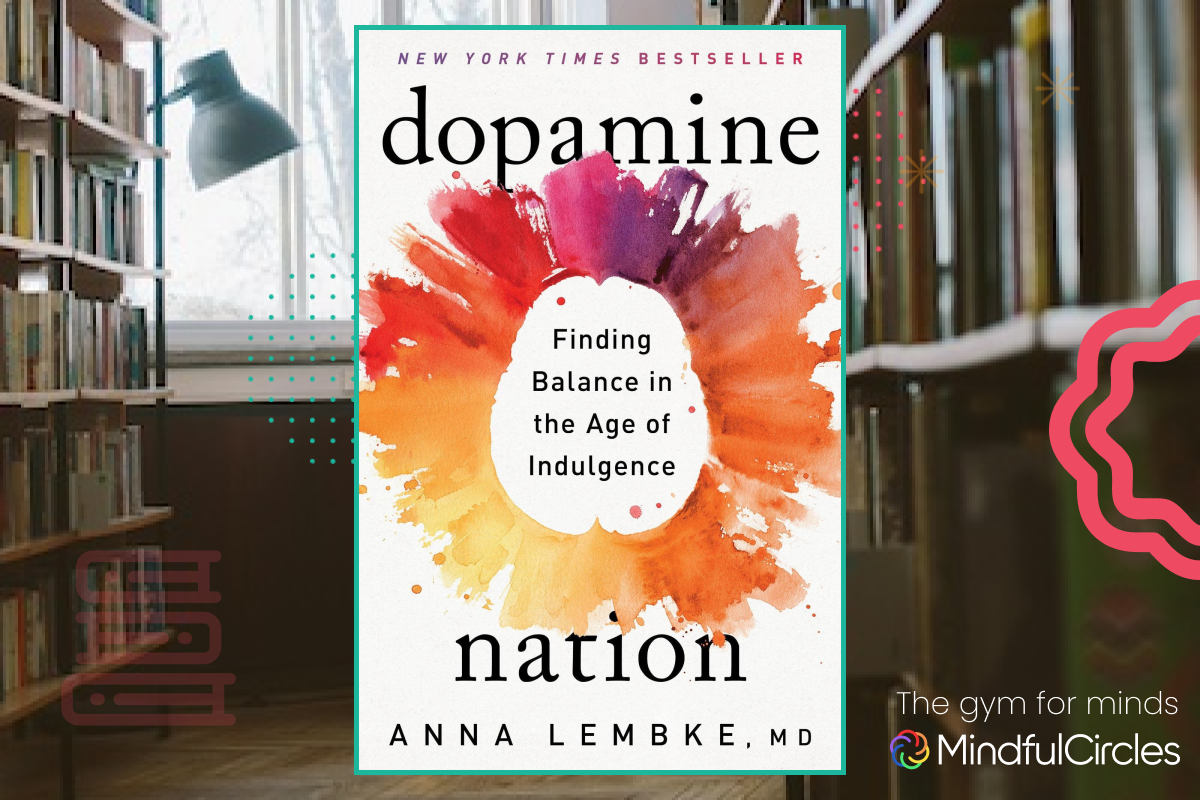

The Woman Behind the Book
Anna Lembke is a psychiatrist and professor at Stanford University School of Medicine, where she runs the Stanford Addiction Medicine Dual Diagnosis Clinic. She spent years treating people addicted to opioids, alcohol and stimulants, and was among the early voices warning about the opioid crisis in her earlier book, Drug Dealer, MD. Many readers first met her in the Netflix documentary The Social Dilemma.
Dopamine Nation, published in 2021, widened the lens. Lembke noticed that the patients arriving in her clinic were no longer only addicted to drugs. They were addicted to their phones, to gaming, to shopping, to porn, to news, to work. And they were not unusual people. They were ordinary people living in an unusual world.
The book is also personal. Lembke writes openly about her own compulsion: romance novels. It started with Twilight, escalated to more and more explicit books read late at night on an e-reader, and slowly began eating her sleep and her presence with her family. A Stanford addiction psychiatrist, hooked on vampire romance. She tells the story not as a confession, but as a point: no one is outside of this.
The Core Idea
Lembke’s central argument is that we have transformed the world from a place of scarcity into a place of overwhelming abundance — and our brains, built for scarcity, have not caught up.
For almost all of human history, pleasure was rare and hard-won. Food had to be hunted. Connection required presence. Entertainment required effort. Today, pleasure is instant, endless and delivered straight into our pockets. And the more easily we reach for it, the less satisfied we become.
“The smartphone is the modern-day hypodermic needle, delivering digital dopamine 24/7 for a wired generation.”
The paradox at the heart of the book: the relentless pursuit of pleasure, and the relentless avoidance of pain, leads to pain. Rising rates of anxiety, depression and loneliness in the wealthiest societies on earth are not a mystery. They are, at least in part, the cost of never going without.
The Pleasure-Pain Balance
The most memorable image in the book is a seesaw.
Lembke explains that the brain processes pleasure and pain in the same region, and that it works constantly to keep the two in balance. When we experience something pleasurable, the balance tips towards pleasure. Dopamine is released. We feel good.
But the brain does not like to stay tipped. So it responds by pushing back. Lembke asks us to imagine little gremlins jumping onto the pain side of the seesaw to level it out. This is the comedown, the hangover, the hollow feeling after an hour of scrolling, the just one more.
With occasional pleasure, the gremlins jump off again and balance returns. The problem comes with repetition. When we reach for the same pleasure again and again, the gremlins stay. More arrive. The seesaw becomes permanently tilted towards pain. Now we need the drug, the phone, the drink, just to feel normal — and without it, we feel anxious, irritable, restless and flat.
Lembke calls this a dopamine deficit state. It is why tolerance grows, why the same pleasure gives less each time, and why what began as a reward slowly becomes a need.
Dopamine Is About Wanting, Not Having
A quietly important point in the book: dopamine is less the chemical of pleasure than the chemical of wanting. It is the brain’s motivation signal, the pull towards the next thing.
This is why the anticipation of a notification can feel stronger than the notification itself. And it is why so much modern technology is designed around uncertainty and novelty — the refresh, the feed, the next episode. These do not satisfy desire. They keep it alive.
For ambitious people, this has an uncomfortable edge. Work, achievement, metrics and validation can run on exactly the same circuitry. Not every compulsion looks like a vice. Some look like a very productive week.
The Dopamine Fast
Lembke’s first clinical prescription is abstinence — not forever, but for long enough to let the brain reset.
In her clinic, she typically asks patients to stop their drug of choice for about thirty days. Four weeks is roughly how long it takes for the gremlins to climb off the seesaw and for the reward system to recalibrate.
She is honest about what happens. The first two weeks usually feel worse, not better. Anxiety rises. Sleep is disturbed. Cravings are loud. But somewhere in weeks three and four, many patients describe something they had forgotten: ordinary life starts to feel good again. A walk. A conversation. A meal. The world regains its colour.
Lembke offers a simple framework for this process, built around the letters of the word itself — DOPAMINE: Data (what and how much are you consuming), Objectives (what does it do for you), Problems (what is it costing you), Abstinence (thirty days without it), Mindfulness (observing what arises), Insight (what you learn about yourself), Next steps (what you choose afterwards), and Experiment (returning, if at all, with new rules).
Self-Binding
Willpower, Lembke argues, is a poor strategy. The better strategy is to put distance between yourself and the thing you crave before the craving arrives.
She calls this self-binding, and draws on the image of Odysseus, who had himself tied to the mast of his ship so he could hear the Sirens’ song without steering towards the rocks. Odysseus did not trust his future self. He was right not to.
She describes three kinds of self-binding. Physical — creating actual distance: deleting the app, leaving the phone in another room, not keeping alcohol in the house. Chronological — setting time limits: no screens after nine, only on weekends, never before breakfast. Categorical — ruling out whole categories that act as triggers: not just less sugar, but no sweets at all.
Self-binding is not a sign of weakness. It is an honest admission of how strong the pull is.
Pressing on the Pain Side
One of the most counterintuitive ideas in the book: if too much pleasure tips us towards pain, then deliberately choosing pain can tip us back towards pleasure.
When we do something hard — cold water, intense exercise, a demanding task — the brain responds by sending gremlins to the pleasure side of the seesaw. The discomfort comes first. The lift comes after, and it tends to last longer than the lift from easy pleasure.
This is why a cold swim can leave you calm for hours, and why a hard run can feel better than a lazy afternoon. Lembke is careful here. Pain, too, can be pursued compulsively, and she acknowledges that the same principle can be taken too far. But in small, chosen doses, voluntary discomfort is one of the most reliable ways back to balance.
Radical Honesty and Prosocial Shame
The final and perhaps deepest section of the book moves from the brain to the heart.
Lembke observed that the patients who recovered best were almost always the ones who began telling the truth — not only about their addiction, but about small, everyday things. She calls this radical honesty. Lying, even in minor ways, keeps us disconnected from ourselves and others. Telling the truth builds self-awareness, strengthens relationships, and makes it harder to hide the patterns that are hurting us.
She also distinguishes between two kinds of shame. Destructive shame isolates: it makes us hide, lie, and use more. Prosocial shame connects: it happens when we admit our mistakes to people who respond not with rejection, but with acceptance — and with a clear path to making things right. This, she argues, is what communities of recovery do so well. Being seen in our failures, and still being welcomed, is itself a form of healing.
It is not an accident that so much of recovery happens in circles.
The Cost and the Critics
Dopamine Nation has been widely praised for its clarity, its honesty, and its vivid patient stories. It has also drawn serious criticism.
Some neuroscientists argue that the book simplifies dopamine considerably. The chemical plays many roles in the brain, and the seesaw with its gremlins, while memorable, is a metaphor built on older psychological theories rather than a precise map of how the brain works. Readers who come away believing they can reset their dopamine in a weekend may be taking the metaphor more literally than the science allows.
Others note that the book relies heavily on individual clinical stories rather than systematic data, and that it can blur the line between genuine addiction and ordinary enjoyment. Not every pleasure is a problem. Not every habit is a disease.
There is also a structural critique. The book places much of the responsibility on individuals to bind themselves, abstain, and be honest — while the phones, platforms, and products are deliberately engineered by teams of very smart people to be as hard to put down as possible. Self-binding is useful. It is also, in part, a personal answer to a collective problem.
The framework is genuinely helpful. It is also a simplification. Both are part of an honest reading.
What the Book Is Really About
Stripped of the neuroscience and the gremlins, Dopamine Nation is a book about one quiet truth: we are not suffering from too little pleasure. We are suffering from too little rest from it.
Its answer is not puritanical. Lembke does not ask us to renounce joy. She asks us to notice what we reach for, why we reach for it, and what it costs — and to be willing to sit with a little discomfort long enough to feel the world again.
Balance, in her telling, is not something you find. It is something you practise. Through abstinence. Through self-binding. Through choosing hard things. And through telling the truth to people who will not turn away.
In a culture of endless indulgence, the most radical thing may be to go without — and to find that what remains is enough.
End of Summary
What to sit with:
Here are three questions to reflect on, each rooted in a core concept from the book:
- (The Pleasure-Pain Balance) What do you reach for when you want to stop feeling something — and what does it leave you with afterwards?
- (Self-Binding) If you took thirty days away from one thing that quietly pulls at you, what would it be — and what distance could you put between yourself and it this week?
- (Radical Honesty) What is one small truth you have been hiding, softening, or leaving unsaid — and who could you safely tell?