

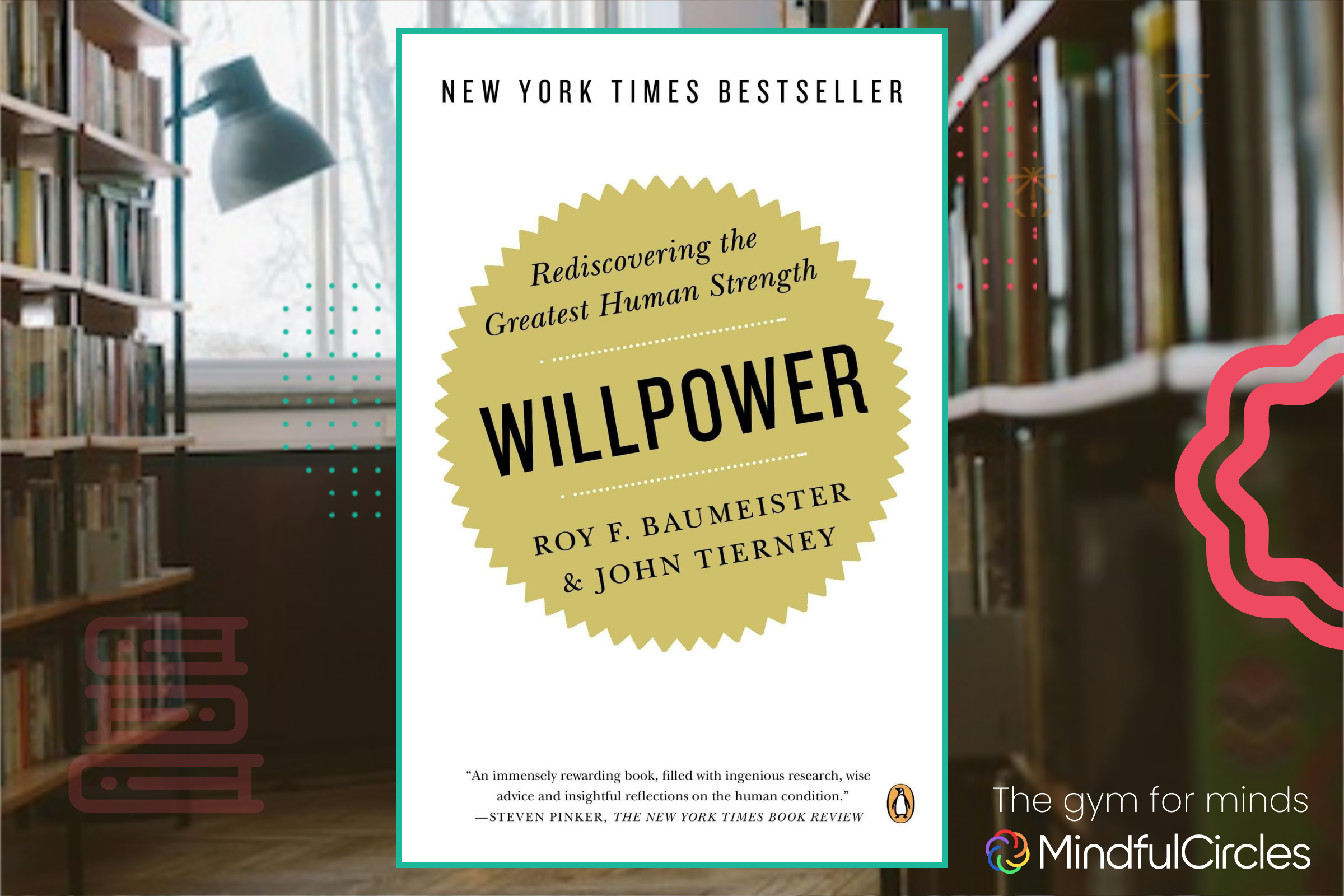

The Men Behind the Book
Roy Baumeister is one of the most cited social psychologists alive. For three decades he has run laboratory studies on self-control, aggression, belonging and the self, and his 1998 experiment on resisting chocolate chip cookies became one of the most quoted studies in modern psychology. John Tierney was a science columnist at the New York Times, and the pairing shows: the book moves between the laboratory and the world, between effect sizes and Victor Hugo locking away his own clothes so he could not leave the house until the novel was finished.
Published in 2011, Willpower arrived with an argument that felt almost contrarian at the time. The self-help shelves were full of passion, purpose, positive thinking, flow. Baumeister and Tierney went in the other direction and made the case that the single most reliable predictor of a good life is a rather unglamorous capacity: the ability to make yourself do the thing you do not feel like doing.
The Core Idea
The book opens with a finding from the research on personal strengths. When psychologists surveyed the traits that correlate with a life going well — health, savings, relationships that last, work that gets finished — two came out ahead of everything else. Intelligence was one. Self-control was the other. And of the two, only one can be meaningfully trained.
From there the central claim: willpower is not a metaphor and not a virtue. It is a resource. It is finite. It is drawn from one common supply for every kind of self-regulation you do in a day. And when it runs low, you do not feel tired in any way you would recognise — you simply become someone slightly different. More reactive. More tempted. Less able to hold your own line.
The most important thing to know about self-control may be that you have less of it available than you think, and that you spend it on things you never counted as effort.
The Radish and the Cookies
The founding experiment is almost comically simple. Students arrived at a lab that had been filled with the smell of freshly baked chocolate chip cookies. Some were invited to eat the cookies. Others were seated in front of them and told to eat radishes instead.
Both groups were then given a geometry puzzle to solve. What neither group was told is that the puzzle had no solution. The only real measurement was how long they persisted before giving up.
The cookie eaters worked for around twenty minutes. The radish eaters gave up in eight.
Nothing about the puzzle had changed. What had changed was that one group had already spent something before they sat down. Baumeister called it ego depletion — the state left behind after an act of self-control, in which the next act of self-control comes harder.
One Reservoir, Many Demands
The consequence that matters most is not the depletion itself but the shared supply.
You do not have a separate account for work discipline, a separate one for patience with your partner, a separate one for what you eat at eleven at night. It is one account. The morning spent staying composed in a meeting where you badly wanted to say something is withdrawn from the same balance as the evening’s intention to go to the gym.
This reframes a great deal of ordinary self-judgement. The founder who holds an entire negotiation together and then snaps at someone they love on the way home is not revealing their true character. They are revealing the state of a resource. The book’s practical inversion of this is worth sitting with:
if you want to know why you keep failing at one thing, look at what else you spent the day resisting.
Depletion also has a signature. Depleted people do not report feeling less willpower. They report that everything feels more — the food tastes better, the frustration cuts deeper, the desire is louder. The volume goes up on wanting, at exactly the moment the capacity to refuse goes down.
Decision Fatigue
Tierney’s contribution to the book’s public life was the phrase decision fatigue: the finding that making choices draws on the same supply as resisting temptation.
The illustration that travelled furthest came from a study of an Israeli parole board. Prisoners appearing early in a session, or just after a food break, were granted parole far more often than those appearing at the end of a long stretch of cases. The depleted judge does not become harsh, exactly. The depleted judge defaults — and the default in a parole hearing is no.
Every decision spends something: choosing between options, resolving trade-offs, committing when you cannot be certain. Which is why the confectionery is at the supermarket checkout and not the entrance, and why the same person who negotiated a term sheet at four in the afternoon cannot decide what to have for dinner at eight.
The Muscle
Here the book turns hopeful. If willpower behaves like a muscle in being tired by use, it may also behave like a muscle in being strengthened by it.
The experiments were odd and rather charming. Participants were asked to practise small, arbitrary disciplines for a few weeks: sit up straight; use the non-dominant hand for everyday tasks; speak in complete sentences without slang; track every euro spent. None of these tasks was important. That was the point.
What emerged was transfer. People who practised the trivial discipline improved on things that had nothing to do with it — they studied more, drank less, ate better, washed the dishes rather than leaving them. The training was not in posture. The training was in the act of overriding an impulse, which appears to generalise.
You cannot decide to have more willpower. You can practise something small and unimportant until the capacity is there when something important asks for it.
The Unfinished Task
One of the quieter chapters concerns the Zeigarnik effect — the tendency of unfinished tasks to keep intruding on the mind. The waiter remembers the open order and forgets it the moment the bill is paid.
The received interpretation was that the unconscious keeps nagging until the task is done. Later work by Baumeister and E.J. Masicampo revised this, and the revision is the useful part: the nagging stops not when the task is finished, but when a specific plan has been made for finishing it. Not intention. Not resolve. A when and a where.
This is why unstructured obligation is so exhausting. Everything you have not decided how to do is quietly running in the background, spending the same resource you were hoping to use on the work itself.
Precommitment, Bright Lines and Being Watched
The book’s practical core is not about resisting harder. It is about arranging life so that less resistance is required.
Precommitment is the oldest of these: Odysseus tied to the mast, hearing the sirens and unable to act on them. Hugo giving his clothes to his servant. The modern versions are duller and just as effective — the automatic transfer on payday, the phone left in another room, the money staked on a public commitment.
Bright lines are the second. A clear rule is easier to keep than a judgement call, because a judgement call must be re-decided every time it is faced, and every re-decision costs something. Never on a weekday holds; not too often does not.
Monitoring is the third, and the evidence for it is unusually strong. Simply recording a behaviour changes it — Benjamin Franklin’s ledger of virtues, the food diary, the weekly financial review. What is watched tends to improve, even when nothing else is done.
And running underneath all three: sleep, food, and the ordinary maintenance of a body. The book is blunt that the most common cause of a collapse in self-control is not weak character but a person who has not slept properly in four days.
The Cost and the Critics
This is the section that has to be written honestly, because Willpower is one of the most consequential books in modern psychology and also one of the most contested.
The central mechanism — ego depletion — did not survive the last decade intact. In 2016, a coordinated replication across twenty-three laboratories found an effect close to zero. A second large pre-registered replication some years later reached much the same conclusion. Meta-analyses correcting for publication bias suggested that the original literature had been inflated by the file drawer: the studies that worked were published, the ones that did not were not. Ego depletion became one of the emblematic cases of psychology’s replication crisis, and Baumeister has spent years defending it, sometimes on methodological grounds that his critics did not accept.
The glucose explanation fared worse still. The book proposes that willpower runs on blood sugar, and that a glass of lemonade can restore it. The brain’s energy consumption does not in fact vary much with mental effort, and later studies found that merely rinsing the mouth with a sugar solution and spitting it out produced the same effect — which points to reward and motivation, not fuel.
The alternative accounts are, to my mind, more interesting than the original. Michael Inzlicht and others argue that what looks like depletion is a shift — attention and motivation moving away from what you were forcing and toward what you actually want, which is adaptive rather than a failure. Carol Dweck’s group showed that the effect appears mainly in people who already believe willpower is limited. The parole board study has been challenged on how cases were ordered. And the marshmallow test, invoked here as it is invoked everywhere, turned out on larger and better-controlled samples to predict much less than the popular version claims — most of its power came from the child’s background rather than the child.
There is a broader critique too, and it lands on the whole genre. A book that explains outcomes through self-control risks becoming a book that blames people for their circumstances. Work on scarcity by Mullainathan and Shafir suggests the causality often runs the other way: poverty, insecurity and chronic stress consume mental bandwidth, and what then looks like poor self-control is the result of the situation, not its cause. Told to a person in crisis, strengthen your willpower is not far from try harder.
What survives is worth naming clearly, because it is not nothing. Trait self-control — measured as a stable disposition — remains one of the most robust predictors in psychology of health, achievement and relationship stability. But the mechanism turns out to be almost the opposite of the book’s title. People who score highest in self-control do not report winning more battles against temptation. They report having fewer battles. They have arranged their lives, environments and habits so that the moment of heroic resistance rarely arrives.
Which means the most durable parts of Willpower are precisely its least dramatic ones: precommitment, bright lines, monitoring, planning, sleep. The engineering held. The fuel gauge did not.
What the Book Is Really About
Underneath the studies, Willpower is arguing against a story most of us carry without examining it — that self-control is a moral quality, and that the people who have it are simply better made.
Baumeister and Tierney’s answer is that it is a capacity, not a virtue. It can be spent without your noticing. It can be restored. It can be trained. And most usefully, it can be spared — by making fewer decisions, by drawing clearer lines, by designing an environment that does not require you to be exceptional every afternoon at four.
Read alongside Atomic Habits, which we sat with earlier this year, the conclusion converges from two directions. Neither book ends up recommending more effort. Both end up recommending better design.
The version of this that I find hardest and most honest: the days you lose your discipline are usually not the days you were weak. They are the days you were already spent, and did not know it.
End of Summary
What to sit with:
Here are three questions to reflect on, each rooted in a core concept from the book:
- (One Reservoir, Many Demands) Where in your week are you spending self-control without counting it as effort — and which evening intention keeps failing as a result?
- (Bright Lines) What is one recurring decision you re-negotiate with yourself again and again, and what clear rule would end the negotiation for good?
- (Fewer Battles) Think of one thing you keep trying to resist. What would have to change in your environment, your schedule or your commitments so that the resistance was no longer needed?