

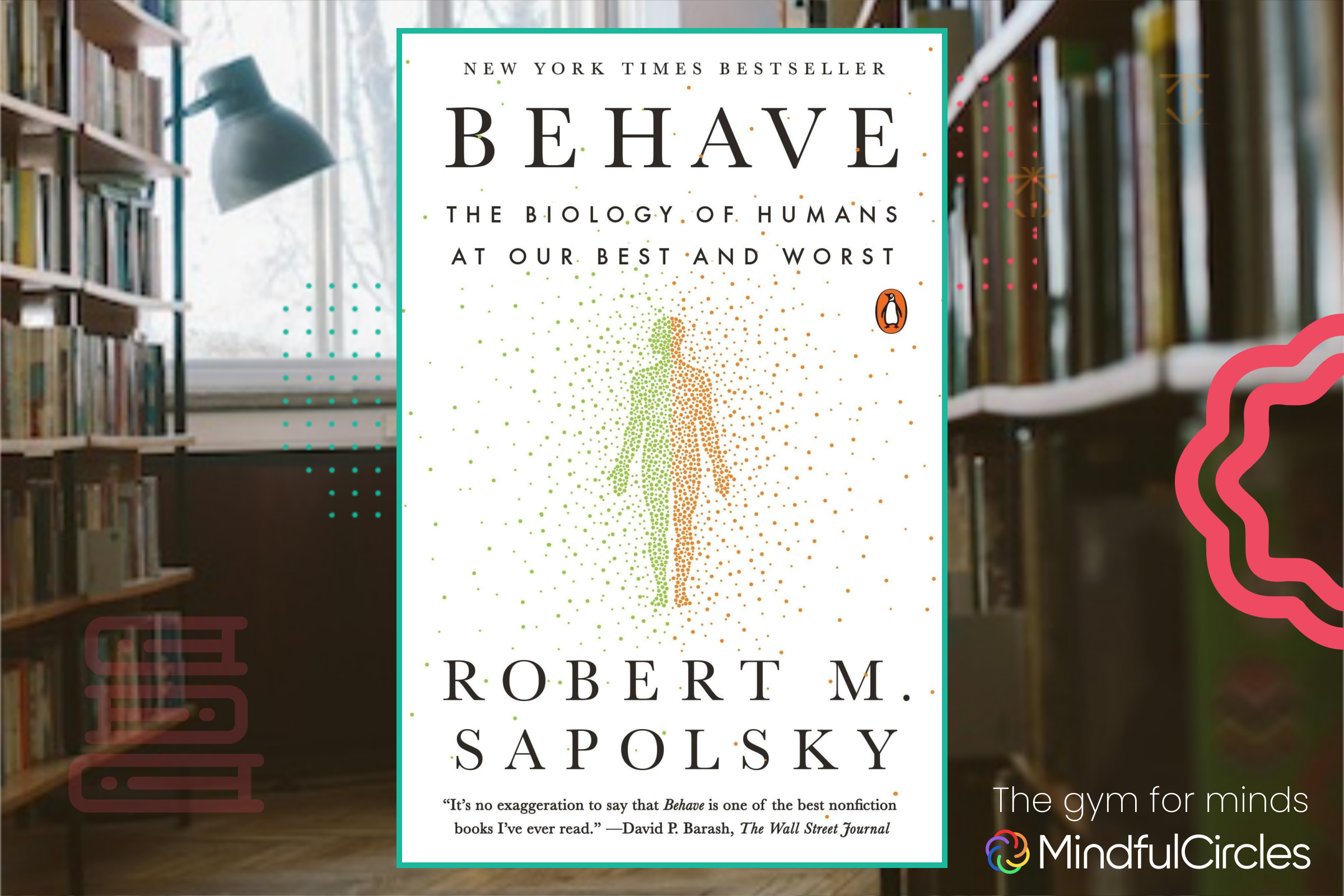

The Man Behind the Book
Robert Sapolsky is a neuroscientist and primatologist, Professor of Biology, Neurology and Neurosurgery at Stanford University, and a recipient of a MacArthur “Genius” Grant. As a young man he spent his summers in Kenya, living alone among a troop of baboons, tracking their stress hormones and their politics. He kept returning for over twenty years. What he was really studying was not baboons. It was us.
Behave, published in 2017, is the book those decades built toward. It won the Los Angeles Times Book Prize, became a New York Times bestseller, and was named one of the Washington Post’s ten best books of the year. It is also eight hundred pages long, and its author is very funny about that fact.
The question the book asks is disarmingly simple: why do we do the things we do? Why does the same human species produce both the person who shelters a stranger and the person who pulls the trigger — and sometimes produces both in the same body, on the same day?
The Core Idea
Sapolsky’s method is the most useful thing in the book, and you can borrow it immediately.
He begins with a single behaviour. A hand pulls a trigger, or touches an arm in comfort. Then he asks: what happened one second before? That is neurobiology — the amygdala, the frontal cortex, the firing of neurons.
Then he asks the same question again, one layer further back. What happened in the seconds and minutes before, in the environment, the sights and sounds and smells that primed that brain? What happened in the hours and days before — the hormones circulating? Weeks and months before — the way the brain reshaped itself? Adolescence? Childhood? In the womb? In the genes? In the culture that shaped the parents who raised the child? In the ecology that shaped that culture, thousands of years ago?
Each chapter is the same moment viewed from further away. And the punchline is that no single layer explains anything on its own.
“It’s complicated.”
That is the book’s refrain, and Sapolsky means it as a discipline rather than a shrug. When we look for the cause of a behaviour — someone’s cruelty, someone’s courage, our own bad Tuesday — we reach for one explanation. His argument is that there is never one. There are only causes stacked on causes, all the way down, and the honest response to a human being is not a verdict but a longer question.
The Amygdala and the Frontal Cortex
Two regions carry most of the story.
The amygdala is the seat of fear, threat detection, aggression and anxiety. It is fast, ancient and indiscriminate. It reacts before you know you have reacted — in some experiments, to a face of an unfamiliar racial group flashed for a twentieth of a second, far below conscious awareness.
The frontal cortex is the slow one. It handles planning, impulse control, delayed gratification, and holding a longer horizon in mind. Sapolsky’s most quoted description of its job: it makes you do the harder thing, when that is the right thing to do.
The crucial detail is that the frontal cortex is the last part of the brain to fully mature — not until the mid-twenties. And it is the region least shaped by genes and most shaped by environment. Which is to say: the part of us we consider most us, most responsible, most adult, is the part most thoroughly built by things we did not choose.
The two regions are in constant negotiation. When the frontal cortex is tired, hungry, stressed, or overloaded, the amygdala wins more often. This is not a character flaw. It is a resource problem — and it is why our worst behaviour so often arrives at the end of a long week.
Hormones Do Not Do What You Think
This is the section that most reliably rearranges a reader’s assumptions.
Testosterone does not cause aggression. Sapolsky is emphatic about this. What it does is amplify whatever behaviour is already being used to maintain status in a given context. If aggression earns status, testosterone increases aggression. If generosity earns status — and in some experimental settings it does — testosterone increases generosity. The hormone does not write the script. It turns up the volume on the script already playing.
Oxytocin is worse for our comfortable stories. It is marketed as the love hormone, the bonding hormone, the cuddle chemical. It is all of that — for people you already consider yours. The same oxytocin that increases trust, warmth and generosity toward the in-group increases suspicion, pre-emptive aggression and hostility toward the out-group. It does not make us kind. It makes us parochial.
Glucocorticoids — stress hormones — behave differently depending on duration. Brief, acute stress can sharpen us. Sustained, chronic stress degrades exactly the frontal-cortex function we rely on to be our better selves. Under long stress we become more reflexive, more selfish, more prone to fall back on habit and prejudice. Chronic stress does not simply make us feel worse. It makes us behave worse.
Us and Them
The heart of the book, and its most uncomfortable chapter.
The human brain forms Us/Them distinctions instantly, automatically, and on the flimsiest of criteria. Divide a room by coin toss and within minutes people favour their own arbitrary group. We are, at a biological level, extraordinarily good at deciding who counts.
And Thems are not merely disliked. They are processed differently — with less activation in the regions associated with thinking about another mind, and more in the regions associated with disgust. At the extreme, this is the machinery of dehumanisation, and Sapolsky traces it soberly through the history of what humans have done to each other.
But he does not stop there, and this is why the book is not a counsel of despair. The categories are unstable. We each belong to many Usses, and which one is active at a given moment depends on context, on framing, on what has just been made salient. The same brain that sorts instantly can be made to re-sort. Contact, shared goals, individuation, perspective-taking — these are not sentimental hopes. They are measurable interventions that change how the brain responds.
His own baboons make the point. When the most aggressive males of the troop he studied died after eating contaminated meat, the surviving troop developed a markedly less brutal social culture — and, remarkably, transmitted that culture to new males who joined years later. Culture, even in baboons, is not destiny handed down. It is something a group maintains.
Free Will, and What to Do With Its Absence
By the final chapters the accumulated weight of the argument arrives at its conclusion: Sapolsky does not believe in free will. Not in the sense most of us assume. Every intention we have is the product of a brain shaped by hormones, development, genes, culture and luck — none of which we selected.
He knows what this sounds like. His response is that we have already made this move once before, and it went well. We once believed epilepsy was demonic possession, and treated the afflicted accordingly. We once believed learning difficulties were laziness or moral failure. In each case, understanding the biology did not produce chaos. It produced mercy — and better outcomes.
His argument is therefore practical rather than nihilistic: less blame, less credit, less contempt. Not the abandonment of consequences — a car with failing brakes still cannot be on the road — but the abandonment of hatred as a response to human behaviour. He extended this argument into a full book, Determined, in 2023.
The Cost and the Critics
Behave is a demanding book, and its critics are not wrong about why.
It is eight hundred pages, dense with studies, footnotes and asides, and readers regularly report abandoning it somewhere in the neuroendocrinology. Sapolsky is a wonderful explainer, but he is explaining a great deal.
Philosophers have pushed back hard on the free-will chapter. Compatibilists argue he is refuting a version of free will that few serious thinkers hold, and that moral responsibility does not require the kind of uncaused causation he dismantles.
Scientists have raised a different concern: many of the studies he draws on come from social psychology and neuroimaging, fields that have since faced significant replication problems. Some of the most quotable findings in the book are less solid than the confident prose suggests — and Sapolsky himself has acknowledged this in later interviews.
And some readers find his politics visible in the margins in a way that occasionally shades from evidence into commentary.
There is also a subtler cost, one worth naming in a circle like ours. A book that explains behaviour completely can quietly become a book that excuses it. If everything is causes, what happens to accountability — to others, and to ourselves? Sapolsky argues the two are compatible. Not every reader is convinced.
The science is genuinely illuminating. The certainty is sometimes greater than the evidence. Both are part of an honest reading.
What the Book Is Really About
Stripped of the neurons and the baboons, Behave is a book about judgement.
We move through our days issuing verdicts. He is arrogant. She is careless. They are the problem. I am weak. Each verdict is a story with one cause, and the cause is almost always character.
Sapolsky’s eight hundred pages exist to make that sentence harder to finish. Behind the arrogance is a status system. Behind the carelessness is a night without sleep. Behind the aggression is a stress hormone, an adolescence, a culture, a childhood, an ecology. None of it makes the behaviour acceptable. All of it makes the person legible.
And what is true of them is true of you. The version of yourself you are ashamed of — the short answer, the avoidance, the flash of anger — did not come from nowhere either.
“We are constrained biological organisms.”
The book does not offer freedom in the way we usually want it. What it offers is something quieter and possibly more useful: the ability to look at another human being, or at yourself in a difficult moment, and ask what happened one second before — instead of concluding that is simply who they are.
End of Summary
What to sit with:
Here are three questions to reflect on, each rooted in a core concept from the book:
- (One Second Before) Think of someone you judged harshly this week. If you traced their behaviour backwards — the hour before, the season they are in, the life they have had — what might you find that you have not been accounting for?
- (The Frontal Cortex Under Stress) Where in your life are you currently mistaking the effects of chronic stress for a flaw in your character — in yourself or in someone close to you?
- (Us and Them) Where have you drawn a Them line lately — in your team, your family, your industry, your city? What would have to happen for that line to move?