

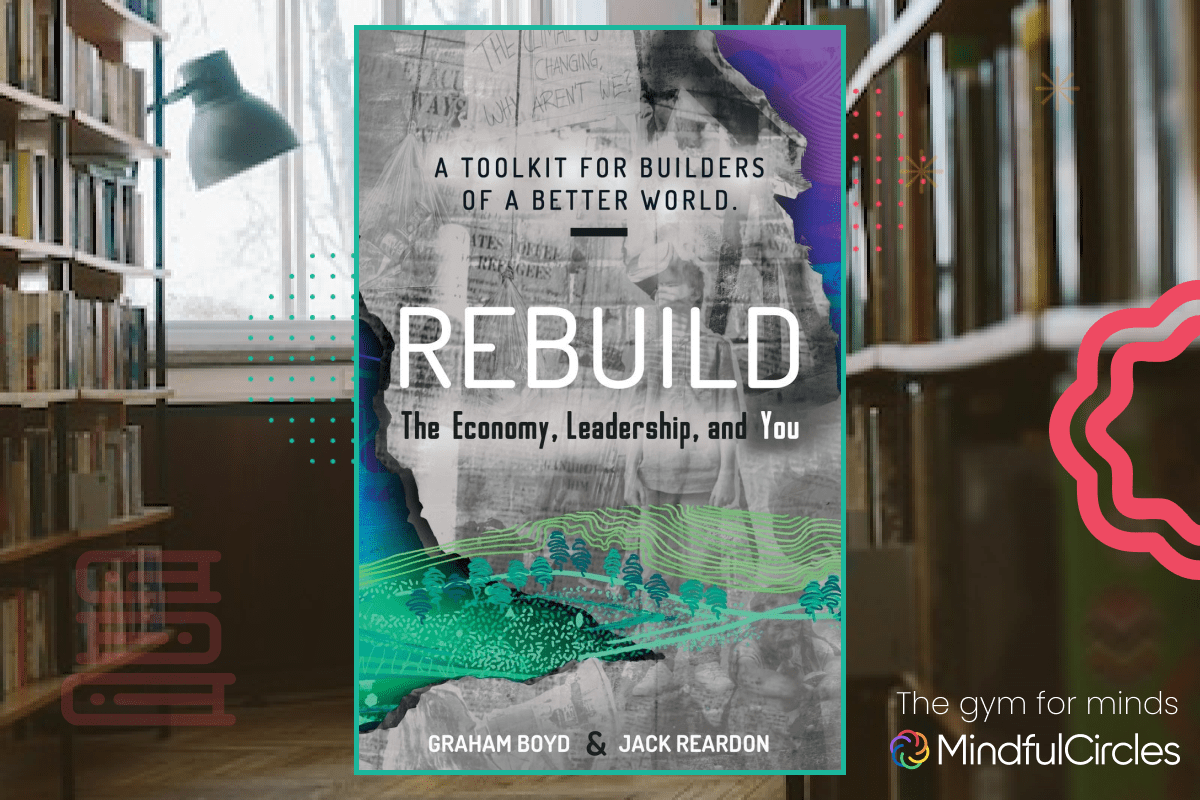

Author & Book Overview
Graham Boyd, PhD has lived three careers in one lifetime — particle physicist, manager at Procter & Gamble, and serial startup founder. He is the founder of Evolutesix, an ergodic finance holding company and regenerative startup ecosystem builder. His work sits at an unusual intersection: the hard mathematics of physics, the human complexity of organisations, and the moral urgency of the climate crisis.
Jack Reardon holds a doctorate in economics and has spent his career as a tireless critic of mainstream economic thinking. He is the founding editor of the International Journal of Pluralism and Economics Education, a global forum for rethinking how economics is taught and practised. He is a professor at the University of Wisconsin–Eau Claire, and the author of three economics textbooks.
Together, they wrote Rebuild in 2020, published by Evolutesix Books. The book was a finalist for the American Book Fest Best Book Awards. Powell’s Books It runs to 514 pages — part guidebook, part theoretical framework, part personal development manual. It has been praised by organisational psychologists, impact investors, sustainability founders, and economists alike.
One reviewer described it as what Adam Smith would write today as Part 3 of The Wealth of Nations. Another called it their Bible as a young entrepreneur trying to do meaningful work in a broken world.
A notable criticism: the book is dense. It covers particle physics, pluralist economics, developmental psychology, legal incorporation models, and sociocracy — sometimes all in the same chapter. Readers who approach it expecting a quick business book will be challenged. Those who stay with it describe it as transformative.
The Central Argument
The book opens with a provocation that sets the tone for everything that follows.
“Just as Picasso and Einstein realised a century ago, when problems are insoluble, it’s because the way we’re looking at the world is the problem.”
Boyd and Reardon argue that the climate crisis, inequality, and the dysfunction of our organisations are not problems we can solve by trying harder within the current system. The current system is the problem. And the current system was built on assumptions — about human nature, about value, about growth — that are simply wrong. Not morally wrong (though that too), but factually, scientifically wrong.
The solution, they argue, is not reform. It is rebuild. From the foundations up — starting with yourself.
The book is structured in three nested layers, each one containing the next:
You → Organisations → Economy
This structure is not arbitrary. It reflects the authors’ core conviction: you cannot build a regenerative economy out of unregenerate people, and you cannot build healthy organisations out of people who have not done the inner work. The outer and the inner are connected. Transformation is fractal.
Part One: You
The Lenses We See Through
Boyd and Reardon begin not with economics or leadership, but with perception. The reality we experience, they argue, is not objective. It is constructed — shaped by the lenses we use to interpret events, and the meaning-making stories we tell ourselves about what those events mean.
This is not pop psychology. They draw on serious developmental frameworks — particularly the work of Robert Kegan on adult development — to show that human beings are capable of growing more complex, more adaptive, more compassionate meaning-making over a lifetime. But most of us stop. We get a set of lenses that work well enough, and we use them forever.
The problem is that our current global challenges — climate, inequality, systemic failure — require a level of thinking more complex than the lenses most leaders currently use. We are trying to solve 21st century problems with 20th century minds.
The invitation of this section is radical in its simplicity: grow your lenses. Not by reading more, but by deliberately working with your own development as a human being. By noticing the stories you tell yourself. By sitting with discomfort long enough to let it teach you something.
For the Mindful Circles community, this section will land immediately. This is, in essence, what we do every Tuesday.
The Adaptive Way
One of the book’s most praised concepts is The Adaptive Way — a personal operating system for navigating uncertainty without losing yourself.
At the heart of the Adaptive Way is a simple but powerful shift: moving from seeking external validation toward trusting your own inner authority. Boyd and Reardon argue that in a complex, fast-changing world, no single person — not your mentor, your investor, your partner — can fully understand what you are capable of. Seeking their approval as a guide for your decisions is not humility. It is a trap.
“Seeking validation from others to build my business is a self-defeating trap, because no single person has the capability to understand fully what I, or any other person, is capable of.”
The Adaptive Way teaches practices for staying connected to your own discernment — while remaining genuinely open to others. This is the paradox at the heart of good leadership: self-trust and deep listening, held together.
Part Two: Organisations
Why Our Organisations Are Failing Us
The second layer of the book turns to organisations — and here Boyd’s background as a startup founder and physicist becomes central.
He argues that most organisations are built on a fundamentally flawed model: hierarchical, extractive, optimised for shareholder return, and designed to treat people as resources rather than as whole human beings. This is not a new critique. What is new is the precision and depth with which Boyd and Reardon trace this failure back to its roots — including the mathematical assumptions baked into how we model risk, value, and growth.
The conventional economic model of organisations assumes what physicists call ergodicity — roughly, that the average experience of a group over time reflects the experience of any individual within it. Boyd shows, drawing on cutting-edge work in ergodic economics (particularly the work of Ole Peters at the London Mathematical Laboratory), that this assumption is simply false. The way risk compounds over time for an individual is fundamentally different from how it averages out across a group. The entire architecture of modern finance and management is built on a mathematical error.
This is one of the book’s most intellectually startling contributions — and also one of the most practical. Because if the maths is wrong, then the incentive structures, the equity models, the investment logic — all of it needs to be rebuilt.
FairShares Commons
The alternative Boyd and Reardon propose for organisational structure is the FairShares Commons model — a legal and governance framework that distributes ownership, voice, and accountability across all stakeholders: founders, workers, investors, and the wider community.
FairShares Commons is not utopian idealism. It is a practical legal structure, already being used by organisations around the world, designed to make the interests of all stakeholders genuinely binding — not just aspirational. It is designed to be antifragile: to strengthen under stress rather than breaking.
Paired with sociocracy (or Holacracy) as a decision-making system, it creates organisations where authority is distributed, conflict is used as a driver of evolution rather than suppressed, and the organisation as a whole can learn and adapt.
Part Three: Economy
The Economy We Have — and Why It Fails
The final and largest layer of the book addresses the economy itself.
Boyd and Reardon begin from a deceptively simple definition: an economy is a method for providing living organisms with what they need to survive and thrive. By that measure, our current economy is failing — catastrophically. The climate crisis is the most visible evidence, but it is one symptom among many: rising inequality, ecological depletion, the breakdown of social trust.
The authors offer a rigorous critique of neoclassical economics — the dominant framework taught in universities and used by governments and central banks. They argue it is built on assumptions about human nature (purely rational, self-interested actors), about value (reducible to price), and about growth (always desirable, always possible) that are contradicted by physics, biology, psychology, and lived experience.
Their alternative draws on pluralist economics — an approach that integrates multiple frameworks and disciplines, treats the economy as a complex adaptive system, and measures success not by GDP but by genuine wellbeing for people and planet.
A Regenerative Economy
The vision Boyd and Reardon offer is what they call a regenerative economy — one that does not merely sustain, but actively restores. One that operates within planetary boundaries. One built from ecosystems of regenerative businesses rather than extractive corporations.
The book argues that an economy is just a method to provide living organisms with what they need to survive and thrive — and that we can create one that works for the planet, for people, and for profit, by reinventing the foundations rather than patching the regulations. Graham-boyd
The path to this economy, in their model, runs directly through the earlier sections of the book. Regenerative businesses require regenerative leaders. Regenerative leaders require inner development. The outer transformation is downstream of the inner one.
Key Concepts at a Glance
Ergodicity — the mathematical insight that individual outcomes over time cannot be predicted by group averages. The foundation of the book’s economic critique.
The Adaptive Way — a personal operating system for leading with self-trust and openness in conditions of uncertainty.
FairShares Commons — a legal and governance model that distributes ownership and voice across all stakeholders, built for regenerative organisations.
Antifragility — borrowed from Nassim Nicholas Taleb: systems that grow stronger under stress, rather than merely surviving it.
Developmental complexity — the idea, drawn from Robert Kegan, that human beings can grow more sophisticated meaning-making capacity across a lifetime, and that this growth is both possible and necessary.
Regenerative economy — an economic model designed not just to sustain, but to restore — people, communities, ecosystems.
What the Critics Say
The book’s admirers are many and passionate. Its critics tend to raise one of two concerns.
First: density. At 514 pages, covering physics, economics, psychology, law, and governance, it asks a great deal of the reader. Some find the breadth exhilarating. Others find it overwhelming.
Second: ambition. The scope of the claim — that rebuilding the global economy starts with rebuilding yourself — strikes some readers as either naive or grandiose. The authors’ response, implicit throughout, is that the alternative — tinkering with regulations while leaving the foundations untouched — is what has demonstrably failed.
A Final Reflection
There is something quietly radical about this book. It refuses the separation between the personal and the political, the inner and the outer, the individual and the systemic. It insists that you cannot build a regenerative world while remaining an unregenerate person — and that the work of becoming more whole, more adaptive, more compassionate is not a detour from the real work. It is the real work.
For a circle of people who are building startups, navigating burnout, and asking hard questions about what they are actually trying to create — this book offers both validation and challenge. Yes, the world needs rebuilding. And yes, it starts here. In this room. With each of us.
“Changing the world starts by exploring the depths of ourselves.”
The End
Reflection Question for the Circle
As you reflect on what we’ve read today, ask yourself:
“What part of this reading resonated most with where I am in life right now—and why?”
You’re welcome to share this in the Circle, or simply take a quiet moment to sit with it. If you are reading our blog online, simply leave a comment or connect with our community on social media.