

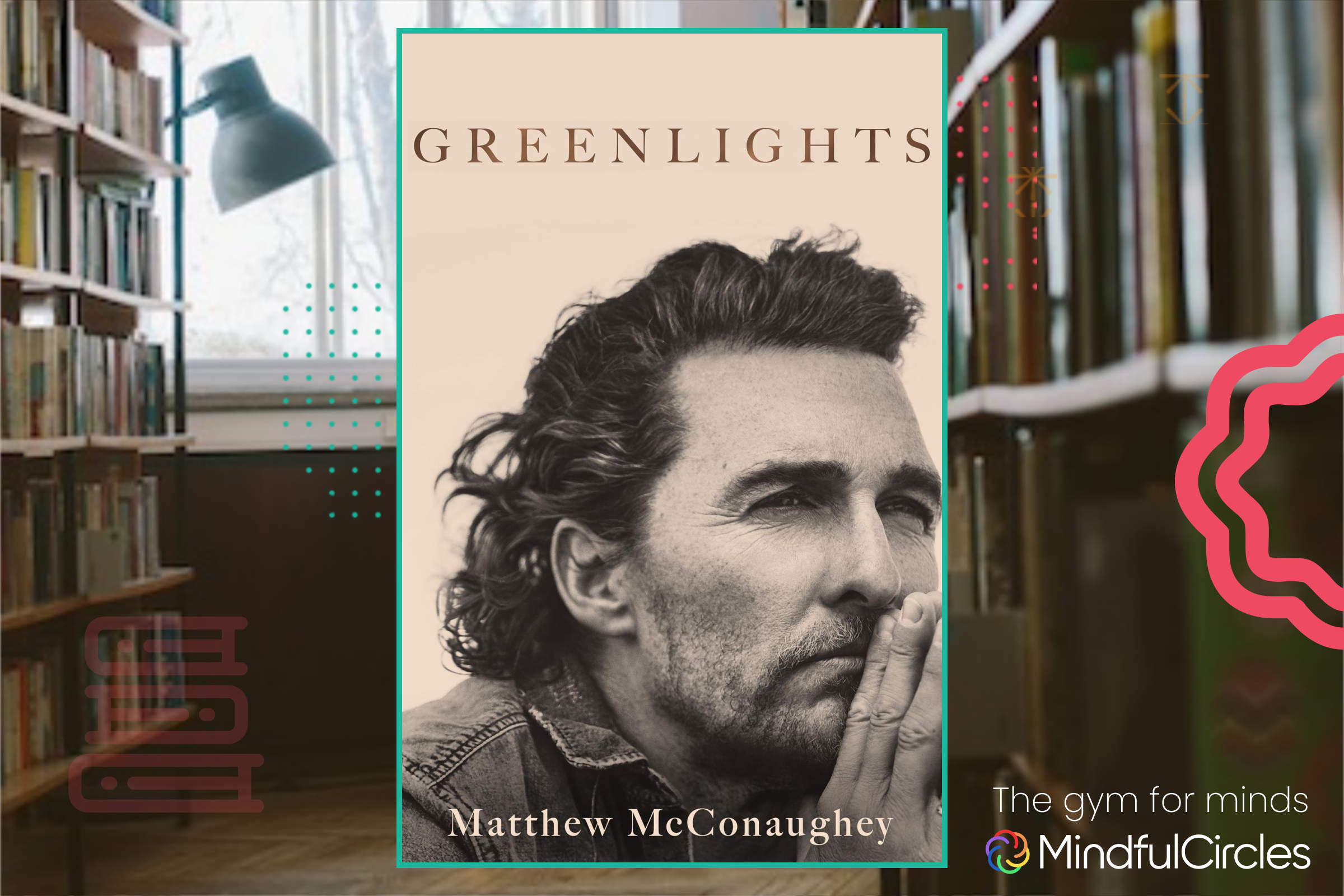

The Man Behind the Book
Matthew McConaughey is an American actor from Uvalde, Texas, born in 1969, best known for a career that swung from lightweight romantic comedies to the raw, awarded roles of his later years — including his Oscar-winning performance in Dallas Buyers Club. Greenlights, published in 2020, is his first book. It is not a conventional celebrity memoir. It was assembled from thirty-five years of diaries he had been keeping — scraps, notes, poems, bumper-sticker one-liners scribbled on napkins and beer coasters — and it reads less like an autobiography and more like a man laying out the clues he collected while trying to work out the riddle of his own life.
He calls the book a love letter to life. Its aim is disarmingly modest: not to tell you how to win, but to help you understand.
The Core Idea
The whole book turns on a single metaphor borrowed from the film world. In Hollywood, when a studio approves your project, they greenlight it — you can proceed. McConaughey takes that word and stretches it across a life. Greenlights are the moments when things align: approval, flow, a fresh start, a door swinging open at the right time.
But the deeper claim is about the other colours. Yellow lights and red lights — the pauses, the setbacks, the losses, the pain — are not the opposite of greenlights. Given enough time and the right response, they become them. The interruption that felt like failure turns out to be a redirection. The wall turns out to be a door.
“I don’t want to just see green lights. I want to catch them.”
The book is about the difference between those two verbs. Seeing is passive. Catching is a practice — a way of paying attention, positioning yourself, and reading your own life for the signals it is already sending.
Getting Relative with the Inevitable
The most useful idea in the book is a phrase McConaughey repeats: get relative with the inevitable.
Some things in life cannot be changed. The storm is coming, the person is gone, the door has closed. Fighting the inevitable is how we exhaust ourselves. But acceptance, in his telling, is not surrender. Once you stop wrestling what you cannot control, you free up all that energy to arrange what you can — to position yourself so that when the light does turn green, you are ready to move.
This is his quiet answer to the self-help cliché that you can bend reality to your will. You mostly can’t. What you can do is meet reality honestly, adjust your posture toward it, and keep yourself in a state where good fortune, when it arrives, finds you facing the right direction.
The Family That Forged Him
McConaughey grew up inside one of the more extraordinary households in modern memoir. His parents, Jim and Kay, divorced twice and married each other three times — a relationship built on both real violence and a fierce, inseparable love. His father was loud, physical, and ruled by an old-fashioned code McConaughey calls outlaw logic — a personal morality that sometimes ignored the rules of polite society but never betrayed itself.
The discipline was hard, sometimes brutal, and McConaughey — controversially — refuses to frame it as damage. He presents it instead as the forge that gave him his spine: accountability, keeping your word, showing up. Whether a reader accepts that framing is one of the honest tensions of the book. But the portrait of his parents’ unbreakable, volatile bond is its emotional centre — proof, to him, that something can look like it’s breaking and never actually break.
Just Keep Livin’
His father died suddenly, only days into the filming of Dazed and Confused — the small role that would launch McConaughey’s career. His dad had long promised the family he’d go out doing exactly what he loved most, and, improbably, that is how it happened.
The grief did not flatten McConaughey. It charged him. Out of it came the phrase that became his compass and, later, the name of the foundation he and his wife run for at-risk teenagers: just keep livin’. Not “move on.” Not “get over it.” Just keep going, keep choosing life, keep walking forward while carrying what you carry. It is one of the gentler and more durable ideas in the book — a way of holding loss without letting it stop you.
Finding His Frequency — The Unbranding
The section most relevant to anyone building a career is McConaughey’s account of walking away from the thing that was working.
By the late 2000s he was the reliable, bankable romantic lead — and quietly hollowed out by it. So he did something that looked, from the outside, like career suicide: he turned the rom-coms down. All of them. He told his team he would rather do nothing than do more of the same, and for nearly two years, nothing is roughly what came. The offers dried up. The money stopped.
He calls this unbranding — deliberately breaking the identity the market had assigned him so that a truer one could form. He also describes the search for his frequency: the specific pitch that is authentically yours, which you can only hear once you’ve turned down the noise of who everyone expects you to be. When the silence finally broke, the roles that came were the serious ones — the run of work now called the “McConaissance,” culminating in Dallas Buyers Club and an Academy Award. The lesson is not “quit your job.” It is that sometimes the greenlight only appears after you’ve had the nerve to sit in the dark.
The Form of the Book
It’s worth naming how strange and deliberate the book’s shape is. Between the stories sit McConaughey’s bumper stickers — compressed one-line aphorisms, often reproduced in his own handwriting — along with poems, prescriptions, and what he calls outlaw logic. One recurring one: less impressed, more involved. Another: persist, pivot, or concede — the three honest options in any hard situation. The scattered, improvisational form is not sloppiness; it mirrors the book’s argument that a life is not a straight line but a series of signals, caught or missed.
The Cost and the Critics
Greenlights was a commercial phenomenon and a genuinely well-told story, but it is not above criticism, and an honest reading names the objections.
The most serious is around the family violence. McConaughey’s insistence on reframing harsh, sometimes brutal treatment as pure character-building will read, to some, as a survivor’s necessary meaning-making — and to others as a troubling minimisation of harm. His year as an exchange student in Australia, which he treats as pivotal, was by his own account isolating and distressing, and some readers find his relentless optimism papers over pain that deserved to be sat with longer rather than converted so quickly into a lesson.
There is also the charge that the philosophy is easier to live by from where he stands. “Get relative with the inevitable” and “catch your greenlights” are wise, but a life with talent, striking good looks, and eventually enormous resources catches greenlights that never appear for most people. The book can tip from earned wisdom into charmed serendipity dressed as method. And the style — the swagger, the bongo-playing free-spirit persona, the mysticism of the wet dreams that send him to the Amazon and Mali — delights some readers and alienates others entirely.
The wisdom is real. So is the privilege it was learned inside. Both belong in an honest reading.
What the Book Is Really About
Underneath the traffic-light metaphor and the outlaw swagger, Greenlights is about one quiet discipline: paying attention to your own life. Reading its signals. Accepting what can’t be moved so you can move what can. Choosing, again and again, to keep living forward — and trusting that the reds and yellows you’re sitting in now may be greenlights that simply haven’t turned yet.
“The arrow doesn’t seek the target, the target draws the arrow.”
You don’t chase the good life into existence. You become the kind of person, doing the kind of work, that the good life is drawn toward — and then you stay awake enough to catch it when it comes.
End of Summary
What to sit with:
Here are three questions to reflect on, each rooted in a core concept from the book:
- (Getting Relative with the Inevitable) Where in your life are you still fighting a red light that isn’t going to change — and what would shift if you accepted the situation and repositioned yourself within it?
- (Yellow and Red Lights Turning Green) Think of a setback from your past that, in time, became a redirection. What did it eventually open — and does that change how you’re reading a hard moment you’re in now?
- (Unbranding & Finding Your Frequency) What “brand” or expectation — one others hold of you, or one you hold of yourself — might you need to turn down, even into silence, to move toward the life that’s actually yours?