

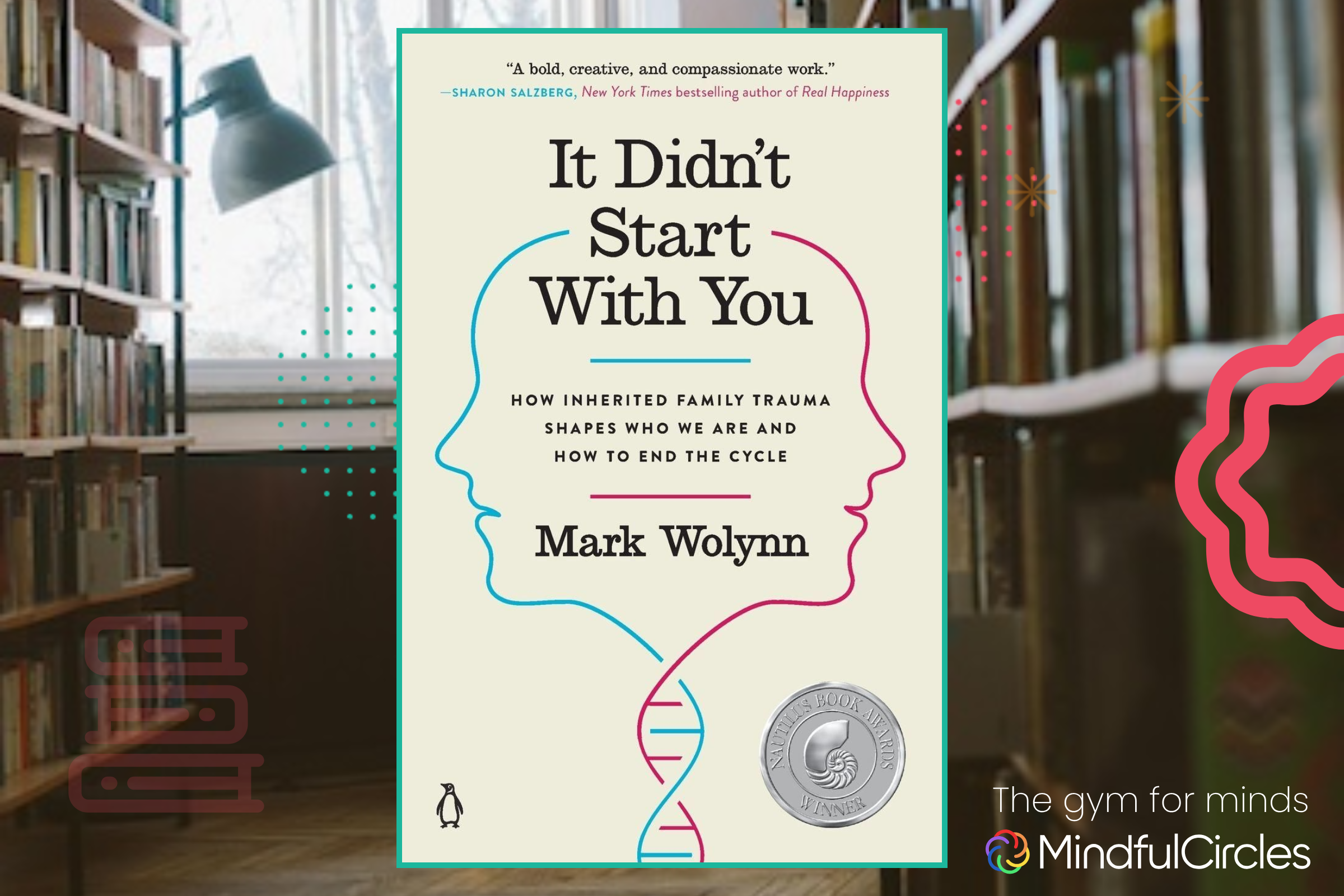

The Man Behind the Book
Mark Wolynn is an American writer and the director of the Family Constellation Institute in San Francisco. He is not a psychologist by training, and he did not set out to study trauma. He came to it because of something that happened to his eyes.
Years before he wrote this book, Wolynn began losing the sight in one eye. Doctors diagnosed a chronic form of retinopathy with no known cure and warned that his other eye could follow. When they had little more to offer than “it’s stress”, he left his life behind and went searching: through books, teachers and long periods of travel, including in Indonesia.
The teachers he met kept returning him to the same place: his relationship with his parents, and particularly with his mother. As he looked closer, he found a chain of loss running back through his family, including grandparents who had been orphaned young. As a boy, he had cried into his mother’s clothes when she went away. Years later, she told him that she had done exactly the same as a child. Wolynn describes the slow work of healing that bond, and says that over time his vision returned.
That experience became the foundation of his work. He trained in Family Constellations, a therapeutic method developed by the German therapist Bert Hellinger, and built his own approach to what he calls inherited family trauma. It Didn’t Start With You was published in 2016.
The Core Idea
Some of our fears do not seem to belong to us. A panic that arrives out of nowhere. A dread of being abandoned that no event in our own life can explain. A pattern that repeats across generations: the failed marriages, the estrangements, the sense of never quite being safe.
Wolynn’s argument is that some of these feelings may have started with someone else: a parent, a grandparent, even a great-grandparent, whose unresolved trauma was passed down without ever being spoken.
He points to two routes. The first is psychological and relational: children absorb the fears, silences and survival habits of the adults who raise them. The second, more controversial, is biological: emerging research suggesting that the effects of trauma might leave traces that can be passed to the next generation.
What goes unspoken in one generation is often lived out in the next.
The book’s hope is that by identifying where a pattern began, we can finally put it down.
The Family Body
Wolynn opens with a striking biological fact. When your mother was a five-month-old foetus in your grandmother’s womb, the cell that would become the egg that became you was already present inside her. In a very literal sense, three generations once shared one body.
He then turns to research. Studies by Rachel Yehuda at Mount Sinai found differences in stress hormone regulation in the children of Holocaust survivors. A widely discussed 2013 study at Emory University trained male mice to fear the smell of cherry blossom, and found that their offspring, and even their offspring’s offspring, reacted to the smell without ever having been trained.
For Wolynn, these studies suggest that the body may remember more than our own lifetime. Whether or not the biological mechanism holds up in humans, his deeper point stands on firmer ground: families pass on not only genes, but fears, silences and ways of surviving.
The Core Language Approach
The most practical part of the book is a method for tracing a feeling back to its source. Wolynn calls it the core language approach.
He asks readers to listen closely to the exact words they use for their deepest fear, especially the dramatic, emotionally charged ones. I’ll be all alone. They’ll leave me. I’ll lose everything. I’ll disappear. He calls this the core sentence.
These words, he argues, are often a clue. They may sound far too extreme for our own life, but they might fit perfectly the experience of someone earlier in the family: a grandmother who lost her children, a great-uncle who was sent away, a relative who fled a war and lost everything. When we find the person whose story matches our words, the fear often begins to make sense, and to loosen.
Wolynn guides readers through four parts: the core complaint (what troubles you most right now), the core descriptors (the words you use for your parents), the core sentence (your deepest fear, in your own words) and the core trauma (the family event it may connect to).
Listen to the words of your fear. They may be telling someone else’s story.
Healing the Broken Bond
Wolynn identifies a small number of patterns that often lie at the root of inherited trauma. One of the most important is an early break in the bond with the mother: a separation, an illness, a hospital stay, a mother who was physically present but emotionally overwhelmed.
He is careful here. The point is not to blame parents. Most parents passed on what was passed to them. The point is to see the chain clearly enough that we can stop it continuing through us.
The healing practices he offers are simple and often ritual-like. Writing a letter to a parent or ancestor. Placing a photograph somewhere you will see it. Speaking healing sentences, aloud or silently: I see you. I know what happened to you. I will live my life fully, and I will do it in your honour. Imagining the strength of earlier generations standing behind you, rather than their pain weighing on you.
The aim is not to erase the past, but to release ourselves from carrying what was never ours to carry.
The Cost and the Critics
It Didn’t Start With You has helped many people make sense of feelings they could not explain, and it has brought the idea of intergenerational trauma to a wide audience. It also needs to be read with care.
The scientific claims are the most contested part. The idea that trauma is passed down biologically through epigenetic changes is well supported in some animal studies, but evidence in humans is limited and debated. Yehuda’s Holocaust study was small, and researchers disagree about how to interpret it. The mouse study has been influential but not straightforwardly replicated. Many scientists caution that the book presents early, tentative findings with more confidence than they deserve.
The method also draws heavily on Family Constellations, which has little rigorous research behind it. Its founder, Bert Hellinger, made statements on gender, family hierarchy and abuse that many therapists find deeply troubling, and some practitioners have distanced the method from him.
There is also a risk in the idea itself. Not every fear has an ancestral origin. Tracing all our struggles to the past can become a way of avoiding the present, or of overlooking problems that need direct help, including from trained trauma therapists.
That said, the broader idea that trauma shapes families across generations, through parenting, silence and survival habits, is well established. The insight is real. The biology is uncertain. Both are part of an honest reading.
What the Book Is Really About
Stripped of the epigenetics and the constellations, It Didn’t Start With You is a book about one quiet truth: we are not only individuals. We are the latest chapter in a long family story.
That can feel heavy. It can also be a relief. If some of what you carry did not begin with you, then it is not proof that something is wrong with you. It is an inheritance, and an inheritance can be examined, honoured and, slowly, set down.
The book invites a particular kind of curiosity: to ask about your family’s history, to listen to the words of your own fear, and to treat your ancestors not only as the source of your wounds, but also as the source of your resilience. They survived something. That survival is also in you.
We carry our family’s pain. We also carry their strength. Healing is choosing which one leads.
End of Summary
What to sit with:
Here are three questions to reflect on, each rooted in a core concept from the book:
-
- (The Core Sentence) If you put your deepest fear into one sentence, in your own words, what would it be, and does it sound like your story or someone else’s?
- (Family Patterns) What pattern, around money, work, relationships or silence, do you notice repeating in your family, and what would it mean for it to stop with you?
- (Inherited Strength) What did your parents or grandparents survive, and what strength might you have inherited from them alongside the pain?