

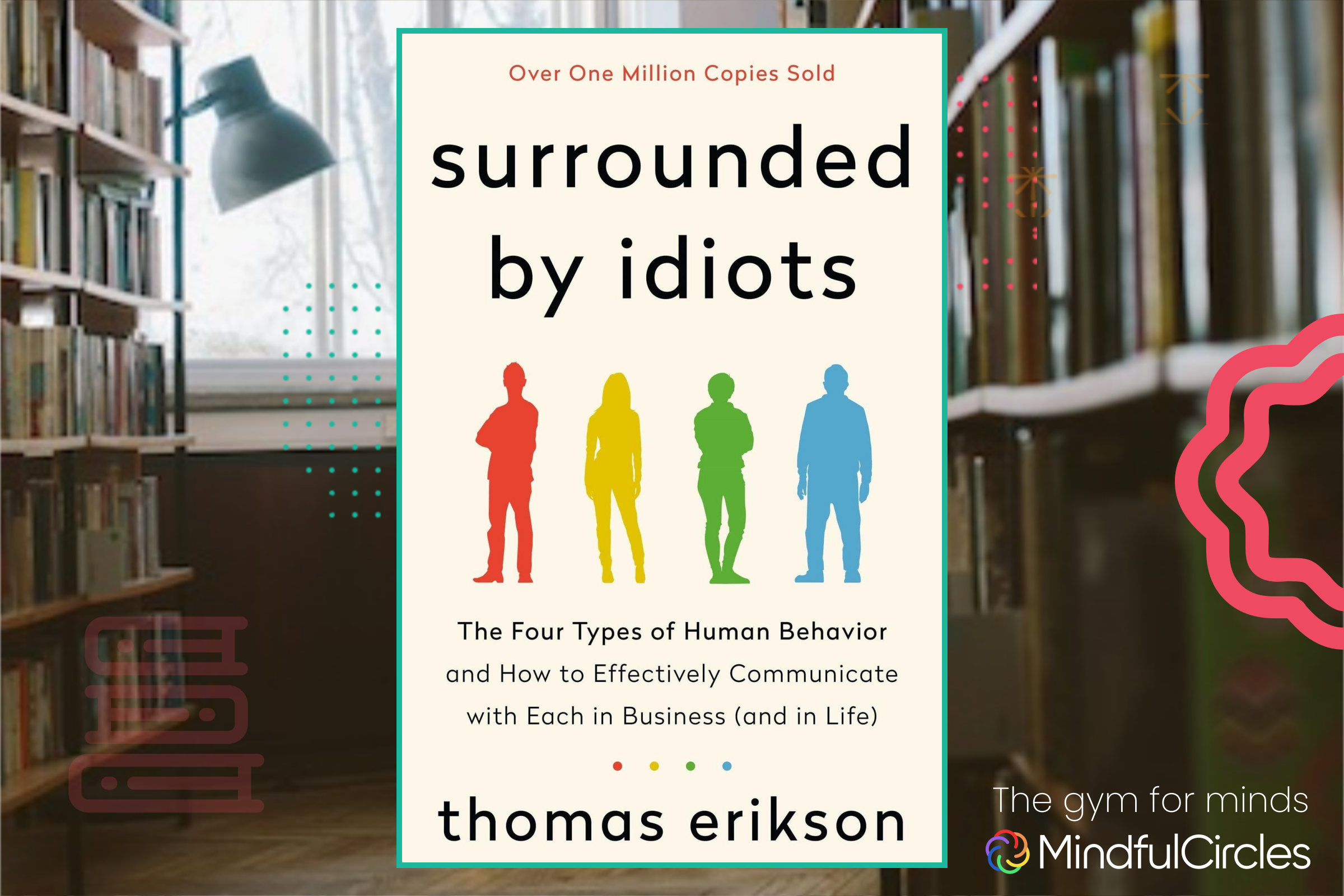

The Man Behind the Book
Thomas Erikson is a Swedish lecturer and writer who spent years training people in communication before he wrote anything at all. Omgiven av idioter appeared in Sweden in 2014, was picked up slowly, and then spread — translated into dozens of languages and sold in the millions. It has become one of the most widely read books on human behaviour of the last decade, and one of the most fiercely argued about.
The title came from a man Erikson once met who was, by every visible measure, doing well in life — and who was also convinced that he was surrounded by idiots. Everyone around him was slow, or careless, or impossible. Erikson’s quiet observation was that the man was not surrounded by idiots at all. He was surrounded by people whose way of being he had never learned to read, and had stopped trying to.
That is the whole book, in one sentence.
The Core Idea
We assume that the way we communicate is the neutral way. Clear, reasonable, obvious. When someone does not respond the way we expected, we do not usually conclude that we spoke a language they do not use. We conclude something about them. He never listens. She takes forever. They make everything into a drama. They never say what they actually think.
Erikson’s argument is that a large share of what we experience as other people’s failings is simply behavioural difference, misread as character. And that the cost of this misreading is enormous — in our work, our friendships, our families, and most quietly, in our own sense of being constantly misunderstood.
The message you send is not the message that matters. The message that matters is the one that is received.
His remedy is a simple map. Not a map of who people are, but of how people tend to behave — and how to speak in a way the other person can actually hear.
The Four Colours
Erikson borrows a framework from the 1920s. The psychologist William Moulton Marston — the same man who built an early lie detector and later created Wonder Woman — proposed in his 1928 book Emotions of Normal People that ordinary behaviour clusters around four patterns: dominance, inspiration, submission, and compliance. Over the following century this was turned into the assessment systems now known as DISC. Erikson’s contribution is to strip it down to four colours and make it usable at a dinner table.
Red — the driver. Direct, fast, decisive, competitive. Reds want results and they want them now. They interrupt, they push, they make the call. At their best: courage and momentum. At their worst: impatience, bluntness, running people over without noticing. To reach a Red, be brief. Lead with the conclusion. Skip the warm-up.
Yellow — the enthusiast. Expressive, optimistic, creative, persuasive. Yellows fill a room, generate ideas, and make things feel possible. At their best: energy and connection. At their worst: scattered, over-promising, talking more than listening, needing to be liked. To reach a Yellow, make space for the enthusiasm — and then write down what was actually agreed.
Green — the steady one. Calm, patient, loyal, an excellent listener. Greens are the reason groups hold together. At their best: stability and genuine care. At their worst: conflict-avoidant, slow to change, saying yes when they mean no. To reach a Green, do not spring things on them. Ask for their real opinion, and then leave enough silence for it to arrive.
Blue — the analyst. Precise, thorough, quality-driven, sceptical. Blues ask the question everyone else skipped. At their best: accuracy and depth. At their worst: perfectionism, coldness, decisions that never quite get made. To reach a Blue, bring detail. Bring evidence. Do not oversell, and do not rush them.
Nobody Is One Colour
The most frequently forgotten point in the book is the one Erikson makes early: almost nobody is a single colour. By his estimate only a small minority of people sit clearly in one, the large majority are a blend of two, and many carry three.
This matters more than it sounds. The moment the map becomes a set of four boxes, it stops describing human beings and starts replacing them. Erikson is explicit that the colours describe behaviour — what a person tends to do — not worth, not intelligence, not fixed identity. The map is meant to be held loosely, as a first guess that you then revise by paying attention.
The Adaptation Principle
If there is one practice in the book, it is this: the responsibility for being understood sits with the person speaking.
This is an uncomfortable idea, because it removes a favourite defence. I was perfectly clear is not a defence if the other person did not receive it. Erikson argues that adapting your delivery to the person in front of you is not manipulation and not self-betrayal. It is the ordinary work of communication — the same way you would speak differently to a child, a stranger, or someone grieving.
The practical version is small. Before a difficult conversation, ask one question: what does this person need in order to be able to hear this? Detail, or brevity? Reassurance, or the bottom line? Time to think, or a decision in the room?
The Person You Find Hardest
One of the more useful threads in the book concerns friction. Erikson notes that the people we find most difficult are often the ones furthest from us behaviourally — the Red who exhausts the Green, the Blue whose questions deflate the Yellow.
But there is a sharper version of the observation. Sometimes the person who irritates us most is not our opposite at all. Sometimes they are doing, loudly, the thing we do quietly. The map is useful not only for reading others, but for noticing which of our own patterns we have been unwilling to look at.
He also points to the gap between how we experience ourselves and how we land on other people. We know our intentions. Others only ever see our behaviour. Most conflicts live in that gap.
The Cost and the Critics
This is where an honest reading requires care, because the criticism of this book is serious and it comes from inside the field.
The DISC model has no meaningful scientific validation as a personality measure. Psychologists and researchers — particularly in Sweden, where the book began — have said so repeatedly and forcefully. Magnus Lindwall, a professor of psychology at the University of Gothenburg, has said the book is no more scientific than a horoscope. In 2018 the Swedish Skeptics Association gave Erikson their annual award for misleading the public. Critics have also noted that Erikson has no formal training in psychology or behavioural science, while having been marketed in some places as a behavioural expert.
The substantive objection is about the model itself. Decades of research suggest human traits vary along continuous dimensions rather than sorting into types, and the better-validated frameworks used in research look nothing like four colours. Colour systems are also vulnerable to the Barnum effect — descriptions broad enough that almost anyone recognises themselves, which feels like insight but is not evidence.
And there is a human cost to typing people. A label applied to someone else becomes a licence to stop looking. A label applied to yourself becomes an excuse — that’s just how Reds are. The very thing the book is meant to cure, it can quietly cause.
So here is the honest position. As science, the framework does not hold. As a prompt to pay attention — to notice that other people genuinely process the world differently, and to take responsibility for how you land — it has changed how a great many people speak to their colleagues, their parents, and their partners. Those two statements are both true, and neither cancels the other.
Read it as a lens, not as a diagnosis.
What the Book Is Really About
Strip away the four colours and what remains is an older idea, and a harder one.
The people you find impossible are, almost always, not impossible. They are running a different operating system, under pressures you cannot see, with a history you were not there for. The word idiot is simply what we say when we have stopped being curious.
You are not surrounded by idiots. You are surrounded by people you have not yet learned to read.
The book’s real invitation is not to categorise anyone. It is to interrupt the moment of judgement with a question instead — what is going on for them? — and to notice how rarely we ask it, and how much changes when we do.
End of Summary
What to sit with:
Here are three questions to reflect on, each rooted in a core concept from the book:
- (The Idiot Reframe) Who is the person you currently find hardest to deal with — and what would change if you assumed, just for a week, that they are not difficult but simply speaking a language you have not learned?
- (The Adaptation Principle) Think of a conversation that keeps going wrong. What does that person actually need in order to hear you — and what would it cost you to give it to them?
- (The Gap Between Intention and Impact) You know your intentions. Others only see your behaviour. What is one way you consistently land on people that you would be surprised — or uncomfortable — to hear described back to you?