

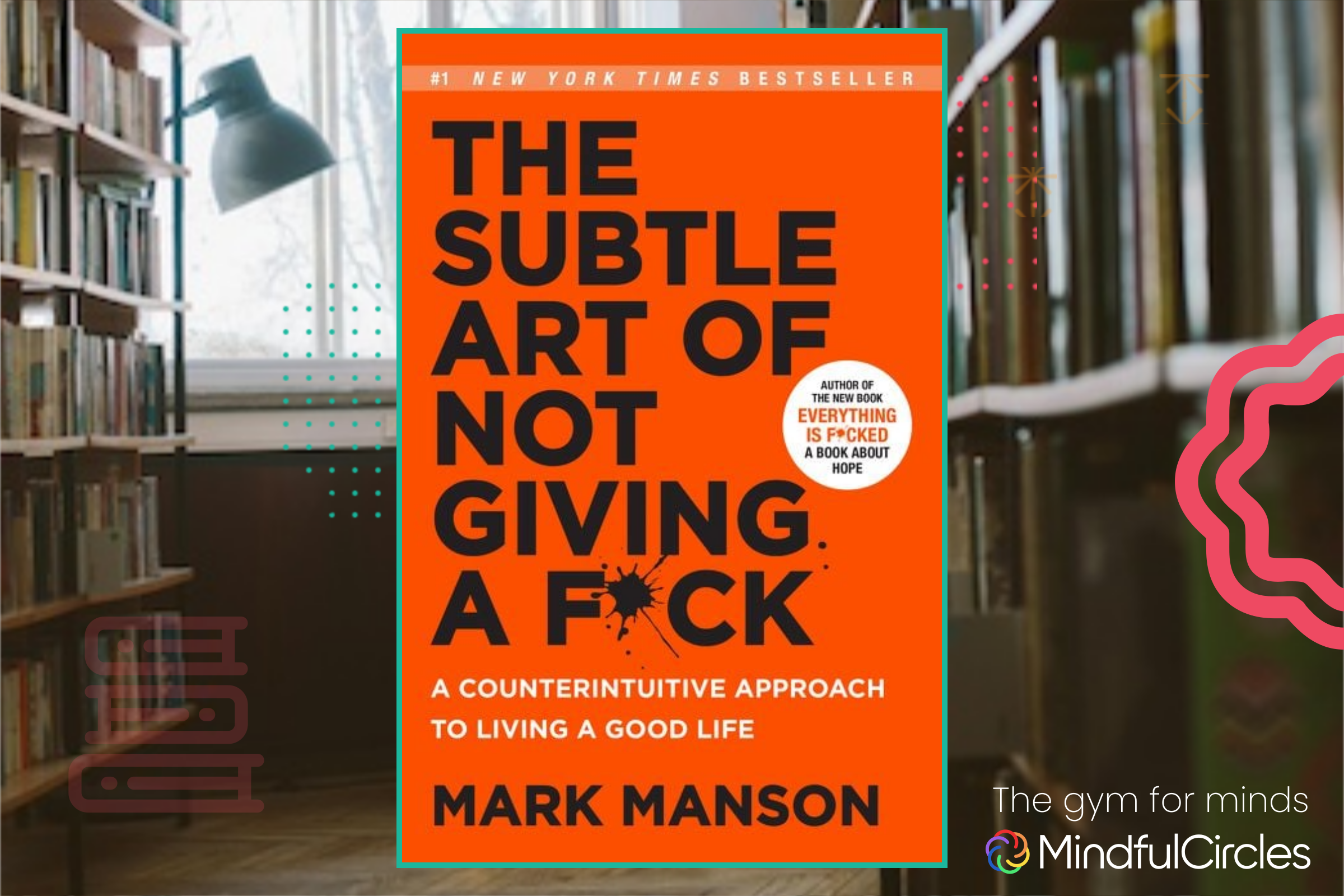

The Man Behind the Book
Mark Manson began as a blogger writing bluntly about dating, relationships, and the messier sides of being human. Over years he built a large audience drawn to a voice that was profane, honest, and allergic to the polished optimism of most self-help. The Subtle Art of Not Giving a F*ck, published in 2016, gathered that sensibility into a single book. It went on to sell over fifteen million copies and became one of the defining personal-growth titles of its decade — in large part because it argued the opposite of what the genre usually sells.
Manson’s project is not new wisdom so much as old wisdom in a contemporary register. Beneath the swearing sits a current of Stoic and Buddhist thought, dressed in the language of someone talking to you across a kitchen table rather than from a stage. That tension — ancient ideas, irreverent delivery — is the book’s signature, and the first thing readers either love or resist.
The Core Idea
The title is a trap, and Manson knows it. Not giving a f*ck does not mean indifference. It does not mean caring about nothing. It means the opposite: caring about less, so that what you do care about can be chosen rather than inherited, and held with real weight.
His starting point is that each of us has a limited supply of attention and concern. Most people spend it carelessly — worrying about strangers’ opinions, minor slights, the wrong number on a screen. The result is a life stretched thin across a thousand small anxieties. Maturity, for Manson, is learning to give your f*cks deliberately, to a short list of things that actually matter, and to stop apologising for the rest.
Caring about everything is not generosity. It is a failure to choose.
The Backwards Law
One of the book’s foundations is an idea Manson borrows from the philosopher Alan Watts: the harder you chase a positive experience, the more the chase itself reminds you of what you lack. Wanting to be happier underlines your unhappiness. Wanting to be calmer keeps you aware of your restlessness. The pursuit of a feeling can quietly manufacture its opposite.
The inversion is the interesting part. Accepting a negative experience — boredom, struggle, uncertainty — is itself a kind of positive experience, because it removes the second layer of suffering: the suffering about suffering. The person who is at peace with discomfort is, paradoxically, more comfortable than the person frantically trying to escape it.
The Feedback Loop from Hell
Manson gives this trap a name. We feel anxious, and then we feel anxious about being anxious. We feel angry, and then ashamed of our anger. We feel sad, and then guilty for feeling sad in a life that, on paper, looks fine. Each emotion spawns a judgement about the emotion, and the judgement is heavier than the original feeling ever was.
Much of modern culture, he argues, feeds this loop — by insisting that we should be exceptional, optimised, and relentlessly positive. The pressure to be extraordinary becomes its own source of misery. His counter is almost relieving in its plainness: most of us are fairly ordinary in most respects, and accepting that is not defeat. It is the ground from which a sane life can actually be built.
Happiness Comes from Solving Problems
Manson rejects the premise that happiness is a destination — a state you arrive at once the problems are gone. Problems are never gone. Solving one simply produces a better class of problem. The person with no money has money problems; the person with money has problems of meaning, relationship, and time. There is no problem-free life, only an upgrade of the problems you get to have.
So happiness is not the absence of problems. It is found in the act of solving them — in having problems you actually enjoy working on. The question is not how to escape struggle, but how to find struggle worth showing up for.
The Better Question: What Are You Willing to Suffer For?
This is, perhaps, the most quietly useful idea in the book. Everyone wants the good outcome — the fit body, the successful business, the great relationship. Wanting the reward is universal and tells you almost nothing about your life. The revealing question is the one underneath it: what pain are you willing to sustain to get there?
The body you admire is the body of someone who enjoys the gym, or at least tolerates it. The business you envy belongs to someone willing to absorb years of uncertainty and rejection. We do not get to choose only the prize. We choose, by what we are willing to endure, what we are truly committing to. Look at the suffering you keep returning to, Manson suggests, and you will see what you actually value — whatever you tell yourself otherwise.
Don’t ask what you want from life. Ask what pain you are willing to live with.
Choosing Your Values
If life is a series of problems and chosen struggles, then everything depends on which problems you choose — and that comes down to your values. Manson argues that most unhappiness is not a problem of effort but a problem of bad values: chasing things that are outside your control, fleeting, or measured entirely by other people.
He sketches the difference plainly. Poor values — being liked by everyone, always being right, feeling pleasure at all times, looking successful — set you up to fail, because they depend on things you cannot govern. Better values are reality-based and within reach: honesty, curiosity, building something, taking responsibility, being a good friend. The point is not to care less. It is to care about the right things, defined by whether you can actually live them.
Responsibility, Not Fault
One of the book’s sharpest distinctions is between fault and responsibility. Fault is about the past: who caused this. Responsibility is about the present: who responds to it now. Many things in a life are genuinely not your fault — the family you were born into, the harm done to you, the bad luck. But the response to all of it is still yours to make.
Manson frames this not as a burden but as a recovery of power. The moment you accept responsibility for a situation — however unfair its origin — you also accept the ability to change it. Waiting for the world to be at fault first is waiting forever. The work begins when you stop asking whose fault it is and start asking what you are going to do.
The Willingness to Be Wrong
Growth, in Manson’s telling, requires being comfortable with uncertainty — and most of us are not. We cling to our beliefs and our self-image because they feel like safety. He offers a rule of thumb he calls the law of avoidance: the more something threatens your sense of who you are, the harder you will avoid looking at it.
The remedy is to hold your identity loosely. The narrower and more rigid your story about yourself, the more fragile you become, because every challenge feels like an attack on your existence. The person who can say I might be wrong about this can keep learning. The person who cannot has quietly chosen comfort over truth.
…And Then You Die
The book closes where most self-help refuses to go: death. Manson writes about losing a close friend in his youth — a loss that stripped away his own posturing and forced the question of what a life is actually for. Confronting mortality, he argues, is not morbid. It is clarifying. Death is the one fact that makes our choices matter; without it, nothing we did would weigh anything at all.
Sitting with the fact of your own ending, he suggests, is the fastest way to find out what you truly give a f*ck about. Most of the things that consume our days shrink to nothing in that light. What remains — the people, the work, the way you treated others — is the short, real list worth giving your life to.
The Cost and the Critics
The book has been enormously popular and, predictably, divisive. The most common criticism is that its ideas are not original: it is Stoicism and Buddhism repackaged with profanity, and readers familiar with those traditions may find little that is new. Some experience the relentless swearing as a marketing device that wears thin, or as a tone that flattens genuinely subtle ideas into slogans.
There is also the risk of misreading. Not giving a f*ck can be taken as licence for apathy or callousness — the opposite of Manson’s actual argument, which is about caring more deliberately, not less. And like much of the genre, the book speaks most easily to readers who already have a baseline of stability; telling someone to simply choose better values lands differently when the obstacle is poverty, illness, or crisis rather than misplaced attention.
Even so, the core moves are sound. Choose your values consciously. Accept that struggle is the price of anything worthwhile. Take responsibility for your response to a life you did not fully choose. The packaging is loud. The substance, read honestly, is older and quieter than the cover suggests.
What the Book Is Really About
Stripped of the swearing, The Subtle Art of Not Giving a F*ck is a book about attention as a finite resource, and about the freedom that comes from spending it on purpose. It does not promise happiness, success, or transformation. It promises something smaller and more honest: that if you stop trying to care about everything, and choose instead a few things worth suffering for, you might build a life that feels like yours.
Its real subject is not indifference. It is commitment — the kind that only becomes possible once you have given yourself permission to let most things go.
Freedom is not having endless options. It is choosing what to commit to, and letting the rest fall away.
End of Summary
What to sit with:
Here are three questions to reflect on, each rooted in a core concept from the book:
- (What Are You Willing to Suffer For?) Pick something you say you want. What is the pain that comes with it — and are you actually willing to live with that pain, or only with the prize?
- (Choosing Your Values) Where in your life are you measuring yourself by something outside your control — being liked, being right, looking successful? What would a value you can actually live instead look like?
- (Responsibility, Not Fault) Name one situation that is not your fault, but is now your responsibility. What is the first small thing you could do to respond to it this week?
MindfulCircles
We just published the reflection in one minute short vide on TikTok, Instagran and YouTube:
instagram: https://www.instagram.com/reel/DaNPYTxtmWX/?utm_source=ig_web_copy_link&igsh=MzRlODBiNWFlZA==
TikTok: https://www.tiktok.com/@mindfulcircles.org/video/7657134956866473248?is_from_webapp=1&sender_device=pc
YouTube: https://youtube.com/shorts/TX_tMe1fRaE?si=RRIPBeMtYqTGLYC2