

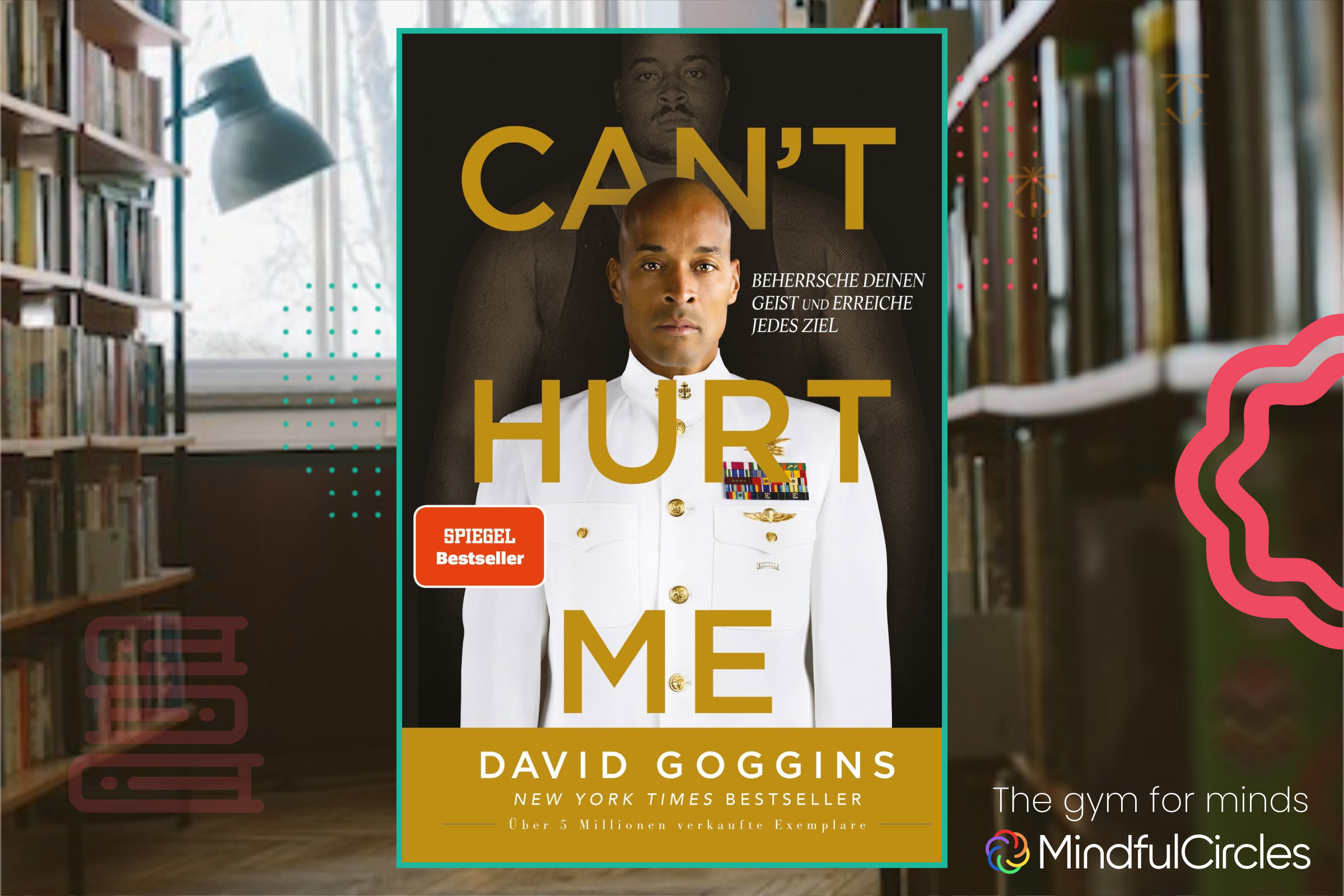
 The Man Behind the Book

David Goggins is a retired US Navy SEAL, ultra-endurance athlete, and one of the few people to have completed SEAL training, Army Ranger School, and Air Force Tactical Air Controller training. He has run some of the hardest ultramarathons on earth and once held the world record for pull-ups in 24 hours.
But the book is not really about any of that. It is about the man who, before all of it, was 297 pounds, sprayed cockroaches for a living, and was so afraid of his own life that he could not look at himself in the mirror.
Can’t Hurt Me is the story of how that man became the other one — and the method, brutal and uncompromising, he claims anyone can use.
The Core Idea
Goggins’ central argument is simple and unfashionable: most people are operating at about 40% of their capacity, and they have made peace with it.
He calls this the 40% Rule. When your mind tells you that you are done — exhausted, finished, broken — you are, on average, only 40% of the way to your actual limit. The other 60% is hidden behind discomfort, fear, and the stories we tell ourselves to avoid pain.
The book is a method for getting at that 60%. Not through motivation. Not through positive thinking. Through what Goggins calls callusing the mind — the deliberate, repeated practice of doing what is hard, especially when you do not want to.
“The only way you gain mental toughness is to do things you’re not happy doing.”
A Childhood That Should Have Ended Him
Goggins opens with his childhood, and he does not soften it. He grew up under a violent father who forced him and his brother to work long hours in the family roller-skating rink, beat his mother in front of him, and terrorised the household.
After his mother escaped with him to Indiana, he faced relentless racism in an almost all-white town. He suffered from a learning disability that went undiagnosed for years. He cheated his way through school. He developed a stutter, a skin condition, and a deep self-hatred he carried into adulthood.
By his early twenties he was working night shifts as an exterminator, eating boxes of doughnuts on the drive home, weighing nearly 300 pounds. He had given up.
The point of this opening is not sympathy. It is contrast. Goggins wants the reader to understand that the man he became was not built on a foundation of advantage. It was built on a foundation of refusing to accept the foundation he was given.
The Accountability Mirror
The first real practice in the book is what Goggins calls the Accountability Mirror.
One night, watching a documentary about Navy SEALs, he decided he wanted to become one. He weighed 297 pounds. He had three months to lose 106 pounds to qualify.
He stood in front of the mirror and, instead of telling himself encouraging things, told himself the truth. You are fat. You are lazy. You are a liar. You have wasted your life. He wrote his goals on Post-it notes and stuck them to the mirror. Every day, he had to face them.
The Accountability Mirror is the opposite of self-esteem culture. Goggins argues that lying to yourself about who you are is the deepest form of self-harm. The way out is not affirmation. It is unflinching honesty about the gap between who you are and who you want to be — held in your own face, every day, until you close it.
Callusing the Mind
The central metaphor of the book is the callused mind.
A callus forms when skin is repeatedly exposed to friction. The body’s response to pain is to build protection at exactly the point of contact. Goggins argues the mind works the same way. Every time you do something hard that you did not want to do — get up at 4am, finish the run, have the difficult conversation — you build a callus in your mind. Next time, the same friction hurts less.
The implication is the inverse: a mind that has only ever known comfort is soft. It will break at the first real test. Not because the person is weak, but because the mind has never been trained to absorb friction.
This is why Goggins is so suspicious of comfort. To him, comfort is not a reward. It is a slow erosion of the very capacity that makes a life worth living.
Taking Souls
When Goggins entered SEAL training — three times, because he kept failing the swim and getting injured — he developed a practice he calls Taking Souls.
The idea: when an instructor, an opponent, or life itself is trying to break you, you flip the dynamic. You smile. You ask for more. You perform beyond what they expected, in the exact moment they expected you to quit. You take their belief that they could break you, and you take it from them.
Taking Souls is, at its core, a reframing technique. The fixed expectation in any hard moment is that pain will produce surrender. Goggins teaches the reader to make pain produce the opposite — a deeper commitment, a more visible refusal, a quiet inner no that becomes a loud outer more.
“When you think you’re done, you’re only at 40% of your body’s capability.”
The Cookie Jar
Goggins also offers a tool for the moments when you are genuinely at your edge.
He calls it the Cookie Jar. The idea is to build, over time, a mental archive of every hard thing you have ever done — every fight you won, every test you survived, every time you kept going when you wanted to stop. When the next hard moment comes and the mind starts whispering you can’t, you reach into the jar and pull one out. I did that. So I can do this.
This is one of the gentler practices in the book, and one of the most psychologically sound. It is, essentially, a deliberate counter-archive to the brain’s negativity bias — which remembers failures and forgets victories. The Cookie Jar reverses that.
The Cost and the Critics
Can’t Hurt Me has been one of the most influential self-help books of the last decade, and Goggins himself does not present his method as cost-free. Throughout the book he describes stress fractures, a heart condition that required surgery, destroyed joints, strained relationships, and a first marriage that did not survive his obsession. He is honest that he is not a balanced or happy man — only an unbreakable one. “I don’t believe in balance,” he writes. “I believe in intensity.”
Critics have pushed further. Psychologists note that the method, applied without discernment, can shade into disordered behaviour — over-training, suppression of emotion, contempt for rest. What Goggins calls callusing the mind can, in other contexts, be called dissociation. Journalists have questioned some of his more dramatic athletic claims, though the broad outline of his life is verified. Others point out that Goggins writes as if his method is universal, when in fact it was forged by a particular nervous system and a particular trauma history — and may injure readers with chronic illness, mental health conditions, or histories that make more pain the wrong prescription. The book also sits inside a hyper-masculine, military register that some readers find inseparable from the wisdom, and others find a barrier to it.
The method works. The price is real. Both are part of an honest reading.
What the Book Is Really About
Stripped of the shouting and the push-ups, Can’t Hurt Me is a book about one question: what is the relationship between suffering and meaning?
Goggins’ answer is direct. Voluntary suffering — chosen, sustained, faced with open eyes — is not a punishment. It is a forge. The self that walks out of it is not the self that walked in. And the self that never walks into it remains, however comfortable, only a fraction of itself.
You do not have to agree with him to be changed by him. And that, perhaps, is the most Goggins thing about the book — it does not ask for your agreement. It asks what you are going to do.
“You are in danger of living a life so comfortable and soft that you will die without ever realising your true potential.”
End of Summary
What to sits with:
Here are three questions to reflect on, each rooted in a core concept from the book:
1. (The Accountability Mirror) What is one truth about your current life that you have been avoiding saying to yourself plainly?
2. (The 40% Rule) Where in your life are you treating your first “I can’t” as the final word — when it might only be the 40% mark?
3. (The Cookie Jar) Recall one moment when you kept going even though part of you wanted to stop. What did that moment teach you about who you are?
MindfulCircles
You cam view one minute summary of the book on:
Instagram https://www.instagram.com/reel/DY0R4L-Nd1B/?igsh=aWp1czJxeDdzbTdw
TikTok https://www.tiktok.com/t/ZP8p7kDPj/
& Youtube https://youtube.com/shorts/kIxHn8LFW-E?is=Xc6upeLzKbSggx0r