

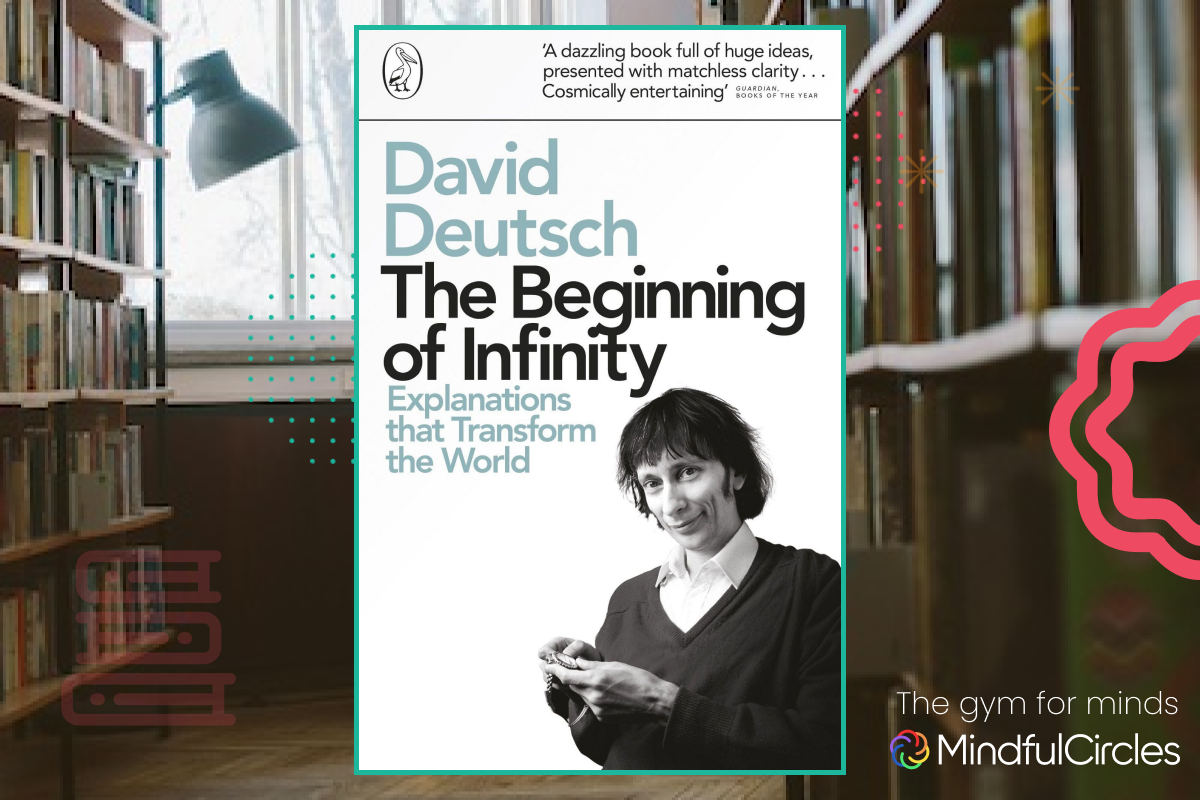

Explanations That Transform the World
Author & Book Overview
David Deutsch is a British physicist at the University of Oxford, where he works at the Department of Atomic and Molecular Physics. He is widely regarded as the father of quantum computing — his 1985 paper describing the first universal quantum computer is considered one of the most important theoretical contributions in modern physics. He is a Fellow of the Royal Society and a recipient of the Dirac Prize. His first book, The Fabric of Reality (1997), established him as one of the most original philosophical thinkers in contemporary science.
The Beginning of Infinity was published in 2011 by Viking / Allen Lane. It became an international bestseller and was shortlisted for the Royal Society Winton Prize for Science Books. It has sold hundreds of thousands of copies worldwide and has accumulated a devoted, almost cult-like readership among scientists, technologists, and philosophers — particularly in Silicon Valley and the rationalist intellectual communities online. Naval Ravikant, the investor and philosopher, has called it one of the most important books ever written. It remains a perennial recommendation among those who think seriously about epistemology, science, and the long-term future of civilisation.
The book is not easy. It is dense, ambitious, and at times deliberately provocative. It attempts nothing less than a unified theory of knowledge — arguing that the same principles underlying good scientific explanation also govern the growth of human culture, the nature of democracy, the reach of mathematics, the evolution of life, and the destiny of intelligence in the universe.
Notable criticisms: Some reviewers have found Deutsch’s prose demanding and his scope overwhelming. A handful of philosophers and scientists have pushed back on his treatment of quantum mechanics (he is a committed advocate of the Many Worlds Interpretation), his dismissal of empiricism as a sufficient foundation for science, and what some see as an excessive confidence in the power of reason alone. His political and social arguments — particularly his critiques of environmentalism, sustainability thinking, and what he calls “static” societies — have drawn sharp responses. But even his critics tend to acknowledge the book as genuinely original and philosophically serious.
A Note on the Book’s Structure
The Beginning of Infinity does not follow a linear argument so much as a set of interlocking themes that spiral and deepen across eighteen chapters. Deutsch returns repeatedly to the same core ideas — good explanations, the reach of knowledge, optimism, infinity — approaching them from different angles. The structure rewards reading straight through, but each chapter also stands on its own.
Part One: The Reach of Explanations
Chapter 1 — The Spark
Deutsch opens with a deceptively simple question: why did the Scientific Revolution happen when it did, and not before? Humans had been intelligent for hundreds of thousands of years. They had language, culture, memory, and curiosity. Yet sustained scientific progress — cumulative, self-correcting, exponential — began only in seventeenth-century Europe.
His answer is not about tools, geography, or luck. It is about a change in epistemology — in how people understood the nature of knowledge itself.
Before the Scientific Revolution, knowledge was assumed to come from authority: ancient texts, religious tradition, the accumulated wisdom of elders. What was old was trustworthy. What was new was suspicious. The goal of inquiry was to recover or interpret what had already been known, not to discover what had never been known.
The revolution changed this. It introduced the idea that knowledge must be tested against reality — not just argued about, but experimentally subjected to the possibility of being wrong. And crucially, it introduced the habit of seeking explanations, not just observations or predictions.
“The Enlightenment was a rebellion against authority in the field of knowledge.”
This is the spark Deutsch is interested in — not just empirical testing, but the deeper commitment to explanation: understanding why things are the way they are, not merely cataloguing that they are.
Chapter 2 — Closer to Reality
Here Deutsch develops what he considers the defining feature of good scientific knowledge: hard-to-vary explanations.
This is one of the book’s most important and original concepts. A good explanation, Deutsch argues, is not simply one that fits the data. Many explanations can fit the same data. What distinguishes a genuinely good explanation is that it is hard to vary — its details are not arbitrary. Each component is there for a reason, and changing any part of it would make the explanation fail.
He contrasts this with what he calls “bad explanations” — explanations that can be adjusted endlessly to accommodate any new fact, and therefore explain nothing at all.
His example: if you ask why the seasons change, and someone says “a god controls them,” this can be made to fit any observation. Warm summer? The god is pleased. Cold winter? The god is punishing. The explanation is infinitely adjustable. It has no content.
Compare this to the actual explanation — the tilt of the Earth’s axis, the geometry of the solar system. This explanation is hard to vary. Change the angle of the tilt, and you change the prediction. Change the distance from the Sun, and you change the prediction. Every detail matters. This is what makes it a genuine explanation.
“The key to understanding is not the collection of data but the creation of explanations.”
This criterion — hard to vary — becomes Deutsch’s master key. It applies not just in physics, but in philosophy, politics, culture, and ethics.
Chapter 3 — The Spark of Inspiration (The Jump to Universality)
Deutsch introduces one of his most striking ideas: jumps to universality.
Throughout history, systems designed for limited purposes have unexpectedly become capable of unlimited reach. Writing was invented to record grain inventories — and became capable of expressing any idea in any language. The Hindu-Arabic numeral system was designed to count — and became capable of expressing any number, any mathematical relationship. The computer was built to calculate artillery trajectories — and became a universal machine capable of simulating anything that can be simulated.
These are not gradual expansions. They are sudden, qualitative leaps — moments when a system crosses a threshold from limited to universal. The jump is never planned in advance, because the people building the system cannot imagine the full scope of what they are creating.
Deutsch argues that knowledge itself undergoes jumps to universality. The Scientific Revolution was one such jump — a shift from bounded, tradition-bound knowledge to an open-ended, self-correcting system capable in principle of explaining anything in the universe.
Chapter 4 — Creation
This chapter addresses a question that has puzzled philosophers since antiquity: where do new ideas come from?
Deutsch’s answer is direct and somewhat lonely: we do not know. Creativity — genuine novelty — cannot be reduced to an algorithm, a rule, or a prior cause. New ideas are genuinely new. They are not extrapolations from data. They are conjectures — guesses, leaps, imaginative acts that go beyond the evidence.
This is not mysticism. It is a philosophical point with deep implications. It means that knowledge cannot be justified from the bottom up — from sensory experience alone. The idea that we “read off” theories from observations is wrong. We impose theories on observations, and then test whether reality pushes back.
“All knowledge is created by a process of conjecture and criticism.”
This is Deutsch’s version of Popper’s epistemology, taken further. Knowledge grows not by accumulation, but by creative conjecture followed by critical elimination. We imagine something. We test it. If it survives, we keep it — tentatively. If it fails, we discard it and imagine something new.
Part Two: Persons
Chapter 5 — The Reality of Abstractions
One of the book’s philosophically bolder chapters. Deutsch argues that abstractions are real.
This sounds strange. We are accustomed to thinking of reality as the physical stuff — particles, fields, energy. Abstract things — numbers, laws, minds, justice — seem like useful fictions, concepts we invented to talk about reality without being real themselves.
Deutsch disagrees. He argues that the concept of emergence — the way higher-level patterns arise from lower-level physical processes — means that some abstract things are causally real. They genuinely affect what happens.
His famous example: a flame. If you describe a flame at the level of individual molecules, there is no flame — just a constantly changing collection of oxidising particles. But the flame is real. It has causal power. It can burn you. It cannot be replaced by any finite list of molecules, because the flame is a pattern, a process, an abstraction — and it is more real, in the sense of being causally explanatory, than the molecules alone.
The same applies to minds. A mind is not “just” the neurons that implement it. The mind — the pattern, the software — is real. And persons, as the seat of creativity and knowledge, have a unique status in the universe.
Chapter 6 — The Jump to Universality (Knowledge and Evolution)
Deutsch extends his framework to biological evolution, and draws a sharp distinction between genetic knowledge and human knowledge.
Both are knowledge in his technical sense — information that has been tested by reality and survived. DNA contains knowledge about how to build a body that survives in a particular environment. But genetic knowledge is static. It accumulates very slowly, through blind variation and selection. It cannot plan. It cannot criticise itself. It cannot leap.
Human knowledge is different in kind. Through language and reason, humans can create, criticise, and transmit explanations across generations without waiting for genetic change. This is the jump to universality: the capacity for open-ended knowledge creation.
This difference is not just quantitative — it is qualitative. It is why humans have transformed the planet in a few thousand years while other species have remained essentially unchanged for millions.
Chapter 7 — Artificial Creativity
Can machines be creative? This chapter addresses artificial intelligence directly — and Deutsch’s answer, in 2011, was a careful but definitive not yet, and not by this route.
True creativity, he argues, requires more than computation. It requires the capacity to generate genuinely new explanations — not to recognise patterns, not to interpolate, but to conjecture. Current AI systems (even the most sophisticated) are, in his framework, fast, powerful — but fundamentally non-explanatory. They do not understand. They have no model of why things are the way they are.
This remains one of the most debated sections of the book, given the dramatic development of large language models since its publication. Whether those systems constitute a step toward genuine creativity in Deutsch’s sense is a question the field is still wrestling with.
Part Three: The Jump to Universality in Society
Chapter 8 — A Window on Infinity
Deutsch introduces infinity — not just as a mathematical concept, but as a philosophical one.
The key claim: the reach of knowledge is unlimited. There is no problem in principle that knowledge cannot solve. There is no question that is, by its nature, permanently unanswerable. There is no physical barrier beyond which human understanding must stop.
This is a startling claim. We are used to thinking of human knowledge as limited — by our senses, by our intelligence, by the scope of our instruments. Deutsch disagrees. He argues that the same capacity for explanation that allowed us to understand distant galaxies and subatomic particles is, in principle, unlimited in its reach.
“Problems are inevitable. Problems are soluble.”
This is one of the book’s most quoted lines, and one of its deepest. The word soluble is doing enormous philosophical work here. Deutsch is not claiming all problems will be solved. He is claiming there is no category of problem that is, in principle, permanently beyond solution. The barrier to knowledge is never nature — it is always a failure of imagination, creativity, or resources.
Chapter 9 — Optimism
This chapter builds directly on the previous one. Deutsch argues that the correct philosophical stance toward the future is optimism — not as a mood, not as blind confidence, but as an epistemological commitment.
He distinguishes between two kinds of pessimism that he considers philosophically confused:
Static-world thinking: The assumption that resources are fixed, that growth must stop, that the future is a zero-sum competition for a finite pie. This is wrong because it ignores the transformative power of knowledge. Knowledge creates resources. Every energy crisis in history has been solved not by consuming less, but by discovering more — new technologies, new sources, new efficiencies that could not have been imagined from within the crisis.
Sustainability thinking (in its strong form): The attempt to freeze existing systems and prevent change in order to preserve them. Deutsch is uncomfortable with this, not because he dismisses environmental concern, but because he argues that static systems are fragile. Resilience comes from the capacity to respond and adapt — which requires the freedom to change, experiment, and correct mistakes.
His alternative: a philosophy he calls dynamic optimism — the conviction that problems will always arise, that we cannot predict which ones, and that the correct response is to build systems — scientific, political, cultural — that are good at identifying and solving problems when they arise.
Chapter 10 — A Dream of Socrates
A philosophical interlude in the form of an imagined dialogue with Socrates. Through this device, Deutsch explores the nature of knowledge, the limits of argument, and the relationship between reason and democracy.
The chapter argues that democracy is not justified because it produces the best leaders or the wisest decisions. It is justified because it is the only political system with a built-in mechanism for removing bad leaders without violence. This is the crucial criterion — not wisdom, but error-correction.
“What distinguishes a good political system is not that it is governed by the wise, but that it has the means to remove the unwise.”
A system that cannot correct its own errors — however confident it is in its rulers — is, philosophically speaking, as dangerous as a scientific theory that cannot be falsified. Both are closed against the possibility of learning.
Chapter 11 — The Multiverse
Deutsch returns to physics — specifically to quantum mechanics, which he considers the most important and most misunderstood theory in all of science.
He is a committed advocate of the Many Worlds Interpretation (also called the Everett Interpretation). In this view, quantum mechanics describes a universe that genuinely branches with every quantum event. There is no “collapse of the wave function” — no mysterious moment at which quantum superposition resolves into a single classical outcome. Instead, all outcomes occur — in parallel branches of the multiverse.
This is not metaphor. Deutsch argues that the Many Worlds Interpretation is the only honest reading of the mathematics of quantum mechanics. Other interpretations — Copenhagen, pilot wave, and others — are, in his view, philosophical evasions that avoid the implications of the theory rather than explaining them.
The multiverse is, for Deutsch, not a speculative add-on but a direct consequence of taking quantum mechanics seriously as an explanation. And crucially — it is the kind of hard-to-vary explanation that he prizes above all others.
Chapter 12 — A Physicist’s History of Bad Philosophy
One of the book’s most provocative chapters. Deutsch argues that much of what passes for philosophy of science — particularly the philosophical traditions that have surrounded quantum mechanics — has been actively harmful to scientific understanding.
His primary target is instrumentalism: the view that scientific theories are not descriptions of reality, but merely tools for making predictions. A theory is “true” if it predicts correctly; the question of what is really happening is dismissed as meaningless or unanswerable.
Deutsch finds this intellectually dishonest and practically dangerous. Instrumentalism, he argues, led generations of physicists to stop asking the most important question — what does quantum mechanics mean? — and to retreat into a comfortable but philosophically empty pragmatism (“shut up and calculate”).
He extends this critique to several other philosophical traditions, arguing that they systematically discourage the creation of genuine explanations in favour of measurement, prediction, and operationalism.
Part Four: The Unknowable and the Known
Chapter 13 — Choices
Deutsch applies his epistemological framework to ethics and moral knowledge.
His argument is that moral knowledge is not categorically different from scientific knowledge. Both grow through the same process: conjecture, criticism, and error-correction. We do not derive moral truths from authority, tradition, or pure reason. We create them — slowly, fallibly — through the same process of imaginative conjecture and critical testing that drives scientific progress.
This is a controversial position. It means that moral knowledge is objective — there are better and worse moral ideas, just as there are better and worse scientific theories — but it is not foundational. There is no bedrock moral principle from which everything else can be derived. Instead, moral understanding grows, corrects itself, and improves over time.
The abolition of slavery. The recognition of women’s rights. The gradual extension of moral consideration to previously excluded groups. These are not just changes in preference — they are advances in moral knowledge, just as the Copernican revolution was an advance in astronomical knowledge.
Chapter 14 — Why Are Flowers Beautiful?
A chapter that might seem whimsical but carries a precise philosophical argument. Why do humans find flowers beautiful? Why does natural beauty — sunsets, landscapes, birdsong — move us emotionally?
Deutsch’s answer involves the deep relationship between human minds and the structure of the universe. He argues that beauty is not arbitrary — it is a response to genuine structural features of reality. Mathematical beauty, in particular, is a reliable guide to good explanations. Physicists have long noticed that the most powerful theories tend to be the most elegant ones — not because the universe is designed for human aesthetics, but because elegance and simplicity are markers of the hard-to-vary explanatory structure that good theories possess.
Chapter 15 — The Evolution of Culture
This is among the most original chapters in the book. Deutsch introduces a framework for understanding culture using ideas borrowed from evolutionary biology — but with a crucial twist.
He distinguishes between two kinds of cultural ideas:
Memes (using Dawkins’ concept): Ideas that spread because they are good at replicating themselves — not because they are true or good for humans. Superstitions, rituals, taboos, fashion — these can spread and persist for millennia without being true or useful. They are, in a sense, parasitic on human minds.
Rational memes: Ideas that spread because they are genuinely good explanations — because they survive critical scrutiny, solve real problems, and improve the lives of those who hold them.
The distinction matters enormously. A static society — one dominated by anti-rational memes — resists change, suppresses criticism, and punishes deviation. It achieves a kind of stability, but it is the stability of stagnation. It cannot respond to new problems. It cannot grow.
A dynamic society — one with strong norms of criticism, openness, and conjecture — is unstable in a superficial sense. Ideas come and go. Traditions are questioned. But it is resilient in the deepest sense: it can respond to any problem, because it has the epistemological tools to identify and correct errors.
“The difference between a dynamic and a static society is not that one changes and the other doesn’t. It is that one has the capacity to correct its errors and the other doesn’t.”
Chapter 16 — The Evolution of Creativity
Deutsch explores the relationship between biological and cultural evolution in more depth, and argues that the emergence of human creativity was a phase transition — not just a quantitative increase in intelligence, but a qualitative change in the nature of knowledge.
Before humans, all knowledge on Earth was genetic — encoded in DNA, selected over millions of years. With humans, a new kind of knowledge appeared: explanatory, critical, creative knowledge that could grow without limit.
This, Deutsch argues, is the most important event in the history of life on Earth. Not the emergence of eukaryotic cells. Not the Cambrian explosion. Not the dinosaurs. The appearance of a species capable of open-ended knowledge creation is a genuinely unique event — and its implications are, in the most literal sense, infinite.
Part Five: The Beginning of Infinity
Chapter 17 — Unsustainable
Deutsch directly confronts ideas about limits — environmental, technological, civilisational. He challenges what he calls the sustainability paradigm: the idea that growth must stop, that resources are finite, that humanity is on a collision course with natural limits.
His argument is not that environmental problems are not real. It is that the solution is always more knowledge, not less growth. Every resource constraint in history has been transcended not by austerity but by discovery. Whale oil was replaced not by using less light but by finding kerosene. Scarcity of one thing is always, in principle, addressable by discovering something better.
He is also critical of the psychological and political dynamics of sustainability thinking — the tendency to view human activity as inherently destructive, and to treat the pre-industrial past as a baseline of virtue. Static societies, he argues, are not safe. They are fragile. The only robust response to an uncertain future is the capacity to respond creatively to whatever that future brings.
This chapter has drawn the most criticism — from environmentalists who feel misrepresented, and from those who argue Deutsch underestimates the time constraints of real ecological crises. The debate is genuine and unresolved.
Chapter 18 — The Beginning of Infinity
The final chapter brings together all the book’s themes.
Deutsch’s central claim, in full: we are at the beginning of an infinite journey of knowledge. Not near the end. Not in the middle. At the beginning.
This is both humbling and exhilarating. It means that almost everything we know is wrong, or incomplete, or a pale shadow of what future understanding will contain. It means that the problems we face — climate, disease, conflict, existential risk — are not signs that the journey is ending, but problems that can and will be solved if we maintain the institutions and habits of mind that make knowledge growth possible.
The enemy of the infinite journey is not ignorance. Ignorance can be corrected. The enemy is the conviction that knowledge has limits — that some problems are permanently beyond solution, that some questions must not be asked, that some authorities must not be challenged.
The book ends with a list of what Deutsch calls the Principle of Optimism — a set of commitments that follow from taking the unlimited reach of knowledge seriously:
- Problems are inevitable.
- Problems are soluble.
- The solutions create new problems.
- The solutions to those problems are also achievable.
- There is no limit to this process.
“The beginning of infinity is the moment when humans first began to seek good explanations. Everything that has happened since — and everything that will ever happen — flows from that.”
Key Concepts at a Glance
Hard-to-vary explanations — The hallmark of genuine scientific knowledge. A good explanation cannot be adjusted arbitrarily to fit any new fact. Its details are constrained by the explanation itself.
Jumps to universality — Moments when a limited system unexpectedly becomes capable of universal reach. Writing, numbers, computation, the Scientific Revolution.
The Beginning of Infinity — The thesis: knowledge has no fundamental limits. The Scientific Revolution was not the culmination of human understanding but its beginning.
Static vs. dynamic societies — Cultures defined by anti-rational memes resist change and cannot correct errors. Cultures defined by rational criticism can solve any problem, in principle.
The Many Worlds Interpretation — Deutsch’s preferred reading of quantum mechanics: all quantum outcomes occur in parallel branches of the multiverse. This is not speculation — it is, in his view, the honest reading of the mathematics.
Optimism as epistemology — Not a mood but a philosophical commitment. Problems are inevitable. Problems are soluble. The future is not fixed.
The End
Reflection Question for the Circle
As you reflect on what we’ve read today, ask yourself:
“What part of this reading resonated most with where I am in life right now—and why?”
You’re welcome to share this in the Circle, or simply take a quiet moment to sit with it. If you are reading our blog online, simply leave a comment or connect with our community on social media.