

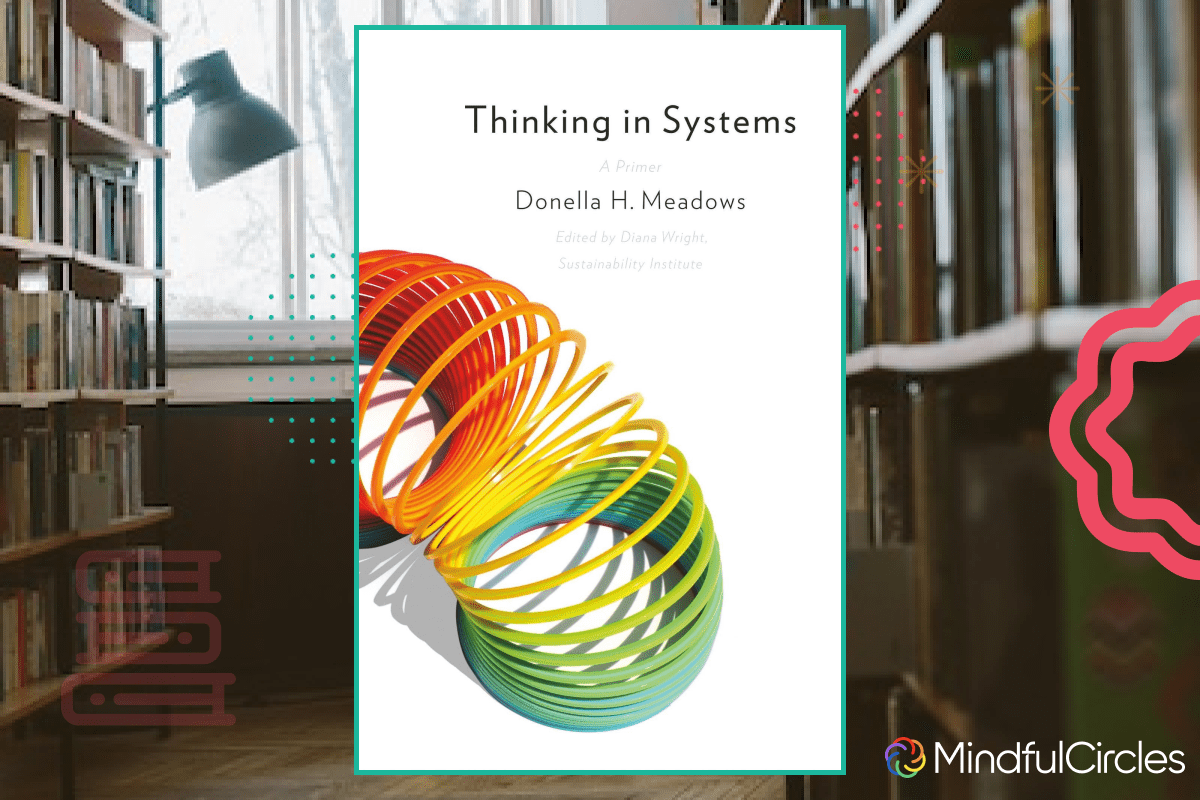

(Foundations of Systems Thinking)
Introduction: About the Author and the Book
Published posthumously in 2008, Thinking in Systems is a foundational introduction to systems thinking written by environmental scientist and systems analyst Donella H. Meadows. Meadows was one of the lead authors of The Limits to Growth, a groundbreaking 1972 report commissioned by the Club of Rome that modeled the long-term consequences of exponential economic and population growth on a finite planet.
Throughout her career, Meadows worked at the intersection of ecology, economics, and complex systems, helping policymakers, scientists, and leaders understand how interconnected systems behave over time. This book distills decades of her teaching into a practical and accessible guide to seeing the world not as isolated events, but as interconnected systems.
Unlike traditional business or self-development books, Thinking in Systems does not offer step-by-step advice. Instead, it provides a mental model for understanding complexity — how economies, organizations, ecosystems, and even personal habits function as dynamic systems shaped by feedback, delays, and structure.
The book has become widely influential across fields such as sustainability, public policy, entrepreneurship, and organizational design. It is often recommended in universities, leadership programs, and innovation circles because it fundamentally changes how people approach problems.
Critics sometimes point out that systems thinking can feel abstract or difficult to apply immediately. However, this abstraction is also its strength: once understood, it provides a lens that applies to nearly every domain of life.
The book is structured progressively:
-
First, it introduces what systems are and how they behave
-
Then, it explores common system patterns and failures
-
Finally, it presents leverage points — where to intervene effectively
Part I lays the foundation by helping us see the invisible structures behind everyday events.
Part I – System Structure and Behavior
The Systems Lens
At the heart of Thinking in Systems, Donella H. Meadows introduces a fundamental shift in perception: moving from seeing isolated events to seeing interconnected systems.
Most people interpret the world through events:
-
a failed product
-
a market crash
-
a team conflict
But Meadows argues that these are only surface-level symptoms. Beneath them lie structures — feedback loops, delays, and relationships — that actually drive behavior.
She writes:
“The behavior of a system cannot be known just by knowing the elements of which the system is made.”
This is the essence of the systems lens:
structure creates behavior.
For founders, leaders, or individuals, this means that most problems are not caused by people — but by the systems they operate within.
ONE: The Basics
Meadows begins by defining what a system actually is.
A system consists of:
-
elements (the parts)
-
interconnections (how parts relate)
-
a function or purpose (what the system does)
While most people focus on elements, Meadows emphasizes that the interconnections and purpose are far more important.
“A system is more than the sum of its parts.”
This explains why changing individual parts often fails to change outcomes. You can replace people, tools, or processes — but if the structure remains the same, the behavior will repeat.
Stocks and Flows
To understand systems, Meadows introduces stocks and flows.
-
Stocks are accumulations (e.g., money, users, knowledge)
-
Flows are rates of change (e.g., revenue, growth, learning)
She explains:
“A stock is the memory of the history of changing flows within the system.”
This is a crucial insight:
what we see today is the result of past flows over time.
Startup lens:
-
Your user base = past acquisition + retention
-
Your culture = accumulated behaviors
-
Your reputation = long-term signal, not a single event
This is why quick fixes rarely work — stocks change slowly.
Feedback Loops
Systems behave the way they do because of feedback loops.
Reinforcing Loops (Growth or Collapse)
These amplify change.
“Reinforcing feedback loops are self-enhancing.”
Examples:
-
Viral growth
-
Network effects
-
Compounding learning
But reinforcing loops also work in reverse:
-
churn → lower trust → more churn
Balancing Loops (Stability)
These resist change and create equilibrium.
Examples:
-
Market corrections
-
Habit stabilization
-
Organizational inertia
Balancing loops are why change is often harder than expected — systems naturally push back.
Delays
Delays are one of the most misunderstood elements of systems.
They represent the time between action and visible outcome.
“Delays are ubiquitous in systems.”
When delays are ignored:
-
we overreact
-
we abandon strategies too early
-
we misinterpret results
Founder example:
You improve product → retention improves → but only months later
If you expect instant results, you might incorrectly pivot.
Why Systems Behave the Way They Do
Meadows emphasizes that systems must be understood over time, not as snapshots.
“Events are the least important part of a system.”
Instead, systems thinkers focus on:
-
patterns
-
trends
-
underlying structure
This is a shift from reactive thinking → to structural thinking.
TWO: A Brief Visit to the Systems Zoo
In this chapter, Meadows introduces common system behaviors — recurring patterns seen across industries, organizations, and societies.
These patterns are not random — they emerge from structure.
Exponential Growth
Driven by reinforcing loops, systems can grow rapidly — until they hit limits.
Examples:
-
startup growth
-
population growth
-
viral content
But growth is never infinite.
Limits to Growth
Eventually, every system encounters constraints.
“No physical system can grow forever.”
Growth slows because of:
-
resource limits
-
competition
-
internal inefficiencies
Startup example:
Early growth feels easy → later growth requires disproportionately more effort.
Oscillation
Systems often swing between extremes due to delays and overcorrections.
Examples:
-
boom and bust cycles
-
hiring → layoffs → rehiring
-
overproduction → shortage
Oscillation happens when actors react too late or too aggressively.
Collapse
If reinforcing loops push growth beyond limits, systems can collapse.
Examples:
-
over-leveraged companies
-
ecosystems under stress
-
unsustainable business models
Collapse is not sudden — it is the result of ignored feedback over time.
The Deeper Insight of Part I
Part I fundamentally rewires how we interpret reality.
Instead of asking:
-
“What went wrong?”
We begin asking:
-
“What system produced this outcome?”
This shift leads to:
-
better diagnosis
-
better decisions
-
more sustainable solutions
Part II – Systems and Us
If Part I helped us see systems, Part II confronts a harder truth:
we are not neutral observers of systems — we are part of them, and often the source of their dysfunction.
This section explores:
-
why systems work so well
-
why they still surprise us
-
and the recurring traps we fall into
THREE: Why Systems Work So Well
Before focusing on failure, Meadows begins with a counterintuitive observation:
systems are remarkably good at maintaining stability and coherence.
Despite complexity, most systems:
-
self-organize
-
adapt
-
and persist over time
She writes:
“Systems have an astonishing ability to maintain themselves.”
This ability comes from feedback loops, redundancy, and adaptation.
Resilience
Resilience is a system’s ability to survive disturbance and return to function.
Examples:
-
ecosystems recovering from shocks
-
companies surviving crises
-
individuals adapting to change
Resilient systems are not rigid — they are flexible.
Key insight:
Efficiency often reduces resilience.
Systems that are optimized too tightly lose their ability to absorb shocks.
Startup example:
A company that optimizes only for growth may lack resilience when markets shift.
Self-Organization
Systems can evolve and restructure themselves without external control.
This is called self-organization.
“Self-organization means changing any aspect of a system to adapt to new conditions.”
Examples:
-
biological evolution
-
market innovation
-
organizational learning
This is the source of creativity and innovation.
Hierarchy
Most systems are structured in hierarchies — subsystems within systems.
Examples:
-
cells → organs → bodies
-
teams → departments → companies
Hierarchy allows complexity to be manageable.
But it also introduces challenges:
-
misalignment
-
communication breakdown
-
local optimization vs global outcomes
The Core Tension
Here lies a key tension in systems:
-
Stability vs adaptability
-
Efficiency vs resilience
Strong systems balance both — but most human-designed systems over-optimize one at the expense of the other.
FOUR: Why Systems Surprise Us
Despite their logic, systems often behave in ways that seem irrational or unexpected.
Meadows argues that this is not because systems are unpredictable — but because our mental models are incomplete.
“We don’t see the world as it is. We see the world as our mental models tell us it is.”
Mistaking Events for Causes
We tend to focus on visible events instead of underlying structures.
Example:
-
“Sales dropped → marketing failed”
But the real cause may be:
-
product issues
-
customer experience
-
long-term trust erosion
This leads to symptom-level solutions instead of systemic ones.
Ignoring Delays
We act as if results should be immediate.
When delays are present:
-
we overcorrect
-
we abandon strategies prematurely
Example:
Cutting investment because results are slow — just before they would have appeared.
Narrow Boundaries
We define systems too narrowly.
We ignore:
-
external dependencies
-
unintended consequences
-
interconnected systems
This leads to decisions that optimize one part while harming the whole.
Nonlinear Relationships
Systems are rarely linear.
Small actions can have:
-
no effect
-
delayed effect
-
massive effect
And large actions may:
-
do very little
This is why intuition often fails in complex systems.
The Illusion of Control
We often believe we are in control of systems we barely understand.
Meadows warns that control is limited — especially in complex environments.
This insight is crucial for leadership:
-
not everything can be predicted
-
not everything can be controlled
But systems can still be influenced intelligently.
FIVE: System Traps… and Opportunities
This is one of the most practical and powerful chapters in Thinking in Systems.
Meadows outlines recurring patterns — system traps — that cause failure across organizations, economies, and personal lives.
Policy Resistance
When interventions fail because the system pushes back.
“The system has a way of resisting changes.”
Example:
Pushing teams harder → burnout → lower performance
Tragedy of the Commons
Shared resources are overused because individual incentives are misaligned.
“Each actor has an incentive to exploit the system.”
Startup example:
Over-optimizing for user attention → long-term platform degradation
Drift to Low Performance
Standards gradually decline as expectations adjust.
Example:
Accepting “good enough” repeatedly → mediocrity becomes normal
Escalation
Actors compete in ways that reinforce each other negatively.
Example:
Price wars → shrinking margins → weakened industry
Success to the Successful
Resources flow to winners, reinforcing inequality.
Example:
Big companies attract more talent → become even stronger
Addiction
Short-term fixes replace long-term solutions.
“The intervention makes the system more dependent on itself.”
Example:
Relying on paid ads instead of building real product value
Rule Beating
Rules are followed in form but violated in spirit.
Example:
Teams optimizing for KPIs instead of real outcomes
The Key Insight of Part II
Part II reveals something uncomfortable but essential:
👉 We are often the reason systems fail.
Not because we are irrational — but because:
-
we think in events, not structures
-
we ignore feedback and delays
-
we optimize locally, not systemically
But the same patterns that create failure also reveal opportunities.
Once seen clearly, they can be redesigned.
Part III – Creating Change — in Systems and in Our Philosophy
SIX: Leverage Points — Places to Intervene in a System
This chapter is the intellectual core of the book.
Donella H. Meadows introduces the concept of leverage points — specific places within a system where a small shift can produce large changes.
But she immediately challenges a common intuition:
👉 The places where we think change happens are often the least effective.
Low-Leverage Interventions (Shallow Changes)
Most people intervene at the level of parameters:
-
budgets
-
taxes
-
targets
-
incentives
These are easy to adjust but rarely transformative.
For example:
-
increasing marketing spend
-
adjusting pricing
-
setting new KPIs
These may produce short-term results, but they do not fundamentally change system behavior.
Feedback Loops
More powerful leverage comes from changing feedback loops.
“A feedback loop that is missing or weak can be strengthened.”
This means:
-
reinforcing positive loops (growth, learning)
-
weakening harmful loops (burnout, churn)
Startup example:
Improving product quality → increases retention → drives organic growth → reduces reliance on paid acquisition.
Instead of pushing harder, you redesign the system.
Information Flows
Another powerful leverage point is who knows what, and when.
Changing information flows can transform behavior without changing incentives.
Examples:
-
transparency dashboards
-
user feedback loops
-
internal communication systems
Insight:
People behave differently when they have better visibility into consequences.
Rules of the System
Rules — formal or informal — shape behavior deeply.
These include:
-
laws
-
company policies
-
cultural norms
Changing rules can have significant impact, but still operates within the system’s deeper structure.
Self-Organization
Even deeper is the system’s ability to evolve itself.
Systems that can:
-
learn
-
adapt
-
restructure
are far more powerful than rigid ones.
Encouraging self-organization means:
-
empowering teams
-
decentralizing decision-making
-
allowing experimentation
Goals of the System
At an even deeper level lies the goal.
Every system behaves according to its purpose.
“Changing the goal of the system changes everything.”
Startup example:
-
Goal = “maximize growth” → aggressive scaling, short-term focus
-
Goal = “maximize customer value” → product quality, retention, trust
Same company. Completely different behavior.
Paradigms (The Deepest Leverage)
The most powerful leverage point is the mindset or paradigm from which the system arises.
“The mindset or paradigm out of which the system arises… is the source of the system.”
This includes beliefs like:
-
what success means
-
what is valuable
-
what is possible
Changing paradigms transforms entire systems.
Examples:
-
from extraction → sustainability
-
from competition → collaboration
-
from control → adaptability
Transcending Paradigms
Meadows goes even one step further.
The highest level of thinking is not just adopting a new paradigm — but recognizing that all paradigms are limited.
This creates intellectual flexibility:
-
the ability to shift perspectives
-
the ability to question assumptions
-
the ability to adapt continuously
This is rare — but incredibly powerful.
SEVEN: Living in a World of Systems
The final chapter moves from theory to philosophy.
It answers a deeper question:
👉 How should we live in a world we cannot fully control?
Humility
The first principle is humility.
No one fully understands a system.
“We can’t control systems or figure them out completely.”
This challenges the illusion of control — especially relevant for leaders and founders.
Learning and Adaptation
Because systems are complex, we must:
-
experiment
-
observe
-
adjust
Rather than seeking perfect solutions, we engage in continuous learning.
Expanding Time Horizons
Systems unfold over time.
Short-term thinking often creates long-term problems.
Living systemically means:
-
thinking in years, not days
-
considering second- and third-order effects
Celebrating Complexity
Instead of fearing complexity, Meadows encourages us to embrace it.
Complex systems:
-
create diversity
-
enable innovation
-
sustain life
Trying to oversimplify them often causes harm.
“Dancing with Systems”
Meadows concludes with one of the most beautiful metaphors in the book:
“We can’t control systems… but we can dance with them.”
To “dance with systems” means:
-
listening instead of forcing
-
adapting instead of controlling
-
understanding instead of reacting
It is a shift from domination → to participation.
Final Reflections on
Thinking in Systems
Taken as a whole, Thinking in Systems offers not just a framework, but a transformation in how we think.
It teaches us that:
-
problems are rarely isolated
-
behavior comes from structure
-
quick fixes often fail
-
meaningful change requires depth
For founders, leaders, and individuals, this perspective is profound.
It moves us from:
-
reacting → to understanding
-
controlling → to influencing
-
optimizing parts → to designing systems
And perhaps most importantly, it teaches patience — because real change happens slowly, but deeply.
The End
Reflection Question for the Circle
As you reflect on what we’ve read today, ask yourself:
“What part of this reading resonated most with where I am in life right now—and why?”
You’re welcome to share this in the Circle, or simply take a quiet moment to sit with it. If you are reading our blog online, simply leave a comment or connect with our community on social media.