

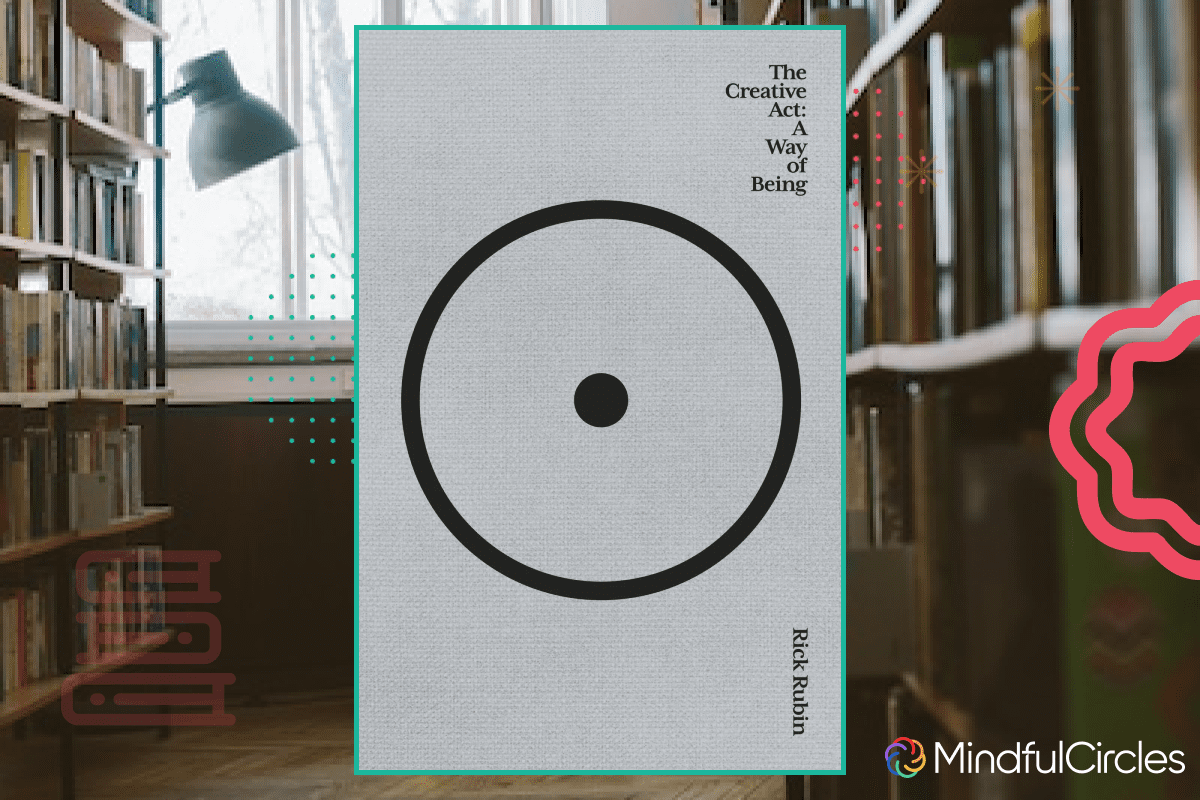

About the Author: Rick Rubin
Rick Rubin is widely regarded as one of the most influential music producers in history. Co-founder of Def Jam Recordings, he shaped entire genres—hip-hop, rock, metal, pop, alternative—working with legendary artists such as Run-D.M.C., Johnny Cash, Beastie Boys, Red Hot Chili Peppers, Jay-Z, Adele, Kanye West, and Metallica.
Rubin’s reputation isn’t built on technical mastery but on his creative philosophy. He is known for sitting barefoot in studios, stripping music down to essential feeling, and encouraging artists to expand what they believe is possible. He calls himself not a producer, but a reducer—removing noise until only truth remains.
With no formal music training, Rubin embodies the idea that creativity is not a skill but a way of being—a central thesis of this book.
About the Book
Published in 2023, The Creative Act: A Way of Being became an instant #1 New York Times bestseller and one of the most influential creativity books of the decade. It is structured as 78 short meditations on creativity, consciousness, perception, and presence.
The book is not a memoir, nor a technical manual. It is a philosophical companion for living creatively—whether you are an artist, founder, parent, or anyone who wants to show up more fully to life.
Rubin frames creativity not as something we do but something we are:
“The act of creation is an act of paying attention.”
The book blends Zen-Buddhist sensibilities, Stoic echoes, and Rubin’s decades-long practice of helping artists uncover authenticity.
Reception
Praise
-
Celebrated by artists, CEOs, and creators as one of the most grounding, spiritually oriented guides on creativity.
-
Compared to Zen Mind, Beginner’s Mind and The War of Art for its clarity and depth.
-
Hailed for its simplicity and the poetic resonance of each chapter.
Critics
-
Some reviewers noted its abstract nature—more “wisdom poetry” than practical guide.
-
Others saw it as repetitive or too mystical.
-
A minority criticized the lack of direct stories about the iconic artists Rubin has worked with.
Yet most readers praised it as a profound, meditative, and timeless reflection on the nature of creativity.
PART I — Unmasking Creativity: The Foundations
Below is a deep, chapter-by-chapter synthesis using the chapter titles you provided and tracing the philosophical backbone that Rubin builds.
1. Connected Detachment (Possibility)
Rubin begins by introducing one of his core creative paradoxes: being deeply connected to the work while also detached from outcome. Detachment is not apathy but freedom. Creativity collapses when we cling.
“We work best when we’re free from the need for results.”
Connected detachment opens possibility. When we stop forcing ideas, ideas find us.
2. The Ecstatic
Rubin emphasizes that creativity is not intellectual—it’s ecstatic, meaning “to be outside oneself.” Creative breakthroughs happen when we access a state of heightened perception, presence, and flow.
He refers to this as tuning into a universal creative energy, something larger than ego.
3. Point of Reference
To create meaningful work, one must clarify the internal compass. Rubin encourages creators to understand what genuinely moves them—not what gets applause.
“The only correct answer is the one that feels alive inside you.”
Referencing others dilutes originality; referencing your deepest sense of truth amplifies it.
4. Non-Competition
Unlike typical business manuals, Rubin argues that comparison kills creativity. The creative act is not a race.
Creativity thrives when you view others not as rivals but as fellow travelers.
“There is no competition because nobody else can create what you are here to create.”
5. Essence
Rubin consistently strips ideas to their core. Essence is the purest form of an idea—before perfectionism, ego, or fear distort it.
This mirrors his production style: remove everything until only soul remains.
6. Apocrypha
This chapter addresses myths creators tell themselves—stories inherited from culture, childhood, or insecure ego.
Apocrypha = false narratives that block authenticity.
Rubin invites us to notice stories, question them, and let them dissolve.
7. Tuning Out (Undermining Voices)
Rubin confronts the internal critics—the FOPO, the doubter, the perfectionist, the comparing mind. He discusses techniques for lowering the volume of these voices so the true creative impulse can emerge.
“The loudest voice in the room is rarely the wisest.”
Meditation, solitude, and silence help tune out noise so intuition can speak.
8. Self-Awareness
Self-awareness is a creative instrument. When you understand your patterns—your fears, triggers, judgments—you stop letting them control the work.
Rubin treats self-awareness not as a trait but a practice.
9. Right Before Our Eyes
Many ideas are already present; we simply fail to notice them. Creativity is learning to see what is already there.
Rubin suggests slowing down, observing intensely, and recognizing hidden connections.
10. A Whisper Out of Time
Ideas often arrive subtly—like a whisper. You must be quiet enough internally to hear them.
Rubin recommends rituals that cultivate silence and receptivity.
“A great idea rarely shouts. It appears softly, inviting you to lean in.”
11. Expect a Surprise
Creativity should not be predictable. Rubin encourages welcoming the unexpected, letting the work evolve beyond initial plans.
When creators force ideas to match expectations, they suffocate discovery.
12. Great Expectations
This chapter warns of the weight of expectations—self-imposed and socially inherited. Expectations distort creativity by adding pressure and narrowing playfulness.
Rubin suggests entering each project without prediction.
13. Openness
Openness is the creative posture: open mind, open heart, open senses. Without openness, perception becomes dull.
Creativity requires permeability—letting the world affect you deeply.
14. Surrounding the Lightning Bolt
You cannot force inspiration, but you can build the conditions for it. Rubin outlines the idea of “surrounding the lightning bolt”—creating an environment where inspiration is more likely to strike.
This includes attentive living, rest, nature, curiosity, and consistent practice.
15. 24/7 (Staying In It)
Rubin reframes creativity as a full-time state of being. Even when you’re not making, you’re attuning, observing, collecting impressions.
Creative living is continuous awareness, not occasional bursts.
16. Spontaneity (Special Moments)
Great work often emerges spontaneously. Rubin urges creators to welcome spontaneity—not over-refine or over-control ideas.
“A spark captured in the moment has an electricity no amount of polishing can replicate.”
17. How to Choose
Decision-making is part of creativity. Rubin encourages intuition-based choices instead of logic-heavy justifications.
The right choice is the one that feels aligned—not the one you can rationalize.
18. Shades and Degrees
Not everything is binary. Creativity often lives in nuance. Rubin teaches creators to perceive subtleties—tone, rhythm, mood, texture—and to trust sensitivity.
This is where mastery evolves.
PART II — Redefining Creativity: The Later Areas of Thought
We now move through the remaining meditations—from Implications to What We Tell Ourselves.
These chapters drift into more spiritual, reflective territory. Rubin guides the reader toward a creative identity rooted not in performance, but in presence.
As before, each section below captures the essence of Rubin’s message while keeping the depth, tone, and philosophical texture of the book.
19. Implications (Purpose)
Rubin connects creativity with purpose—not as a goal, but as a natural consequence of aligning with one’s internal truth. Purpose emerges from doing the work with sincerity, not from chasing meaning.
“When we create in alignment with our deepest nature, purpose reveals itself through the work.”
Creativity becomes a form of contribution, not ego expression.
20. Freedom
True creative freedom arises from dissolving constraints rooted in fear: fear of judgment, failure, or imperfection.
Rubin distinguishes two freedoms:
-
Freedom from (expectation, control, external outcomes)
-
Freedom to (explore, risk, experiment)
The first enables the second.
21. The Possessed
An artist doesn’t possess ideas—ideas possess the artist. Rubin likens creativity to channeling: the creator becomes a vehicle for something beyond the conscious mind.
He emphasizes humility: the work flows through you, not from you.
This dissolves ego and amplifies authenticity.
22. What Works for You (Believing)
Rubin empowers creators to develop their own methods. Techniques, frameworks, and rituals from others are only starting points.
“If a method supports your aliveness, it’s right for you. If not, discard it.”
Belief in your own process is essential to consistent creation.
23. Adaptation
Creativity demands constant adaptation—both to the work and to life. Rubin encourages flexibility, openness to change, and the ability to let go of ideas that no longer serve the project.
Adaptation is not compromise; it is responsiveness.
24. Translation
Ideas come to us in raw energetic form. Creativity is the art of translating that energy into a medium—music, writing, painting, coding, entrepreneurship.
Translation is imperfect by nature. Rubin encourages acceptance of this imperfection and iterative refinement instead of paralysis.
25. Clean Slate
Each new project is a clean slate—untethered from previous successes or mistakes. Rubin invites creators to approach every new work with beginner’s mind.
“Yesterday’s masterpiece is today’s starting point for nothing.”
Letting go allows freshness.
26. Context
Meaning lives not only in the work itself but in the context—the story, the environment, the moment, the culture.
A piece may resonate differently across time and place. Context is part of the creative ecosystem, yet outside the creator’s control. This invites humility and detachment.
27. The Energy (In the Work)
Every work carries an energetic imprint—tone, resonance, feeling. Rubin urges creators to prioritize energy over perfection.
Refinement should enhance the emotional charge, not sterilize it.
28. Ending to Start Anew (Regeneration)
Every creative cycle ends, and every ending is the beginning of a new cycle. Rubin reframes completion as release—freeing the creator to begin again without attachment.
He underscores the importance of endings for creative renewal.
29. Play
At the center of all creativity is play. Playfulness dissolves fear, unlocks experimentation, and reconnects us with curiosity.
Rubin warns against letting adulthood suppress the childlike nature that fuels discovery.
30. The Art Habit (Sangha)
Rubin honors community (“sangha”): a supportive creative network that nourishes the artist’s growth. Even solitary creators rely on a broader ecosystem—mentors, peers, audiences.
Creativity flourishes within connection, not isolation.
31. The Prism of Self
We don’t see reality—we see it filtered through ourselves. Rubin invites the reader to recognize bias, stories, and emotional residues shaping their perception.
This chapter emphasizes self-inquiry to clarify the creative lens.
32. Let It Be
Sometimes the most powerful creative act is acceptance. Rubin urges creators to stop forcing outcomes and let the work reveal itself.
“The work knows what it wants to be.”
Letting it be preserves authenticity.
33. Cooperation
Creativity is relational—between artist and medium, artist and idea, and artist and environment. Rubin reframes creation as cooperation rather than domination.
When creators cooperate with circumstances, constraints become catalysts.
34. The Sincerity Dilemma
Rubin explores the tension between sincerity and showmanship. The modern world often rewards performance (the appearance of authenticity) over actual authenticity.
He insists sincerity is the cornerstone of timeless work.
35. The Gatekeeper
The inner gatekeeper—the voice of fear, doubt, and premature judgment—protects but also restricts. Rubin teaches us to negotiate with this voice, not obey it blindly.
Discernment arises from listening to intuition instead of fear.
36. Why Make Art?
Rubin returns to the existential core: we make art to connect, to make sense of life, to translate the invisible into form.
“We make art because it reminds us we are alive.”
Art is a mirror of human experience.
37. Harmony
Harmony is not perfection; it is alignment. Rubin encourages creators to align inner and outer states—values, energy, intention, action. Harmony produces coherence in the work.
38. What We Tell Ourselves
The final chapter confronts self-narratives. Stories we repeat about ourselves—“I’m not talented,” “I’m behind,” “I’m not creative”—shape our creative destiny.
Rubin ends with the invitation to rewrite these stories:
“The story you tell yourself is the work you will create.”
He closes the book as he opened it—with presence, self-trust, and quiet.
🌿 Final Reflections on The Creative Act: A Way of Being
The Creative Act is not a book about producing art; it is a book about living artfully. Rubin dismantles the myth of creativity as a rare gift and reframes it as a universal human state—one that emerges when we pay exquisite attention to life.
It teaches that creativity is:
-
a practice of presence
-
a relationship with the unknown
-
an act of listening
-
a form of self-honesty
-
and ultimately, a way of returning to ourselves
Rubin’s gift is the gentle reminder that creation is not about achieving something extraordinary, but about being in a way that allows the extraordinary to happen through us.
The End
Reflection Question for the Circle
As you reflect on what we’ve read today, ask yourself:
“What part of this reading resonated most with where I am in life right now—and why?”
You’re welcome to share this in the Circle, or simply take a quiet moment to sit with it. If you are reading our blog online, simply leave a comment or connect with our community on social media.