

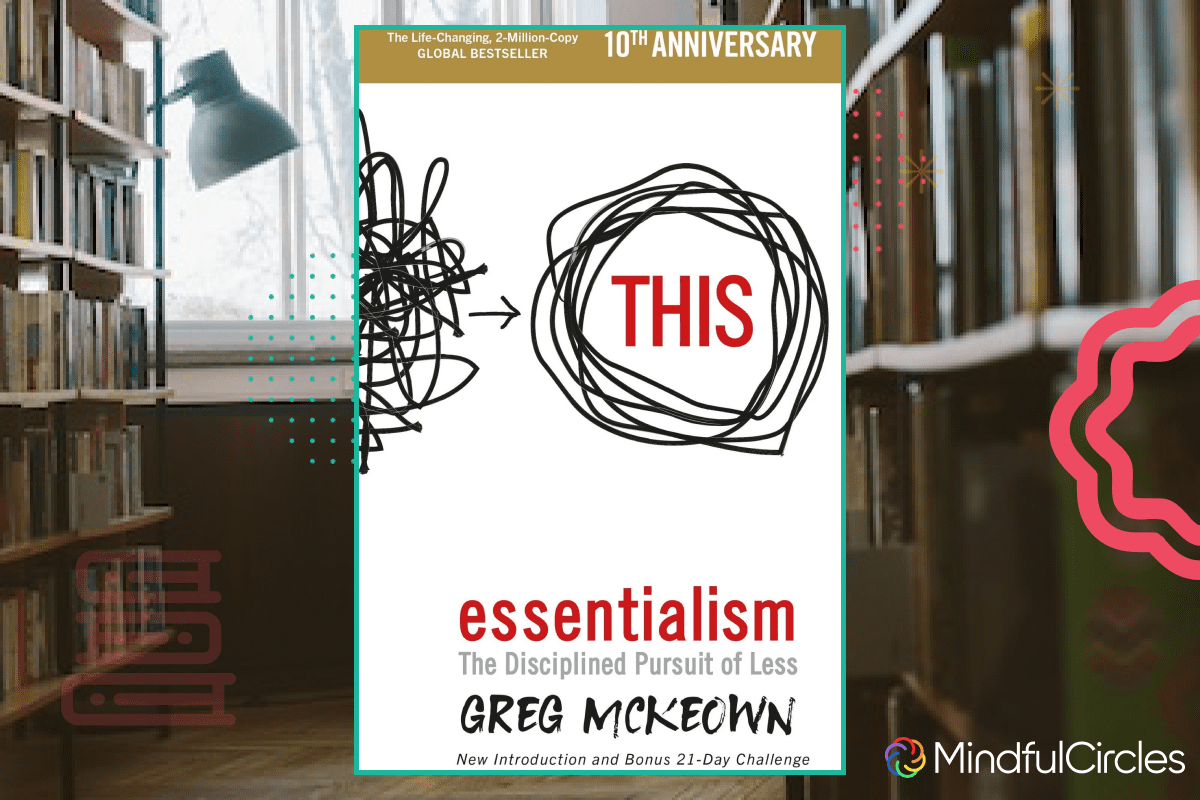

Greg McKeown was born in London in 1977 and went on to earn an MBA from Stanford Graduate School of Business — an institution whose influence permeates his thinking throughout this book. He is the founder and CEO of McKeown Inc., a leadership and strategy design agency based in California, and has taught, consulted, and spoken at some of the most recognisable organisations in the world: Apple, Google, Facebook, Amazon, Microsoft, Nike, and even the Navy SEALs. In 2012, the World Economic Forum inducted him into its Forum of Young Global Leaders. Essentialism: The Disciplined Pursuit of Less, first published in 2014, became an immediate New York Times bestseller. Together with his follow-up book Effortless, his works have sold over three million copies and been published in forty languages. A 10th Anniversary Edition was released in 2024, featuring a new introduction and a 21-day challenge — a testament to the book’s enduring relevance. Its cultural reach is striking: in Brazil, the book has outsold Harry Potter; in Japan, a series of graphic novels was created based on its ideas; and public figures from Steve Harvey to Maria Shriver have cited it as one of their most important reads. At its heart, Essentialism is a philosophical and practical guide to one of the most difficult skills in modern life: saying no to almost everything, so you can say a full yes to what truly matters.
Part I: Essence — The Core Mindset of an Essentialist
Chapter 1: The Essentialist
McKeown opens with a deceptively simple question: what if we could do less, but better? He introduces the idea through the story of a Silicon Valley executive — “Sam Elliot” — who, after his company was acquired, found himself pulled in a hundred directions at once. Despite working harder than ever, Sam felt he was making no meaningful progress. This is the trap of the Non-Essentialist: the belief that doing more, saying yes more, and being available to more people is the path to success. McKeown argues the opposite.
The Essentialist operates from a different premise entirely. Rather than asking “How can I fit it all in?”, the Essentialist asks: “What is the very most important thing I can do right now?” The model is elegantly visualised in the book as two arrows: the Non-Essentialist spreads energy across dozens of directions, making a millimetre of progress in each; the Essentialist focuses all energy into a single powerful direction, achieving breakthrough results.
“Essentialism is not about how to get more things done; it’s about how to get the right things done. It doesn’t mean just doing less for the sake of less either. It is about making the wisest possible investment of your time and energy in order to operate at our highest point of contribution by doing only what is essential.”
McKeown also introduces the Paradox of Success — a four-phase cycle that many high achievers fall into without realising it. Phase 1: clarity of purpose leads to success. Phase 2: success leads to a reputation as the go-to person. Phase 3: more opportunities and demands flood in. Phase 4: energy becomes so scattered that the very clarity that created the original success disappears. Success itself becomes the enemy of Essentialism.
Chapter 2: Choose — The Invincible Power of Choice
One of the most profound reframes in the book is McKeown’s distinction between choice and options. We tend to think of choice as a thing — as if it were something we possess or are given. But McKeown insists that choice is an action. It is something we do. Options are external; they can be taken away. The act of choosing cannot.
This matters because of what psychologists call learned helplessness — the state in which people, after repeatedly experiencing situations where they feel they have no control, stop trying to exert control even when they could. Many people live their professional and personal lives as though they have no real agency: they accept every request, attend every meeting, say yes to every commitment — not because they choose to, but because they have forgotten that choosing is always available to them.
“If you don’t prioritize your life, someone else will.”
The antidote is to consciously reclaim ownership of your choices. Recognising that “I choose to do this” rather than “I have to do this” shifts the psychological relationship to every task.
Chapter 3: Discern — The Unimportance of Practically Everything
McKeown draws on economist Vilfredo Pareto’s famous principle — that roughly 80% of results come from 20% of efforts — to make a broader philosophical claim: almost everything is noise. Very few things are signal. The Essentialist’s primary skill is the ability to tell the difference.
He also introduces the idea of the vital few versus the trivial many, a phrase borrowed from quality management pioneer Joseph Juran. Most of what we spend time on falls into the trivial many. The challenge is that the trivial many often feel urgent, important, and even virtuous — which is precisely what makes them dangerous.
“You cannot overestimate the unimportance of practically everything.”
Chapter 4: Trade-Off — Which Problem Do I Want?
McKeown argues that trade-offs are not a problem to be solved — they are a reality to be embraced. The Non-Essentialist tries to avoid trade-offs by doing everything; the Essentialist makes peace with the fact that choosing one thing means not choosing something else, and views this as a strategic advantage rather than a loss.
He cites the example of a major US airline that tried to compete in every category simultaneously and ultimately failed, while Southwest Airlines thrived by making a single clear trade-off: we are a budget airline for short-haul routes. That clarity became a source of enormous competitive strength.
The key question is not “How can I do everything?” but rather: “Which problem do I want?”
Part II: Explore — Discerning the Vital Few from the Trivial Many
Chapter 5: Escape — The Perks of Being Unavailable
Before we can determine what is essential, we need space to think. McKeown argues that in our culture of constant connectivity, creating deliberate space for reflection has become a radical act. He introduces the example of Frank O’Brien, founder of a New York marketing company, who once a month holds a full company day with no phones, no emails, and no meetings — not as a retreat, but as a strategic discipline.
McKeown also references the habits of great thinkers: Newton withdrew from Cambridge during the plague to develop his laws of motion. Jeff Weiner, then CEO of LinkedIn, scheduled two hours of “nothing” in his calendar every day, describing it as his most important meeting of the day.
The prescription is practical: protect time to think. Put it in your calendar. Guard it as seriously as any important meeting.
Chapter 6: Look — See What Really Matters
In a world of information overload, the Essentialist learns to filter ruthlessly. McKeown distinguishes between listening to everything and listening for the signal. He encourages keeping a journal — not to record everything, but to note only the most significant observations, and to review those notes periodically looking not for individual data points but for patterns.
He also recommends clarifying the question before diving into research or decision-making. The clearer the question, the more efficiently you can filter the noise.
Chapter 7: Play — Embrace the Wisdom of Your Inner Child
One of the book’s more surprising claims is that play — which McKeown defines as anything we do “simply for the joy of doing” — is not a distraction from essential work. It is essential in itself.
Drawing on research by psychiatrist Stuart Brown, McKeown argues that play broadens the range of options we consider, serves as an antidote to stress, and enhances creative and executive brain function. He cites the example of Dieter Rams, the legendary designer at Braun whose “less but better” philosophy shaped everything from consumer electronics to the iPhone (Jony Ive has openly credited Rams as a primary influence).
“Play is an antidote to stress, and it is one of the most important drivers of creativity and innovation.”
Chapter 8: Sleep — Protect the Asset
McKeown is unequivocal: sleep is not a luxury. It is an essential investment in the one asset that enables everything else — you. He cites research showing that sleep deprivation produces cognitive impairment equivalent to being drunk, and that one additional hour of sleep can yield several more hours of productive, high-quality output during the day.
“Our highest priority is to protect our ability to prioritise.”
Sleep is the foundation of that ability. When we are rested, we can discern. When we are exhausted, everything feels equally urgent — and that inability to distinguish is the death of Essentialism.
Chapter 9: Select — The Power of Extreme Criteria
This chapter introduces one of the book’s most famous concepts: the 90% Rule. When evaluating any opportunity, identify the single most important criterion for that decision. Score the opportunity against that criterion on a scale of 0 to 100. If it scores less than 90, treat it as a zero — which means reject it.
The logic is elegant: if we accept things that are “pretty good” or “might be useful,” our lives fill with mediocrity. The 90% Rule forces us to raise the bar so high that only the truly excellent gets through.
McKeown also offers a three-question framework for evaluating opportunities: What do I feel deeply inspired by? What am I particularly talented at? What meets a significant need in the world? When all three align, you have found something essential. And the simplest summary of all: if it isn’t a clear yes, it’s a no.
Part III: Eliminate — Cutting Out the Trivial Many
Chapter 10: Clarify — One Decision That Makes a Thousand
McKeown distinguishes between a vague intent (“we want to be the best”) and an essential intent — a clear, concrete, inspiring, and measurable goal that makes a thousand subsequent decisions unnecessary. An essential intent answers one critical question: “How will we know when we are done?”
He uses the example of a nurse who discovered hospitals were disposing of chemotherapy drugs in the regular waste system. Her essential intent became a single, clear mission: to ban PVC plastics in medical equipment. That clarity drove a decade of work that transformed an entire industry.
The power of an essential intent is that it removes decision fatigue. Once you know what truly matters, the thousand small decisions that follow essentially make themselves.
Chapter 11: Dare — The Power of a Graceful “No”
Saying no is where Essentialism meets its greatest resistance. McKeown acknowledges that saying no is psychologically difficult. Humans are wired for social approval; rejecting a request feels like rejecting a person. But a clear, graceful no is not only more honest than a reluctant yes — it is ultimately more respectful.
“Anyone can talk about the importance of focusing on the things that matter most — and many people do — but to see people who dare to live it is rare.”
He offers practical strategies: separate the decision from the relationship; focus on the trade-off (what will you have to give up if you say yes?); and remember that the respect earned from a clear no is usually greater than the resentment generated by a half-hearted yes.
Chapter 12: Uncommit — Win Big by Cutting Your Losses
One of the most insidious traps in human psychology is the sunk cost fallacy — the tendency to continue investing in something because of what we’ve already invested, rather than based on its future value. We stay in bad projects and bad commitments because walking away feels like admitting we were wrong.
The Essentialist has the courage to uncommit. McKeown suggests a powerful reframe: ask not “How much have I invested in this?” but “If I hadn’t already invested in this, how hard would I work to get involved now?” If the honest answer is “not at all,” that’s your signal.
He also recommends a “reverse pilot” — quietly stopping a low-value activity without announcing it, and observing whether anyone notices. Often, they don’t.
Chapter 13: Edit — The Invisible Art
McKeown takes his inspiration from film editing. Great editing is invisible: you don’t notice what was cut, only that what remains has power and clarity. The same principle applies to life.
Editing means not just removing the obviously bad, but having the discipline to remove the good in order to make space for the great. The Essentialist views their time and activities the way a great editor views a manuscript: always asking, “Does this serve the essential intent? Does this belong?”
Chapter 14: Limit — The Freedom of Setting Boundaries
Counterintuitively, boundaries are not restrictions — they are liberations. By establishing clear limits in advance (“I don’t check emails after 7pm,” “I don’t take meetings on Fridays”), we remove the need for hundreds of individual willpower battles. The rule absorbs the decision.
The Essentialist designs their limits like a system architect, not a daily negotiator. Saying no to the nonessential isn’t selfish — it is what allows you to say a full yes to the things that truly matter.
Part IV: Execute — Making the Vital Few Almost Effortless
Chapter 15: Buffer — The Unfair Advantage
McKeown opens this chapter with a quote attributed to Abraham Lincoln: “Give me six hours to chop down a tree and I will spend the first four sharpening the axe.” The principle of buffering is the same: invest heavily in preparation, so that execution becomes almost effortless.
He highlights the planning fallacy — the well-documented bias by which people consistently underestimate the time and effort needed to complete a task. The antidote is simple: add 50% to your time estimates. If you think something will take one hour, plan for ninety minutes. This is not pessimism; it is Essentialist planning.
Chapter 16: Subtract — Bring Forth More by Removing Obstacles
Progress often comes not from adding more effort, but from identifying and removing the single biggest obstacle. McKeown draws on Eliyahu Goldratt’s business novel The Goal, in which a plant manager discovers that the entire factory’s output is being throttled by a single slow machine — and that fixing just that one bottleneck transforms everything.
McKeown calls this the “slowest hiker” principle. In a hiking group, the pace is determined not by the fastest hiker but by the slowest. Ask: “What is the one obstacle that, if removed, would make all other obstacles disappear or become manageable?”
Chapter 17: Progress — The Power of Small Wins
Research by Teresa Amabile at Harvard Business School found that the single greatest motivator for knowledge workers is not money, recognition, or praise — it is the feeling of making progress on meaningful work. McKeown calls this the power of small wins.
The Essentialist approach is to start as small as possible. The question to ask is: “What is the smallest amount of progress that would still be useful and valuable?” This removes the paralysis of perfection and replaces it with the momentum of movement.
Chapter 18: Flow — The Genius of Routine
If small wins are the fuel, routine is the engine. McKeown draws on Mihaly Csikszentmihalyi’s concept of flow — the state of deep engagement in which effort feels effortless and output is at its highest. While flow is often described as spontaneous, McKeown argues it can be cultivated deliberately through routine.
When we execute our most essential activities via consistent routine, we reduce the cognitive overhead of starting, deciding, and motivating ourselves. The routine absorbs the friction. Over time, the essential becomes automatic.
Chapter 19: Focus — What’s Important Now?
McKeown introduces a simple but profound question borrowed from football coach Dan Gable: “What’s important now?” known as WIN.
Not: What do I need to do this week? Or: What’s my five-year plan? But: What, right now, in this moment, deserves my full attention?
Non-Essentialists are often mentally elsewhere — worrying about the past or planning for the future — while the present moment goes unengaged. The Essentialist trains attention the way an athlete trains muscle: deliberately, repeatedly, with full intensity.
Chapter 20: Be — The Essentialist Life
The final chapter steps back from tactics to vision. What would it feel like to live as an Essentialist — not occasionally, not in a single project, but as a way of life? McKeown describes it as a state of clarity, purpose, and presence. Not the frantic busyness of someone trying to do everything, but the calm confidence of someone who knows exactly what they’re doing and why.
He closes with the story of an Australian nurse named Bronnie Ware, who cared for patients in the final weeks of their lives and recorded their most common regrets. At the top of the list:
“I wish I’d had the courage to live a life true to myself, not the life others expected of me.”
Essentialism is the daily practice of not waiting until the end to make that choice.
“Remember that if you don’t prioritize your life, someone else will.”
Appendix: Leadership Essentials
McKeown closes with a brief appendix applying Essentialist principles to leadership. The Essentialist leader models clarity, creates space for their team to do their best work, protects their people from trivial demands, and ensures that the organisation’s mission is concrete enough to make a thousand decisions obvious. The greatest gift a leader can offer is not more opportunities — it is clarity about which opportunities truly matter.
Core Concepts at a Glance
Less, But Better (“Weniger aber besser”): The guiding philosophy of designer Dieter Rams, adopted by McKeown as the mantra of Essentialism. Not “more with less,” but genuinely fewer things, done with far greater depth and quality.
The 90% Rule: Score every opportunity against your most important criterion. If it scores below 90 out of 100, treat it as a zero. If it isn’t a clear yes, it’s a no.
Essential Intent: A single, concrete, measurable goal that is inspiring enough to motivate and clear enough to make a thousand subsequent decisions unnecessary.
The Sunk Cost Fallacy: The human tendency to continue investing in something because of past investment, rather than future value. Ask not “What have I put in?” but “What would I choose today if I were starting fresh?”
The Planning Fallacy: Our consistent underestimation of time and effort. The Essentialist builds in a 50% buffer as standard practice.
The Paradox of Success: The four-phase cycle by which achievement leads to more demands, which scatters focus, which undermines the very performance that created the success.
The Slowest Hiker: The single constraint that throttles all other progress. Remove the bottleneck, and everything accelerates.
The End
Reflection Question for the Circle
As you reflect on what we’ve read today, ask yourself:
“What part of this reading resonated most with where I am in life right now—and why?”
You’re welcome to share this in the Circle, or simply take a quiet moment to sit with it. If you are reading our blog online, simply leave a comment or connect with our community on social media.