

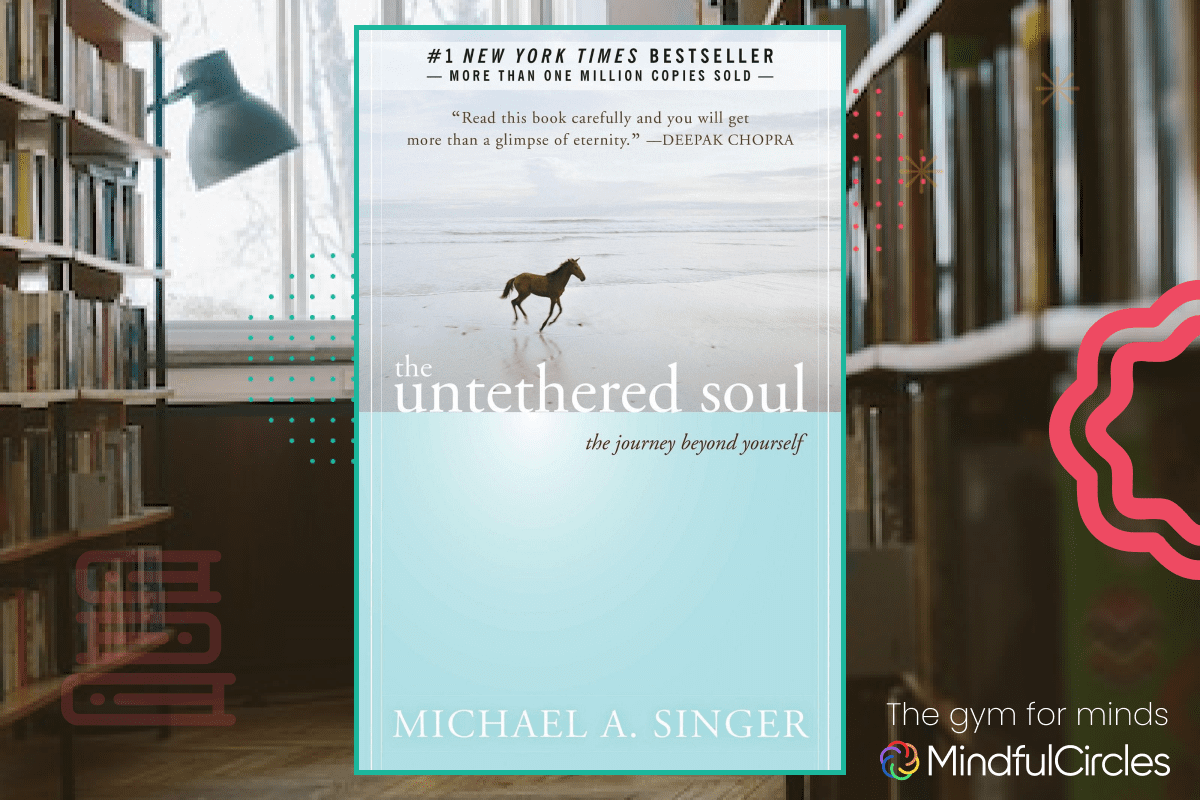

About the Author and Book
Michael A. Singer is an American spiritual teacher, meditator, and entrepreneur — a combination that gives his work an unusual credibility across both contemplative and practical audiences. He studied economics, then pursued a PhD before withdrawing to live in solitude and meditate. That period eventually led to the founding of a spiritual community in Florida and, later, a multimillion-dollar software company (Medical Manager Health Systems) — all while maintaining a daily meditation practice. His later book, The Surrender Experiment (2015), tells that story in full.
The Untethered Soul was first published in 2007 by New Harbinger Publications in association with the Institute of Noetic Sciences. It became one of the bestselling spiritual books of the past two decades, with over three million copies sold. Oprah Winfrey selected it for her book club and called it one of the most important books she had ever read — a moment that dramatically expanded its reach beyond the spiritual community into mainstream culture.
The book sits at the intersection of yoga philosophy, Buddhist psychology, and Western introspective tradition. Its central question is deceptively simple: Who are you, really? And its central argument is equally simple: you are not your thoughts, not your emotions, and not the inner voice that narrates your life — you are the awareness behind all of it. What sounds like a spiritual abstraction becomes, in Singer’s hands, an extremely practical guide to loosening the grip of mental and emotional suffering.
The book has not been without critique. Some readers find its prescriptions easier said than done — the instruction to simply “let go” or “stay open” can feel frustratingly non-specific when you’re in the middle of real pain. Academic psychologists have noted that the book doesn’t engage deeply with trauma, attachment theory, or the neuroscience of emotion. And from certain spiritual traditions, Singer’s synthesis is seen as selective. These are fair points. But for the audience it reaches — people who feel trapped by their own thinking without knowing why — the book offers something genuinely rare: a clear map.
Part I: Awakening Consciousness
Chapter 1 — The Voice Inside Your Head
Singer opens with an observation so simple it’s almost funny: there is a voice in your head, and it never shuts up.
It comments on what you’re doing. It worries about what you said yesterday. It rehearses conversations that haven’t happened. It judges, plans, reminisces, and complains. And for most people, this voice is so constant, so familiar, that they don’t even notice it — they are it.
Singer’s first move is to create a gap between you and the voice. He asks: if you can hear the voice, who is doing the hearing? The very act of noticing the voice means you cannot be the voice. There is a listener. There is a witness. That witness — that awareness — is where the real you lives.
“There is nothing more important to true growth than realizing that you are not the voice of the mind — you are the one who hears it.”
This isn’t a metaphor. Singer means it literally. And once you take it seriously — really seriously — it changes everything about how you relate to your own mental activity.
Chapter 2 — Your Inner Roommate
Singer asks you to imagine having a roommate who talked to you the way your inner voice talks to you: constantly critical, anxious, contradictory, never satisfied. You would move out immediately. And yet you can’t move out from your own mind — so most people learn to accommodate the roommate, manage him, try to keep him quiet with distraction and achievement.
The insight here isn’t that the inner roommate is evil. It’s that you’ve confused the roommate with yourself. You’ve let the most neurotic voice in the room be the one making your decisions.
“If you watch it objectively, you will come to see that much of what the voice says is meaningless. It just talks.”
The invitation is not to silence the voice (which is impossible and probably counterproductive) but to stop identifying with it. To become the one who observes it rather than the one who is spoken through by it.
Chapter 3 — Who Are You?
This chapter does the philosophical work that supports everything else in the book. Singer walks through the layers of self we normally identify with: the body, the mind, the personality, the emotions. Each one can be observed. And if you can observe something, you are not that thing — you are the observer.
What remains when you strip away all the objects of awareness? Awareness itself. Pure consciousness. Singer calls this the true Self — not a self in the psychological sense, but the awareness that has always been present, behind every thought, every feeling, every experience in your life.
This isn’t mysticism for its own sake. It’s a functional reframe: if you are awareness rather than its contents, then nothing that happens in awareness — no thought, no emotion, no circumstance — can fundamentally threaten you.
Chapter 4 — The Lucid Self
Building on the previous chapter, Singer introduces the concept of the “seat of consciousness” — the place inside from which you observe. He uses the metaphor of a movie theater: most people are lost inside the film, reacting as though the events on screen are happening to them. The work of awakening is to remember that you’re sitting in the seat, watching.
The term “lucid” echoes lucid dreaming — the state of knowing you’re dreaming while still inside the dream. Singer suggests that most waking life is a kind of dream, and that the same quality of witnessing awareness that makes a dream lucid can be brought to ordinary experience.
Part II: Experiencing Energy
Chapter 5 — Infinite Energy
Singer turns here to the concept of inner energy — what yogic traditions call shakti or prana, what some call life force. His point is that this energy is naturally abundant. Children have it effortlessly. In moments of love, excitement, or awe, adults access it too. But for most people, much of their natural energy is blocked or consumed by internal psychological tensions — the effort of managing anxiety, suppressing emotions, maintaining self-image.
The practical implication: the path to more energy isn’t external (more coffee, more achievement, more validation). It’s internal — removing the blockages that drain it.
“The only reason you don’t feel this energy all the time is because you block it. You block it by closing your heart, by closing your mind, and by pulling yourself into a restrictive space inside.”
Chapter 6 — The Secrets of the Spiritual Heart
Singer uses “heart” in the yogic sense — the anahata chakra, or heart center — as the seat of emotional and energetic experience. He describes how the heart naturally wants to be open: open to beauty, connection, love, life. But because it has been hurt, it learns to protect itself. It closes.
And a closed heart, Singer argues, is the source of most human suffering — not the events that originally caused the closing, but the closing itself. Because when the heart is closed, experience stops flowing through. Instead it gets stuck, accumulates, festers.
Chapter 7 — Transcending the Tendency to Close
This chapter is one of the most practically useful in the book. Singer identifies a specific, learnable skill: noticing the moment when you feel the impulse to close, and choosing not to.
The impulse to close is familiar — it’s the tightening in the chest when something frightens you, the contraction when someone says something that threatens your self-image, the defensive hardening when you feel rejected. Singer isn’t suggesting you ignore these responses. He’s suggesting you can watch them happen and choose, in that moment, to stay open rather than contracting around them.
“You must be willing to see that your tendency to protect yourself from your problems is actually what’s causing them.”
The practice is to make relaxation — inner openness — your default rather than your exception.
Chapter 8 — Let Go Now or Fall
Singer introduces a key image: the thorn. Imagine a thorn stuck in your arm. You could build an elaborate system to protect it — special clothing, avoiding contact, rearranging your life so nothing ever brushes against it. Or you could remove the thorn.
Most people, he argues, are living around their thorns. Their entire life structure — their routines, relationships, ambitions, and avoidances — is organized around protecting their inner wounds. And because the thorn is still there, the protection is never enough.
The invitation is to let go now, rather than waiting for circumstances to be perfect. The fall he refers to is the fear of what happens if you stop protecting yourself — but Singer suggests that what you find on the other side is freedom, not destruction.
Part III: Freeing Yourself
Chapter 9 — Removing Your Inner Thorn
Continuing the metaphor, Singer now goes deeper into what it actually means to remove the thorn. It means being willing to feel the things you’ve been avoiding. Not dwelling in them, not dramatizing them — but allowing them to pass through rather than pushing them back down.
The psychological mechanism here is surprisingly aligned with contemporary trauma therapy: suppressed emotional material doesn’t disappear, it gets stored. And stored energy is what creates the reactivity, the triggers, the anxiety that seems to come from nowhere. The path through is not avoidance but willingness to experience.
“When a problem is disturbing you, don’t ask, ‘What should I do about it?’ Ask, ‘What part of me is being disturbed by this?'”
Chapter 10 — Stealing Freedom for Your Soul
Singer distinguishes between two ways of seeking peace: changing the world to match your preferences, or changing your relationship to the world. The first is exhausting and ultimately impossible — there will always be something that doesn’t fit. The second is available right now.
This isn’t resignation or passivity. Singer is clear that you can still take action, still pursue goals, still have preferences. The difference is whether you need the outcome to be okay inside.
Chapter 11 — Pain, the Price of Freedom
One of the book’s most honest chapters. Singer acknowledges that opening — really opening — to what you’ve been protecting yourself from, is painful. There is no shortcut around this. The price of freedom is willingness to feel what you haven’t wanted to feel.
But he contextualizes this pain: it is finite. The stored pain of years or decades, when finally allowed to move through, does move through. It is the resistance to pain that makes it last.
“If you want to be free, you have to learn to stop fighting with your own experience.”
Chapter 12 — Taking Down the Walls
Walls are the psychological structures we build to feel safe — fixed opinions, rigid self-concepts, predictable routines, the carefully curated story of who we are. Singer doesn’t argue against structure per se, but against the rigidity that comes from fear. Walls that were built for protection become prisons.
Taking them down requires trust: trust that you can survive contact with the raw, unfiltered nature of experience. Singer suggests that the real you — awareness itself — is already safe, and always has been.
Part IV: Going Beyond
Chapter 13 — Far, Far Beyond
Singer reaches toward the deepest layer of the book here: the possibility of a consciousness that is not just behind the thoughts and emotions of this lifetime, but is fundamentally unlimited — not bounded by the body, the personality, or even the individual story.
He draws on yogic cosmology lightly but doesn’t require the reader to adopt any particular metaphysical framework. The practical point is that your sense of who you are is almost certainly too small. There is something in you that is larger than your history, larger than your fears, larger than your self-concept.
Chapter 14 — Letting Go of False Solidity
We cling to certainty — about ourselves, about the world, about what things mean — because uncertainty feels threatening. Singer suggests that this clinging is one of the main sources of suffering. Reality is fluid, changing, fundamentally uncertain. Fighting that takes enormous energy.
Letting go of false solidity doesn’t mean giving up all structure. It means holding your structures lightly, knowing that they are maps, not the territory.
Chapter 15 — The Path of Unconditional Happiness
This is one of the most quoted chapters in the book. Singer argues that happiness is a decision, not a condition.
Most people live on a conditional basis: I will be happy when — when I have the relationship, the money, the health, the recognition. Singer calls this a trap, because the conditions are never permanently met. There is always the next thing, the next threat, the next problem.
The alternative is to decide, in advance, that you will remain open and at peace regardless of what happens. Not because circumstances don’t matter, but because your well-being is no longer contingent on them.
“There is no reason to be unhappy unless you want to be. There is no reason not to be unconditionally happy, unless you insist on being unhappy.”
This may sound naively optimistic. Singer’s point is that it requires practice — and that the practice is exactly what the rest of the book has been preparing you for.
Chapter 16 — The Joy of Personal Growth
Growth, Singer argues, comes not from achieving goals but from the process of encountering resistance and loosening around it. Every difficult moment — every trigger, every disappointment, every fear — is an opportunity to practice staying open. And each time you do, you grow.
This reframes difficulty entirely. It isn’t an interruption of the good life. It is the good life, when approached with the right relationship to it.
Part V: Living Life
Chapter 17 — Contemplating Death
Singer dedicates a full chapter to death — not morbidly, but as a clarifying lens. He draws on the Stoic and Buddhist traditions: the regular, clear-eyed contemplation of your own mortality as a tool for waking up to what actually matters.
If you knew this was your last day, would you spend it worrying about what someone thought of you last week? Would you hold back love? Would you let fear keep you small?
“Death is the greatest teacher. Learn from it while you still can.”
The awareness of death — not as a distant abstraction but as an intimate, present reality — is one of the most powerful antidotes to unconscious living.
Chapter 18 — The Secret of the Middle Way
The middle way — a concept drawn from Buddhism — is the path between extremes: between clinging and aversion, between seeking pleasure and fleeing pain. Singer describes it as the practice of allowing experience without grasping or resisting.
This doesn’t mean numbness. The middle way is not emotional flatness — it’s the capacity to be fully present with whatever arises without being swept away by it.
Chapter 19 — The Loving Eyes of God
Singer closes the book in a register that is explicitly spiritual — not dogmatically religious, but pointing toward a sense of the sacred underlying ordinary life. He describes the possibility of experiencing the world through what he calls “the loving eyes of God”: a perception in which everything is seen as it is, without the filter of personal fear and preference.
This final chapter is more poetic than practical. It points to where the practices of the book are ultimately leading — not to a better-managed self, but to a dissolution of the small self into something larger. Not a loss, but a homecoming.
Key Concepts at a Glance
The Inner Roommate — the incessant inner voice that most people mistake for themselves.
The Seat of Consciousness — the witnessing awareness behind all experience; the true Self.
The Inner Thorn — unresolved emotional material organized around a wound; the thing your life gets structured to protect.
Unconditional Happiness — the decision to remain open regardless of circumstances, as a practice rather than a feeling.
The Open Heart — the natural state of the heart; the ongoing practice is choosing not to close it when threatened.
Letting Go — not suppression, not avoidance, not dramatic release, but the simple act of not holding on; allowing experience to pass through.
The Untethered Soul doesn’t offer a complicated system. Its power is in how clearly it names something most people have felt but couldn’t articulate: that there is a part of us watching, behind the noise — and that learning to live from that place changes everything.
The End
Reflection Question for the Circle
As you reflect on what we’ve read today, ask yourself:
“What part of this reading resonated most with where I am in life right now—and why?”
You’re welcome to share this in the Circle, or simply take a quiet moment to sit with it. If you are reading our blog online, simply leave a comment or connect with our community on social media.