

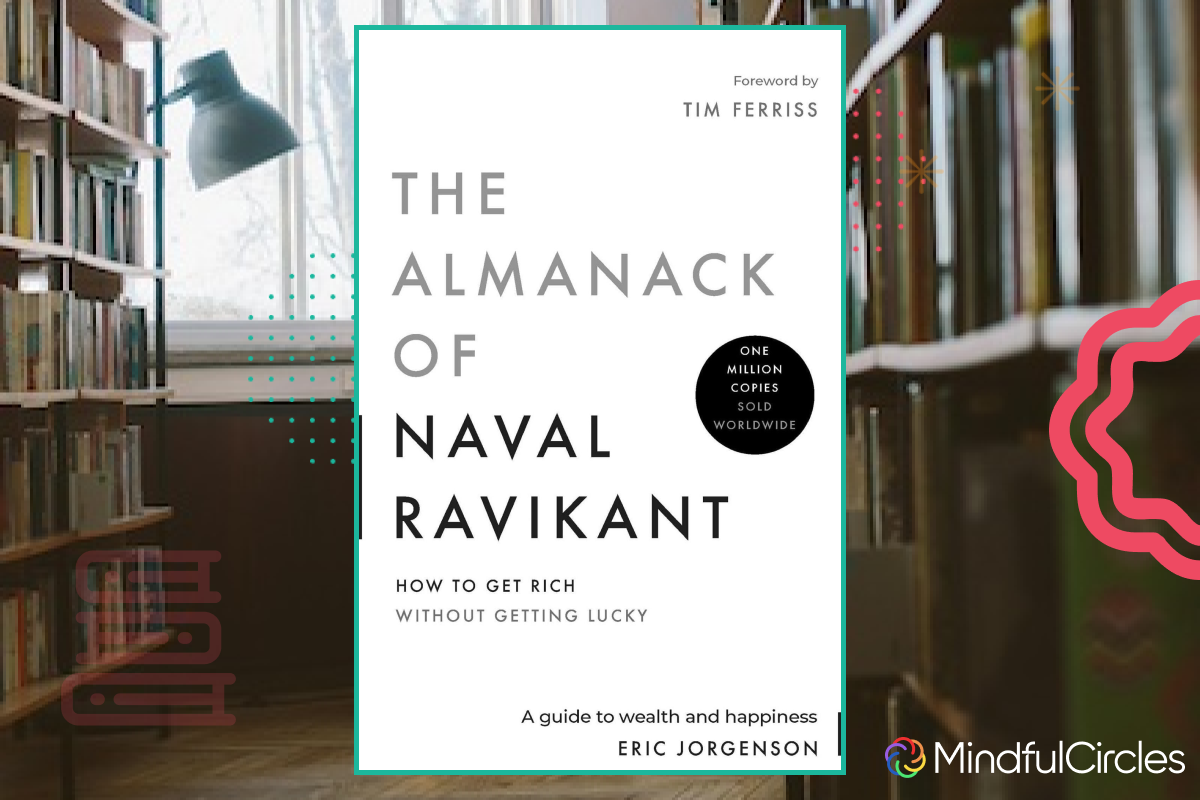

A Guide to Wealth and Happiness
Introduction: About the Author and the Book
Published in 2020, The Almanack of Naval Ravikant is a curated collection of ideas from entrepreneur, investor, and philosopher Naval Ravikant. The book was compiled by Eric Jorgenson, who gathered Naval’s most influential insights from podcasts, essays, interviews, and tweets shared over more than a decade. Rather than presenting a traditional narrative, the book distills Naval’s thinking into a set of mental models about wealth, happiness, decision-making, and personal freedom.
Naval Ravikant is widely known in the technology and startup world as the co-founder of AngelList, a platform that revolutionized startup investing by connecting entrepreneurs and angel investors. Over the years, he has been an early investor in companies such as Uber, Twitter, and Yammer. Yet Naval’s influence extends far beyond venture capital. His reflections on life and success have attracted millions of readers and listeners across blogs, podcasts, and social media.
Naval’s philosophy combines ideas from economics, entrepreneurship, Stoicism, Buddhism, and first-principles thinking. He is particularly interested in understanding how individuals can achieve both financial independence and inner peace.
The core premise of the book challenges a common belief about success. Naval argues that wealth and happiness are not merely the result of luck or circumstance but skills that can be developed.
As he writes early in the book:
“Getting rich is not just about luck. Happiness is not just a trait we are born with. Both are skills we can learn.”
The book therefore explores two major questions:
-
How is wealth actually created in the modern world?
-
How can individuals live happy and meaningful lives once they achieve freedom?
Part I focuses on the first question: the principles behind wealth creation and the role of judgment in making good decisions.
PART I: WEALTH
Building Wealth
Naval begins by redefining what wealth actually means. Many people equate wealth with money or status, but Naval argues that both are superficial proxies.
Money is simply a way of transferring wealth, and status is a social ranking game. True wealth is something far more fundamental.
Naval defines wealth as:
“Assets that earn while you sleep.”
Wealth consists of systems that generate value continuously—businesses, intellectual property, software, or investments that keep producing income without requiring constant labor.
This distinction matters because many people chase money or status, but only a few focus on building the underlying assets that generate wealth.
Understand How Wealth Is Created
According to Naval, modern wealth creation depends on the ability to create value at scale. In the past, wealth often came from controlling land, labor, or natural resources. Today, the most powerful forms of wealth come from technology, networks, and ideas.
Naval summarizes this shift with one of his most widely shared principles:
“Earn with your mind, not your time.”
Traditional employment exchanges hours of work for money. But scalable wealth comes from building systems that operate independently of your time. This includes startups, digital products, investments, or intellectual property.
The key insight is that ownership matters far more than effort alone.
Find and Build Specific Knowledge
One of the most important concepts in Naval’s philosophy is specific knowledge.
Specific knowledge refers to expertise that cannot easily be taught or outsourced. It is usually developed through curiosity, passion, and long-term immersion in a field.
Naval explains:
“Specific knowledge is knowledge you cannot be trained for.”
Unlike standardized knowledge taught in schools, specific knowledge often emerges from personal interests or unusual life experiences. It may include creative ability, technical insight, strategic thinking, or an intuitive understanding of markets.
Because specific knowledge is rare and difficult to replicate, it becomes highly valuable in the marketplace.
Play Long-Term Games with Long-Term People
Naval repeatedly emphasizes the importance of long-term thinking. Wealth creation, he argues, is rarely the result of short bursts of effort. Instead, it is the result of compounding relationships, reputation, and knowledge over many years.
He captures this philosophy in a simple rule:
“Play long-term games with long-term people.”
Trust and integrity become essential assets in these long-term games. People who behave ethically and consistently build reputations that open doors to future opportunities.
In the startup world, this often means forming partnerships with individuals who share similar values and who are willing to invest years into building something meaningful.
Take on Accountability
Another principle Naval stresses is accountability. Many people avoid responsibility because it increases the risk of failure. But Naval argues that the greatest rewards go to those willing to take full ownership of outcomes.
He writes:
“Take on accountability, and take business risks under your own name.”
By attaching your reputation to your work, you signal seriousness and commitment. This builds trust and credibility, which are essential for entrepreneurship and leadership.
Accountability also encourages higher standards of thinking and execution.
Build or Buy Equity in a Business
Naval strongly advises individuals to own equity rather than relying solely on wages.
Working for a salary means that income is limited by the number of hours one can work. Ownership, on the other hand, allows individuals to participate in the exponential growth of successful ventures.
Equity creates leverage over time, particularly when combined with scalable technologies.
This is why founders, early employees, and investors often accumulate disproportionate wealth compared to those working purely for wages.
Find a Position of Leverage
Naval identifies four major forms of leverage that allow individuals to scale their impact:
-
Labor leverage – managing people who work for you
-
Capital leverage – investing money to generate returns
-
Code leverage – building software that scales infinitely
-
Media leverage – distributing ideas through digital platforms
The last two forms—code and media—are especially powerful in the modern era.
Naval explains:
“Code and media are permissionless leverage. They’re the leverage behind the newly rich.”
Anyone can write software or publish content online and reach millions of people without asking for permission from traditional gatekeepers.
Get Paid for Your Judgment
As individuals gain experience, their economic value increasingly comes from judgment rather than labor.
Judgment is the ability to make correct decisions in complex situations. It is built through experience, learning, and reflection.
Naval notes that high-level professionals are often paid for a small number of important decisions rather than routine work.
“The most important skill for getting rich is becoming a perpetual learner.”
Continuous learning improves judgment, which in turn leads to better opportunities and decisions.
Prioritize and Focus
Another key theme in Naval’s philosophy is the importance of focus.
Many people scatter their energy across too many goals and projects. Naval argues that success requires concentrating attention on a few high-leverage activities.
Clear priorities allow individuals to allocate time and energy toward opportunities with the greatest potential impact.
Find Work That Feels Like Play
Naval encourages individuals to pursue careers aligned with their natural curiosity and talents.
When work feels intrinsically rewarding, people are more likely to invest the time required to achieve mastery.
He captures this idea with one of his most memorable statements:
“Find work that feels like play to you, but looks like work to others.”
This alignment between passion and skill often leads to extraordinary performance over time.
How to Get Lucky
Naval provides a nuanced perspective on luck. While some luck is purely random, other forms of luck can be cultivated.
He describes several types of luck, including luck created through persistence, preparation, and reputation.
Over time, individuals who consistently pursue meaningful work and build strong networks attract opportunities that appear like luck to outsiders.
Be Patient
The final lesson in wealth creation is patience.
Many people underestimate how long it takes for success to compound. Yet the most powerful forces in life—wealth, knowledge, relationships, and reputation—grow exponentially over time.
Naval summarizes this principle succinctly:
“All the real benefits in life come from compound interest.”
This applies not only to financial investments but also to learning, trust, and long-term relationships.
Building Judgment
After explaining how wealth is created, Naval turns to the deeper skill that makes wealth possible: judgment.
Judgment
Judgment is the ability to make sound decisions in uncertain environments. In a world filled with information and complexity, this skill becomes increasingly valuable.
While technical skills can often be automated or outsourced, good judgment remains rare.
How to Think Clearly
Clear thinking requires separating facts from narratives and recognizing cognitive biases.
Naval encourages individuals to question assumptions and analyze incentives before forming conclusions.
This disciplined approach to thinking helps avoid common decision-making errors.
Shed Your Identity to See Reality
One of the obstacles to clear thinking is attachment to identity.
When individuals strongly identify with particular roles, ideologies, or groups, they become resistant to information that challenges those identities.
Naval suggests loosening these attachments in order to see reality more clearly.
Learn the Skills of Decision-Making
Naval recommends studying disciplines that improve decision-making, such as economics, probability theory, and psychology.
Understanding incentives and probabilities allows individuals to make better choices in uncertain situations.
Collect Mental Models
A powerful tool for judgment is the use of mental models.
Mental models are simplified frameworks that explain how systems behave. By studying models from multiple disciplines—physics, biology, economics—individuals develop a richer understanding of the world.
These models improve reasoning and problem-solving.
Learn to Love Reading
Finally, Naval emphasizes reading as one of the most effective ways to develop judgment.
Reading allows individuals to absorb centuries of accumulated knowledge and learn from the experiences of others.
It also expands one’s mental models and strengthens critical thinking.
The Almanack of Naval Ravikant — Part II
(Happiness, Self-Mastery, and Philosophy)
After discussing how wealth is created through leverage, ownership, and judgment, Naval Ravikant shifts the conversation toward a deeper and more fundamental topic: happiness.
The transition is intentional. In Naval’s view, wealth is not an end in itself but a tool for achieving freedom — freedom to live according to one’s values, pursue curiosity, and cultivate inner peace.
The paradox, however, is that many people who successfully accumulate wealth still fail to achieve happiness. This leads Naval to explore a crucial question: What actually produces a happy and meaningful life?
LEARNING HAPPINESS
Happiness Is a Skill
Naval begins by challenging another common assumption: that happiness is something we are either born with or stumble upon through fortunate circumstances.
Instead, he argues that happiness can be deliberately cultivated through habits of thought.
As he writes:
“Happiness is a skill you can develop.”
This idea echoes both Stoic and Buddhist philosophy. According to these traditions, suffering often arises not from external events but from our interpretation of those events.
By learning to observe our thoughts and detach from negative mental patterns, we gain greater control over our emotional state.
Happiness Comes from Peace
One of Naval’s central insights is that happiness is less about pleasure and more about peace of mind.
Many people pursue excitement, novelty, and stimulation, believing these experiences will produce happiness. But Naval argues that lasting happiness comes from reducing inner conflict and anxiety.
He summarizes this perspective clearly:
“Happiness is peace in motion.”
This does not mean living passively or avoiding ambition. Rather, it means pursuing goals without allowing one’s emotional state to depend entirely on outcomes.
A peaceful mind remains steady even as life unfolds unpredictably.
Desire Is a Contract with Yourself
Naval offers a striking observation about the nature of desire:
“Desire is a contract that you make with yourself to be unhappy until you get what you want.”
Desire itself is not inherently negative. However, when happiness becomes conditional on achieving specific outcomes, individuals create an endless cycle of dissatisfaction.
Every time one desire is fulfilled, another takes its place.
This insight encourages a more mindful relationship with ambition. Goals can still be pursued, but happiness should not be postponed until those goals are achieved.
Success Does Not Guarantee Happiness
Naval notes that many people assume happiness will automatically follow success. Yet experience often proves otherwise.
Individuals who achieve financial success frequently discover that their anxieties and insecurities persist.
The problem lies in expecting external achievements to solve internal problems.
Naval warns:
“If you can’t be happy with a coffee, you won’t be happy with a yacht.”
Material success can remove certain stressors, but it cannot replace the inner work required for emotional well-being.
Envy Is the Enemy of Happiness
Naval identifies envy as one of the greatest obstacles to happiness.
In modern society, constant exposure to other people’s achievements—through social media, professional competition, or status hierarchies—creates an environment where comparison becomes unavoidable.
Yet comparison is inherently destructive to inner peace.
Naval explains:
“Envy is the enemy of happiness.”
The only sustainable solution is to stop playing status games and instead focus on personal growth, curiosity, and meaningful relationships.
SAVING YOURSELF
Happiness Requires Self-Awareness
Naval argues that many people spend years trying to improve their external circumstances while neglecting their inner world.
True happiness begins with self-awareness — the ability to observe one’s thoughts, emotions, and habits without being controlled by them.
This awareness allows individuals to break destructive mental patterns and cultivate healthier ones.
In many ways, this process resembles meditation, which Naval frequently advocates as a powerful tool for mental clarity.
Meditation and the Mind
Meditation plays a central role in Naval’s philosophy.
Rather than viewing meditation as a spiritual ritual, he describes it as a practical method for understanding the mind.
Through meditation, individuals learn to observe their thoughts without reacting automatically.
Naval explains:
“When you realize that thoughts are just thoughts, you stop letting them control you.”
This realization creates space between stimulus and response, allowing individuals to act more intentionally rather than impulsively.
The Importance of Solitude
Naval also emphasizes the importance of spending time alone.
In modern society, constant connectivity and stimulation make solitude increasingly rare. Yet solitude is essential for reflection, creativity, and emotional balance.
Without moments of quiet, individuals struggle to hear their own thoughts clearly.
Naval therefore encourages intentional periods of disconnection — time spent reading, thinking, walking, or simply being present.
The Value of Reading and Learning
Just as reading strengthens judgment in the pursuit of wealth, it also plays a critical role in personal growth.
Naval believes reading exposes individuals to diverse perspectives and ideas, expanding their understanding of life.
He frequently encourages people to explore philosophy, science, history, and psychology rather than focusing only on business or technical topics.
This intellectual curiosity deepens both wisdom and self-awareness.
PHILOSOPHY
The Role of Philosophy in Life
Naval’s worldview is heavily influenced by classical philosophy.
He draws from traditions such as Stoicism, Buddhism, and Epicureanism to develop a practical philosophy for modern life.
These traditions share a common insight: happiness comes from mastering one’s internal world rather than controlling external events.
Naval explains that philosophy provides mental frameworks that help individuals navigate uncertainty, adversity, and success.
The Stoic Influence
Stoic philosophy plays a significant role in Naval’s thinking.
The Stoics taught that individuals should focus on what they can control while accepting what they cannot.
This principle reduces unnecessary anxiety and allows people to act more effectively.
Naval’s approach reflects this mindset: pursue meaningful goals, but maintain emotional independence from outcomes.
Freedom Through Simplicity
Another recurring theme in Naval’s philosophy is simplicity.
Modern life often encourages accumulation—more possessions, more commitments, more obligations. Yet these additions frequently create complexity and stress.
Naval argues that freedom comes from reducing unnecessary burdens.
Simplifying one’s life—financially, socially, and mentally—creates space for creativity, curiosity, and peace.
The Meaning of Life
Toward the end of the book, Naval reflects on the broader question of meaning.
Rather than proposing a single universal purpose, he suggests that meaning emerges through exploration and curiosity.
Individuals create meaningful lives by pursuing activities that align with their interests, values, and contributions to others.
In this sense, meaning is not something discovered once and for all but something continuously shaped through choices.
Final Reflections on
The Almanack of Naval Ravikant
Taken together, The Almanack of Naval Ravikant offers a philosophical framework for living both prosperously and wisely. The first half of the book explains how wealth is created through leverage, ownership, specific knowledge, and long-term thinking. The second half reminds us that wealth alone cannot produce fulfillment unless it is paired with self-awareness, emotional mastery, and inner peace.
Naval’s philosophy ultimately centers on freedom — freedom from financial dependence, freedom from social status games, and freedom from the compulsive desires that keep many people trapped in cycles of dissatisfaction.
By cultivating judgment, curiosity, patience, and mindfulness, individuals can build lives that are both economically successful and deeply meaningful.
The End
Reflection Question for the Circle
As you reflect on what we’ve read today, ask yourself:
“What part of this reading resonated most with where I am in life right now—and why?”
You’re welcome to share this in the Circle, or simply take a quiet moment to sit with it. If you are reading our blog online, simply leave a comment or connect with our community on social media.